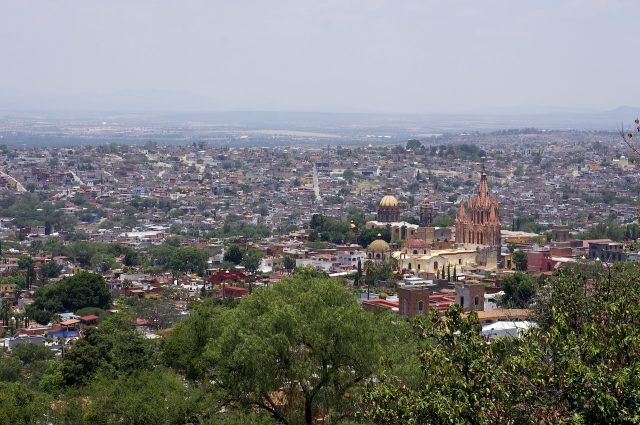
Cap-Haïtien
Haiti · 8 places
Photo: Rémi Kaupp, CC BY-SA 3.0
Cap-Haïtien lingers in the imagination like a place caught between history and the present, where the weight of the past isn’t just preserved in museums but woven into the fabric of everyday life. Perched on Haiti’s northern coast, it was once the heart of the nation, and though the capital moved long ago, the city still carries the quiet dignity of its former grandeur. The streets wind past faded pastel mansions, their balconies sagging slightly but still elegant, their shutters often left ajar as if inviting the sea breeze inside. Life here unfolds at its own pace—no honking traffic, no hurried crowds, just the occasional clatter of a horse-drawn carriage or the slow, deliberate steps of a donkey laden with goods. The rhythm belongs to the ocean, to the way the light slants across the rooftops in the late afternoon, to the way time seems to stretch just a little longer in the shade of the royal palms.
Beyond the city, the landscape feels almost staged in its beauty. To the south, the mountains rise steep and green, their slopes thick with vegetation, while the coastline curves into long, empty beaches where the Caribbean rolls in with a lazy, rhythmic sigh. But the real echoes of history lie just outside the city in the ruins of Sans-Souci Palace and the Citadelle Laferrière. Built in the early 1800s under King Henri Christophe, these monuments were meant to be the foundation of a Haitian empire, constructed by the hands of thousands who had only recently won their freedom. Today, the palace is a skeleton of its former self, its once-opulent halls open to the sky, but the Citadelle still commands the ridge above, its massive walls and cannons a defiant silhouette against the horizon. Climbing the steep path to its gates, you can almost hear the whispers of the past—the ambition, the struggle, the sheer audacity of its creation.
Life in Cap-Haïtien moves to a different clock. The mornings begin with the scent of frying plantains and fresh coffee in the market, where vendors arrange piles of mangoes, avocados, and spices in careful pyramids. By midday, the streets hum with music—sometimes the deep, hypnotic pulse of rara drums, sometimes the bright, syncopated rhythms of kompa spilling from a bar. There are no all-inclusive resorts here, no polished tourist traps. Instead, small open-air restaurants serve plates of griot, the crispy, marinated pork that’s a staple of Haitian cuisine, or whole grilled fish drizzled with lime and garlic, eaten with your fingers while the cook chats with regulars at the next table. The food is simple, but it’s honest, just like the city itself.
For those willing to venture beyond the streets, Cap-Haïtien is a gateway to some of Haiti’s most striking natural landscapes. A short drive away, the waterfall of Saut-Mathurine tumbles down a rocky cliff into a pool of cool, clear water, a hidden oasis where the only sounds are the rush of the falls and the occasional call of a bird from the surrounding forest. Closer to the coast, beaches like Cormier and Labadie offer stretches of sand untouched by development, where the waves lap gently against the shore and the only footprints in the sand are likely your own. The roads leading to these places are rough, the infrastructure minimal, but that’s part of the appeal. There’s a sense of discovery here, of stepping into a world that hasn’t been packaged for visitors.
What makes Cap-Haïtien special isn’t its polish or its convenience, but its refusal to perform. The city doesn’t try to impress; it simply exists, with all its contradictions and quiet resilience. There are no crowds of tourists, no scripted experiences—just the unfiltered reality of a place that has seen empires rise and fall, that has endured storms and hardship, and yet still pulses with life. It’s not a destination for those who crave predictability or luxury, but for those who are willing to meet it on its own terms, it offers something far more rewarding: the chance to see Haiti not as a postcard, but as a living, breathing place. And sometimes, the most memorable journeys are the ones that don’t go exactly as planned.
See & Do
All of them

Places on the map
Marker colour follows the categoryClimate and weather
Detailed weather: Cap-Haïtien- Average temperature
- 26 °C
- Precipitation per year
- 0 mm
Average air temperature
°C
25
25
25
26
27
28
28
28
28
27
26
25
Jan
Feb
Mar
Apr
May
Jun
Jul
Aug
Sep
Oct
Nov
Dec