Kanazawa
Japan · 8 places
Photo: Wikimedia Commons, CC BY-SA 3.0
Kanazawa moves at its own pace, a city where the past lingers without feeling like a relic. It’s quieter than Tokyo, less crowded than Kyoto, yet rich in history and culture. The streets carry the rhythm of feudal Japan—wooden houses line narrow lanes, artisans work in lacquerware and ceramics, and gardens shift with the seasons.
For over 250 years, this was the domain of the Maeda clan, one of Japan’s most powerful families. Their legacy remains in the city’s layout, crafts, and traditions.
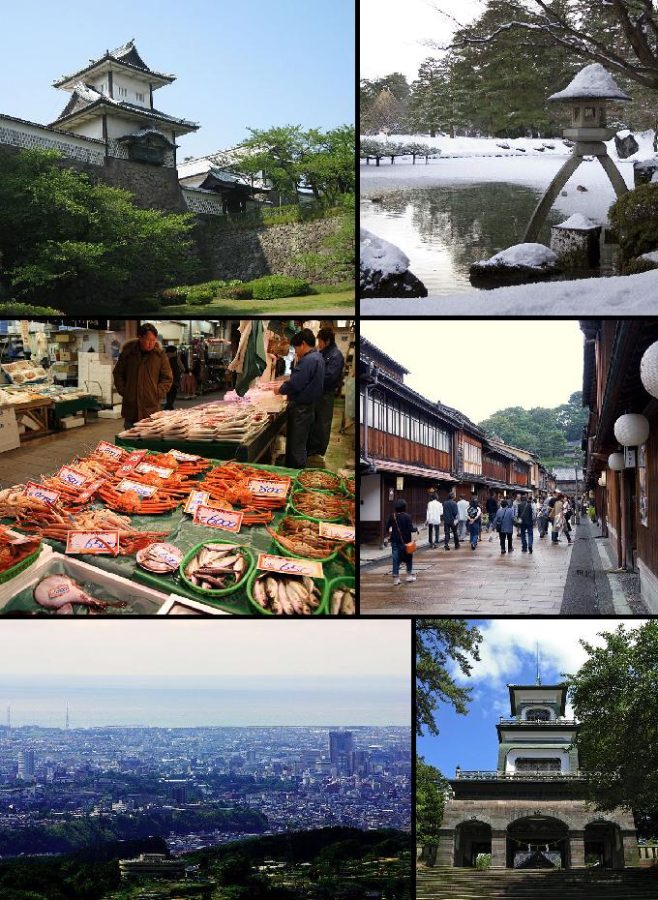
Higashi Chaya is where Kanazawa’s heart beats. Low-slung eaves shelter teahouses and small shops. Mornings are quiet, the only sound the clatter of geta sandals on stone. By evening, lanterns glow over rain-slicked streets. Some teahouses still hold ceremonies where every gesture matters. Nearby, gold and silver filigree glint in shop windows—Kanazawa has been a center for metalwork for centuries.
Kenrokuen lies just beyond the district. Its name means "garden of six attributes," blending space, seclusion, artifice, antiquity, water, and vistas. In winter, ropes support snow-laden branches. In spring, cherry blossoms bloom.
Kanazawa doesn’t reveal itself quickly. Walk along the Asano River at dawn, where fishermen sell their catch from boats. Climb the hill to the castle ruins. The fortress, built in the late 1500s, has been rebuilt over time. A few gates and towers remain, along with old storehouses that once held rice and weapons. Now they house museums. From the heights, the view stretches over rooftops to the distant mountains.
Modernity exists here, but on the city’s terms. The 21st Century Museum of Contemporary Art contrasts with the old teahouses, its exhibits playing with space and perception. The Lacquerware Museum lets you see a craft that has shaped the region for generations. Omicho Market, open since the 1700s, fills with stalls of seafood—octopus, scallops, tuna so fresh it dissolves on the tongue. The market shows how Kanazawa has always thrived, where land and sea provide equally.
What makes Kanazawa special? It balances past and present without forcing a choice. There’s no rush, but it doesn’t feel frozen in time. The city moves at a human pace, offering not just sights, but a sense of something tangible. Maybe that’s why people return—to wander quiet streets, breathe in the scent of tea and rice, listen to water in the gardens, and feel time slow just enough to let the world settle.
Stay
0 placesNothing in this category yet — the catalogue is still growing.
All placesPlaces on the map
Marker colour follows the categoryClimate and weather
Detailed weather: Kanazawa- Average temperature
- 16 °C
- Precipitation per year
- 2502 mm
- Sunshine hours per day
- 5 h
Average air temperature
°C
5
5
9
13
18
22
27
28
24
18
12
7
Jan
Feb
Mar
Apr
May
Jun
Jul
Aug
Sep
Oct
Nov
Dec


