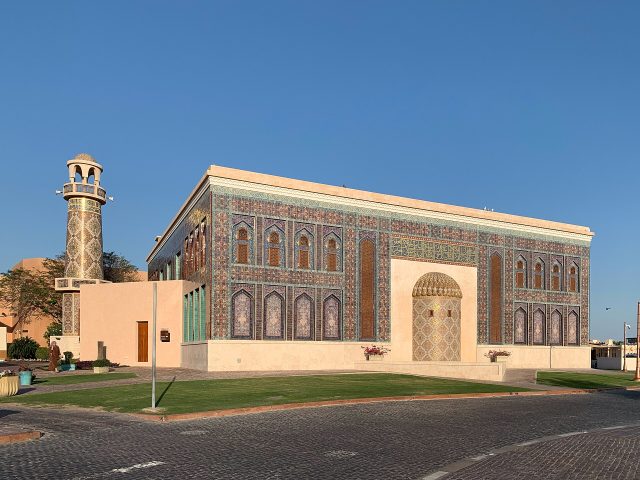
Weather overview
Education City enjoys a desert climate with consistently warm to hot temperatures year-round. The mildest conditions arrive in January and February, when daytime highs hover around +23.5 °C and nights cool to +16.3 °C. By March, the heat begins to build, and from May through September, Education City experiences its hottest period, with afternoons often exceeding +40 °C.
Rainfall in Education City is rare, with most months recording little to no precipitation. The few showers that do occur tend to fall in January, March, or November, but even then, totals remain modest—usually under 20 mm. Travelers can expect long stretches of dry, sunny weather, making Education City a destination where indoor activities often take priority during peak heat.
Temperature
Temperatures in Education City follow a steady upward curve from winter to summer. In January, the average is +19.3 °C, but by June, it climbs to +36.7 °C, with daytime peaks reaching +42.7 °C. The hottest months—June, July, and August—see little relief, as nighttime lows rarely drop below +31.9 °C. Even September and October remain warm, with averages of +34.9 °C and +31.3 °C respectively.
Cooler weather returns in November, when temperatures ease to +26.5 °C, and by December, Education City settles into its most comfortable range, with highs near +25.7 °C and lows around +18.9 °C. The contrast between winter and summer is stark, but the absence of extreme cold makes Education City a year-round destination for those prepared for heat.
| Month | Minimum | Maximum |
|---|---|---|
| January | 16.3 | 23.5 |
| February | 16.6 | 24 |
| March | 19.6 | 28 |
| April | 23.9 | 33.6 |
| May | 28.8 | 39.1 |
| June | 31.9 | 42.7 |
| July | 33.4 | 42.4 |
| August | 33.3 | 41.7 |
| September | 31.3 | 39.6 |
| October | 27.8 | 35.5 |
| November | 23.4 | 30.3 |
| December | 18.9 | 25.7 |
Precipitation
Education City is one of the driest places in Qatar, with an annual rainfall of just 86 mm. Most of this falls in January (18.4 mm) and March (17.2 mm), while June, August, and September typically see no rain at all. Even in the wettest months, showers are brief and infrequent, often evaporating before they can significantly cool the air.
The lack of rain means humidity rarely feels oppressive, though the combination of heat and dry air can be dehydrating. Travelers visiting Education City in July or August should be prepared for uninterrupted sunshine and no chance of rain, while those arriving in November or December might encounter the occasional light shower—though it’s unlikely to disrupt plans.
| Month | Precipitation |
|---|---|
| January | 18.4 |
| February | 9.9 |
| March | 17.2 |
| April | 3 |
| May | 9.9 |
| June | 0 |
| July | 8.6 |
| August | 0 |
| September | 0 |
| October | 2.8 |
| November | 9.7 |
| December | 6.4 |
What to pack
For a trip to Education City in January or February, lightweight layers work well: long sleeves for cooler evenings and breathable fabrics for daytime warmth. A light jacket or shawl can be useful for air-conditioned indoor spaces, where temperatures are often set lower than outside. Sunglasses and a wide-brimmed hat are essential year-round, but especially in these milder months when outdoor activities are more comfortable.
From May to September, heat-adaptive clothing is key. Loose, light-colored garments made from linen or cotton help manage the +35 °C to +42 °C temperatures, while a high-SPF sunscreen and a reusable water bottle are non-negotiable. If you’re visiting in November or December, pack a mix of short-sleeve shirts and a light sweater for evenings, when temperatures can dip to +18.9 °C. Comfortable walking shoes are a must, as much of Education City is best explored on foot—just avoid midday sun during peak summer.
| Month | Wind speed |
|---|---|
| January | 3.6 |
| February | 4.2 |
| March | 4.3 |
| April | 3.8 |
| May | 4.1 |
| June | 4.3 |
| July | 3.8 |
| August | 3.6 |
| September | 3.2 |
| October | 3.1 |
| November | 3.3 |
| December | 3.3 |