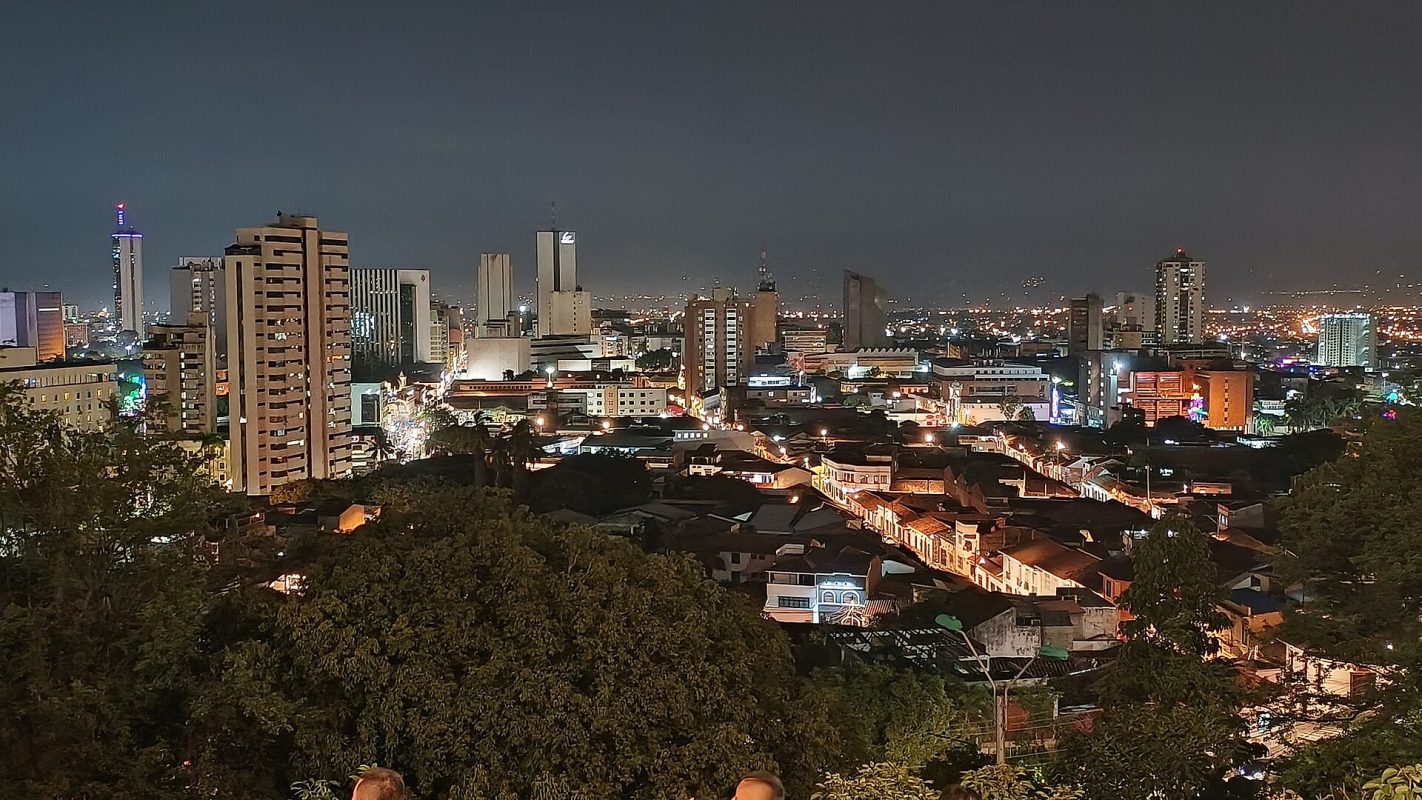
Weather overview
Cali sits in Colombia’s southwestern valley, where the weather stays warm year-round with only subtle shifts between seasons. The city’s tropical climate means temperatures rarely stray far from 23–24 °C, though the feel of the air changes with the rhythm of rain and sun. Visitors will notice two distinct phases: a drier stretch from January to March and again in July and August, while the rest of the year brings more frequent showers.
The most stable weather in Cali arrives in the first months of the year, when sunshine averages 6.6 hours a day in January and rain is less persistent. By April, the skies grow cloudier, and the city enters its wetter season, peaking in October with nearly 187 mm of rainfall. Even then, downpours tend to be brief, leaving plenty of time to explore between showers.
Temperature
Daytime highs in Cali hover around 30–31 °C for much of the year, with only slight dips in June and November, when the mercury settles near 29.7–29.8 °C. Nights offer mild relief, dropping to 18.8–19.8 °C, so a light layer is useful after sunset. The narrow range between day and night makes packing straightforward, though the humidity can make the heat feel more intense during the wetter months.
The warmest stretch arrives in September, when afternoon temperatures reach 31.5 °C, while the coolest nights occur in August at 18.8 °C. Even in the so-called cooler months, the difference is minimal—just a degree or two separates June from September. Travelers from temperate climates may find Cali’s warmth consistent, but the lack of extreme heat makes it comfortable for outdoor activities year-round.
| Month | Minimum | Maximum |
|---|---|---|
| January | 19.1 | 30.9 |
| February | 19.7 | 31.1 |
| March | 19.6 | 30.3 |
| April | 19.6 | 30.3 |
| May | 19.8 | 30.1 |
| June | 19.3 | 29.8 |
| July | 19 | 30.8 |
| August | 18.8 | 31.1 |
| September | 18.9 | 31.5 |
| October | 19.2 | 30.1 |
| November | 19.3 | 29.7 |
| December | 19.4 | 30.4 |
Precipitation
Cali’s rainfall follows a clear pattern, with the driest months—January, July, and August—receiving around 73–100 mm of rain. The wettest period runs from April to November, with April and October seeing the highest totals, often exceeding 180 mm. Despite the rain, storms are usually short-lived, and the city rarely stays gray for long.
The shift between dry and wet seasons is gradual. February and March bring increasing showers, while June and July mark the transition back toward drier conditions. Even in the rainiest months, mornings are often clear, so early outings can help avoid the afternoon downpours. A compact umbrella or a waterproof bag is all that’s needed to stay comfortable.
| Month | Precipitation |
|---|---|
| January | 96.9 |
| February | 177.9 |
| March | 180.4 |
| April | 210.7 |
| May | 183.5 |
| June | 167.2 |
| July | 100.5 |
| August | 73.4 |
| September | 105.4 |
| October | 186.9 |
| November | 182.4 |
| December | 150 |
What to pack
For a trip to Cali, lightweight, breathable clothing is essential, no matter the season. During the drier months—January to March and July to August—sun protection is key, with hats and sunglasses useful for the strong midday rays. A light rain jacket or a foldable umbrella will come in handy for the wetter months, especially from April to November.
Evenings in Cali are mild, so a long-sleeve shirt or a light sweater is enough for comfort. Footwear should be practical: sandals for daytime and something waterproof for rainy afternoons. Since the city’s weather is predictable, packing layers is more about adapting to brief showers than to temperature swings. A small backpack for daily essentials will make navigating the city’s weather easier.
| Month | Wind speed |
|---|---|
| January | 2.5 |
| February | 2.6 |
| March | 2.4 |
| April | 2.2 |
| May | 2.2 |
| June | 2.2 |
| July | 2.4 |
| August | 2.6 |
| September | 2.8 |
| October | 2.5 |
| November | 2.4 |
| December | 2.4 |


