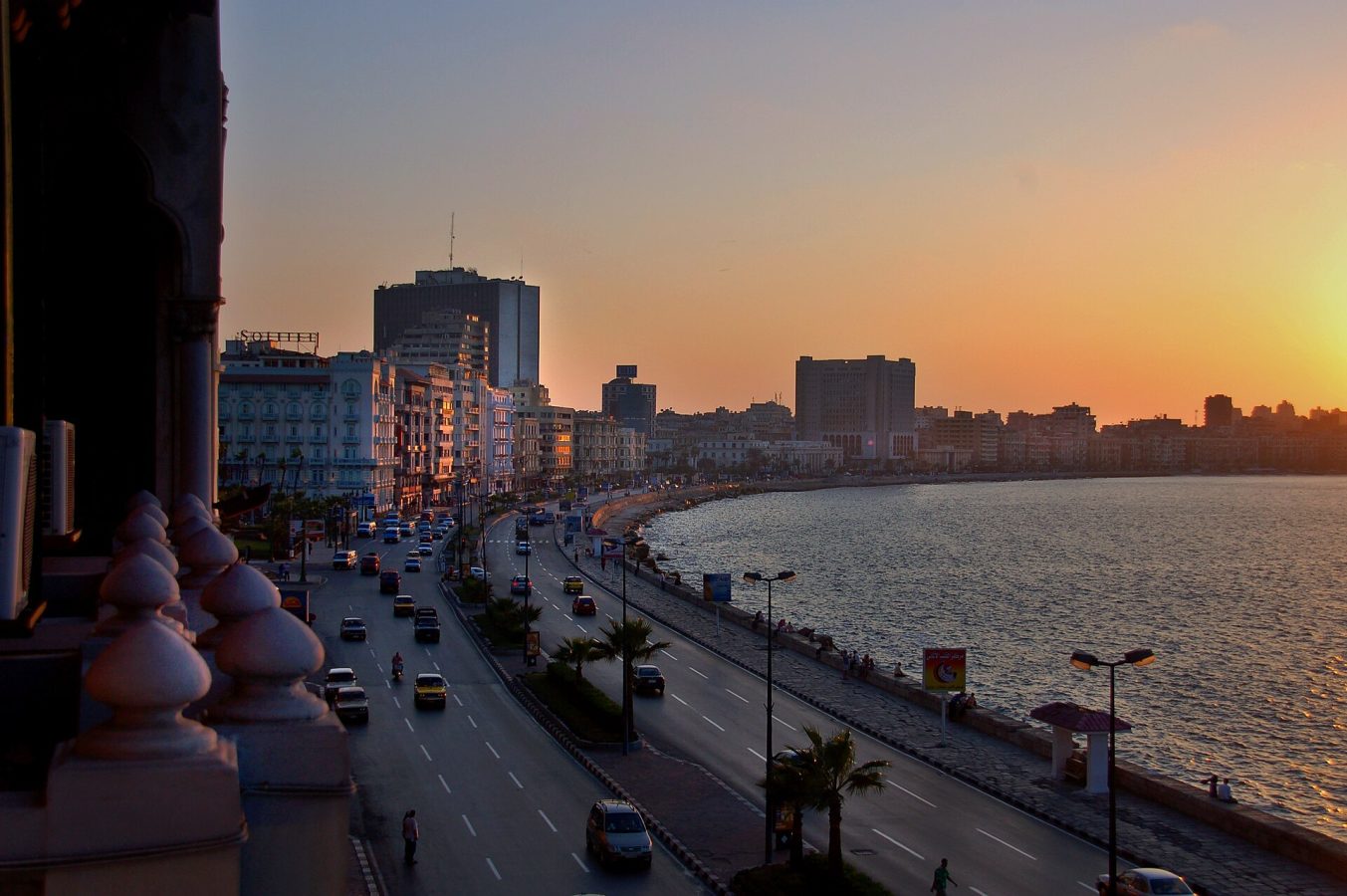
Alexandria
Egypt · 7 places
Photo: David Evers from Amsterdam, Netherlands, CC BY 2.0
Alexandria feels like a place where history hasn’t just been preserved—it’s still unfolding. Founded by Alexander the Great in 331 BC, the city quickly became a crossroads of the ancient world, where Greek philosophy, Egyptian mysticism, and Middle Eastern trade converged. This was the home of the Great Library, a beacon of knowledge that once held the wisdom of entire civilizations, and the Pharos Lighthouse, one of the Seven Wonders of the ancient world. Today, the ruins of that past are scattered across the city, but they don’t feel like relics. They’re part of the living fabric of Alexandria, woven into its streets, its air, even the way people move through the day.
The city stretches along the Mediterranean, and its Corniche is where land and water meet in a constant, easy rhythm. The promenade hums with life at all hours—fishermen mending their nets, families strolling under the palms, old men playing backgammon in the shade. Cafés spill onto the sidewalks, serving grilled sea bass drizzled with lemon and local spices, or tiny cups of strong, sweet coffee. At dusk, the lights of the city reflect on the waves, and the air fills with the scent of salt and charcoal from the street food vendors. The sea here isn’t just a backdrop; it’s a presence, shaping the city’s mood, its pace, even its flavors.
Wander away from the Corniche, and Alexandria reveals itself as a maze of narrow streets where time moves differently. In the older quarters, Ottoman mansions with lacy wooden balconies stand beside crumbling Greek churches, their frescoes darkened by centuries of smoke and incense. Tiny shops sell everything from spices to antique coins, their wares spilling onto the pavement. The Anfoushi district, in particular, feels like a city within a city—less polished, more alive. Here, the descendants of Greeks, Italians, and French still live among the Egyptians, and the mix of cultures is palpable in the food, the architecture, even the way people greet each other. It’s a place where you might hear Arabic, Greek, and French in the same conversation, where a café might serve both ful medames and bougatsa.
Alexandria has always been a city of stories. The poet C.P. Cavafy lived and wrote here, and his former home is now a museum, drawing visitors who want to walk the same streets that inspired his verses. Lawrence Durrell captured the city’s layered soul in *The Alexandria Quartet*, painting it as a place where reality and myth blur. Even now, the city feels like it’s still writing itself—whether in the quiet corners of a bookshop, the chaotic energy of a market, or the shadow of a Roman column half-buried in sand. You don’t need to know its literary past to feel it; the city has a way of making you believe that anything could happen here.
For all its history, Alexandria isn’t stuck in the past. It’s a working city, with universities, theaters, and modern shopping malls where locals browse everything from high-end fashion to handmade jewelry. But what sets it apart from other Egyptian cities is its unhurried pace. It’s not as frenetic as Cairo, not as polished as the Red Sea resorts. There’s a rhythm here, a way of moving through the day that feels deliberate, almost lazy. Alexandria doesn’t try to dazzle you at first glance. It unfolds slowly, like a story you want to linger over, a place that rewards the patient, the curious, the ones willing to look beyond the surface.
Eat & Drink
0 placesNothing in this category yet — the catalogue is still growing.
All placesPlaces on the map
Marker colour follows the categoryClimate and weather
Detailed weather: Alexandria- Average temperature
- 22 °C
- Precipitation per year
- 257 mm
Average air temperature
°C
15
15
17
20
23
26
28
29
27
24
21
17
Jan
Feb
Mar
Apr
May
Jun
Jul
Aug
Sep
Oct
Nov
Dec


