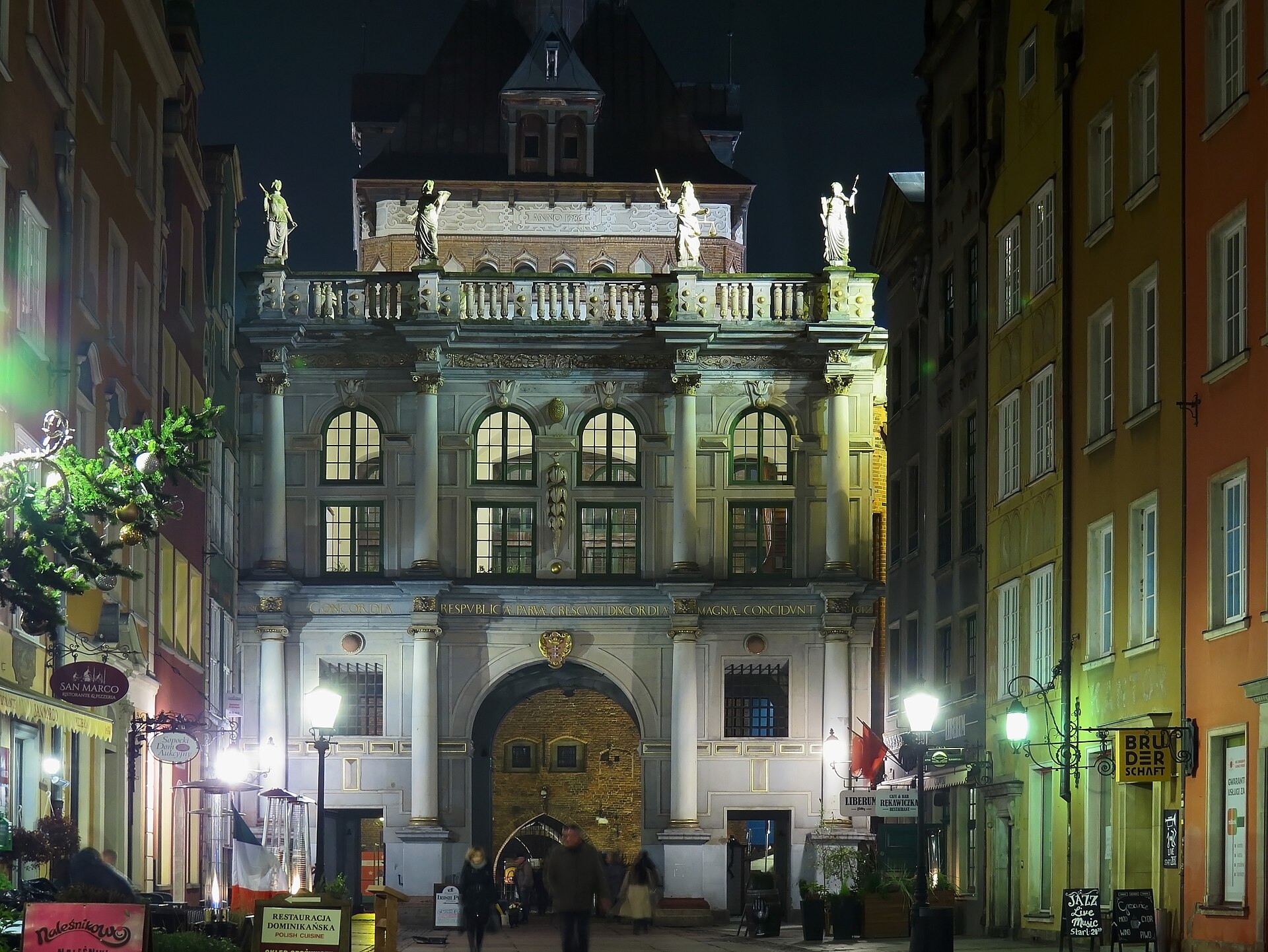
Gdańsk is a city where history isn’t locked away in museums but lingers in its stones, bricks, and the very air you breathe. Nowhere is this more evident than in the Old Town, where every street and building seems to whisper fragments of the city’s long and often turbulent past. Among these silent witnesses, the Golden Gate holds a special place. More than just an architectural landmark, it has stood for centuries as a symbol, greeting and bidding farewell to those who arrive in Gdańsk from the west, along the road that once connected Europe to the heart of this Baltic port.
Built between 1612 and 1614, the Golden Gate replaced older fortifications that had guarded the city since medieval times. By then, Gdańsk was one of the wealthiest and most influential members of the Hanseatic League, a gateway to the Baltic for all of Central Europe. As the city flourished, so did the need for protection—from raids, wars, and foreign armies. The old defenses were no longer enough, and the city authorities commissioned a new gate that would serve not only as a fortress but also as a statement of Gdańsk’s prosperity and ambition.
The architect behind the Golden Gate was Jan Strakowski, a master of his time. He designed the structure in the Mannerist style, which was just beginning to take hold in Northern Europe. Mannerism here reveals itself in the graceful interplay of forms, the way the massive stone seems to float effortlessly above the ground, and the abundance of decorative elements that give the gate a ceremonial, almost theatrical presence. The façade is adorned with figures representing virtues—Peace, Freedom, Harmony, Justice, Piety, Prudence, Patience, and Unity—meant to remind both citizens and visitors of the ideals a good citizen should uphold. These allegories were no accident. In those days, Gdańsk was a melting pot of cultures, languages, and religions, and the city’s leaders worked hard to maintain the delicate balance between them.
The gate itself consists of two sturdy pylons connected by an arch, above which rises an attic bearing the coat of arms of Gdańsk and the figures of the virtues. It was once part of a larger defensive complex that included walls, bastions, and moats. Little remains of those fortifications today, but the Golden Gate has survived nearly intact, becoming one of the city’s most recognizable symbols. It stands at the edge of the Old Town, a quiet sentinel separating the bustle of modern life from the slower, more measured rhythm of the historic streets beyond.
Walking through the Golden Gate feels like stepping into another Gdańsk, one that remembers the days when the city was free, wealthy, and independent. Beyond the gate lies Długa Street, the main artery of the Old Town, leading to the Long Market and the Town Hall. Here, among the narrow facades of merchant houses, each adorned with intricate carvings and paintings, it’s easy to imagine the processions, the bustling trade, and the daily lives of the people who once walked these streets. The Golden Gate wasn’t just an entrance to the city; it was the beginning of a journey to its very heart.
The gate has witnessed wars and destruction, none more devastating than World War II, when Gdańsk was nearly erased from the map. The Golden Gate suffered damage too, but in the postwar years, it was carefully restored to its former glory. Today, it serves as a reminder of how fragile yet enduring the memory of a place can be. The gate doesn’t just stand in its spot—it continues to fulfill its role, bridging the past and the present.
The Golden Gate changes with the seasons. In summer, when tourists gather for photos and street musicians play nearby, it feels like part of the city’s living pulse. In autumn, as the streets grow quieter and a light mist settles over the buildings, the gate takes on a more solemn, almost mysterious air. Winter transforms it into a fairy-tale portal, leading to Christmas markets and the scent of mulled wine. And in spring, as the city awakens, the gate seems to whisper that life goes on, no matter what.
The Golden Gate is more than just a sight to check off a list. It’s a place where you can pause, touch the stone that remembers the hands of the craftsmen who built it four centuries ago, and reflect on the countless people who have passed through its arch over the years. Here, you can feel the breath of history, not as something distant, but as something that still lives beside us. The gate reminds us that Gdańsk is more than a port city or a crossroads of cultures—it’s a place with a character all its own, one that knows how to hold onto its memories.