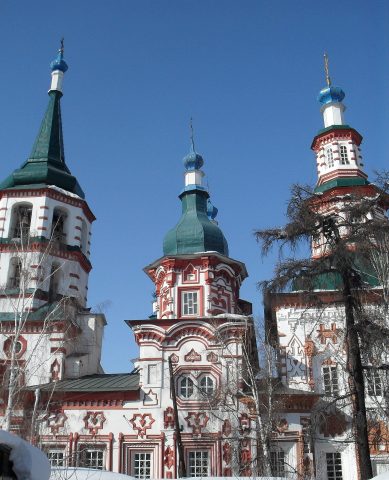
The white walls and golden domes of Znamensky Monastery rise above the Angara River, their reflection trembling in the water. This is where Irkutsk’s past lingers—not in grand declarations, but in the quiet persistence of faith and daily life.
The monastery appeared in the late 17th century, among the first Orthodox complexes in Eastern Siberia. It anchored the spiritual lives of settlers and travelers moving into the region. Wooden structures gave way to stone by the mid-18th century, including the main cathedral dedicated to the Icon of the Mother of God of the Sign. Built over nearly twenty years, it blends Siberian Baroque’s austere lines with delicate ornamentation.
The bell tower, added later, is simpler in design but stands tall enough to guide travelers toward the city. Inside, frescoes and icons remain—some painted locally, others brought from European Russia. The Icon of the Mother of God of the Sign draws pilgrims who believe in its miraculous power.
The monastery has served many roles. In the 19th century, it housed one of Irkutsk’s earliest libraries. Explorers, merchants, and scholars passed through its walls on their way deeper into Siberia. During the Soviet era, churches were closed, some buildings demolished, and the grounds repurposed. Yet locals still came to pray or stand quietly by the walls.
Restoration began in the late 20th century after the monastery was returned to the Russian Orthodox Church. The work was slow—rebuilding structures, recovering lost icons, reinstalling bells. Today, it hosts services, workshops, and a Sunday school, though it remains open to anyone seeking quiet.
The grounds invite wandering. Stone paths curve between churches, shaded by old trees. Fishermen cast lines by the riverbank, while others sit on benches, watching the water. The stillness here feels separate from the city’s noise, just beyond the walls.
Visitors come for different reasons. Historians study its architecture. Artists sketch its domes. Others simply pause for the view—the wide Angara, Irkutsk’s mix of wooden houses and modern buildings, the soft light of dawn or dusk. Sunset is especially striking, when the domes glow and the river mirrors the sky.
Znamensky Monastery has endured fires, revolutions, wars, and neglect. Each time, it has reemerged. A walk through its grounds, a moment inside the churches, or time by the river offers a glimpse of the stories these walls hold.