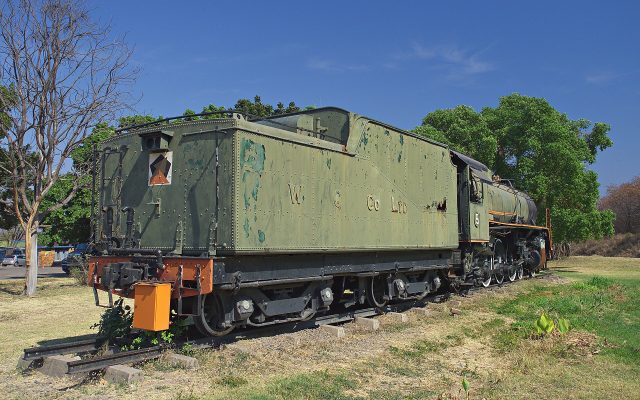
Hwange’s railway station is one of those places where the past lingers in the present, not as a relic behind glass, but as something still very much alive. Built in the mid-20th century, it was never meant to be grand—just sturdy, practical, and reliable, like the trains it served. The station sits in a town that grew around coal mines, and its architecture reflects that era of industrial ambition, when railways were the veins of a young nation’s economy. The building itself is unassuming: brick walls, tall windows, and heavy wooden doors that have seen decades of arrivals and departures. Inside, the waiting hall feels spacious, with high ceilings and benches worn smooth by time. There’s no luxury here, just the quiet rhythm of a place that has always been about function, not frills.
Hwange itself is a town shaped by the railway. Coal from the surrounding mines has long been its lifeblood, and the station is where that industry meets the rest of the country. Freight trains rumble through regularly, hauling loads of fuel to power plants and factories, while passenger services connect the town to Bulawayo and other major hubs. For locals, the station is more than just a transit point—it’s a gathering place, where people catch up on news, share stories, or simply pass the time. The comings and goings of trains mark the hours of the day, a steady pulse that keeps the town moving.
The station’s history is tied to Zimbabwe’s mid-century push for industrialization. When coal deposits were discovered in the area, Hwange became a key player in the country’s economic plans, and the railway was the thread that stitched it all together. The station was built to serve that purpose, and in many ways, it still does. Today, it stands as a quiet witness to an era when the country was building its future, one rail line at a time. The architecture is simple, almost utilitarian, but there’s a certain dignity in its straightforwardness—a reminder that progress doesn’t always need ornamentation.
Around the station, a small world has taken shape. Vendors set up stalls selling fruit, snacks, and handmade trinkets, catering to travelers passing through. Nearby cafés and food stands offer quick meals to those waiting for their train, their menus as no-nonsense as the station itself. There’s no tourist hustle here, no pressure to buy or pose for photos. Everything unfolds at its own pace, unhurried and unpolished. For visitors, it’s one of those rare places where you can step off the usual path and see how life actually works, away from the curated experiences of guidebooks.
For many Zimbabweans, Hwange station is a place of memories. Some recall leaving home for the first time, boarding a train in search of work or opportunity. Others remember waiting on the platform, watching for a familiar face after years apart. Railways have always been part of the country’s story, and stations like this one hold fragments of countless personal histories. Even now, when the station isn’t as busy as it once was, it remains a landmark—a fixed point in a town that has seen its share of change.
What makes places like Hwange station worth noticing is their honesty. There are no grand monuments or carefully staged attractions, just the everyday reality of a town that has always been about work. You won’t find it in most travel guides, and that’s part of its charm. Here, you can sit on a bench, watch the trains come and go, and listen to the murmur of conversations in Shona or Ndebele. The air smells of coal dust and fried food, the sounds of the station blending into the background. It’s not a place for dramatic selfies or Instagram moments, but for those willing to look, it offers something far more interesting: a glimpse of life as it’s actually lived.
If you’re traveling through Zimbabwe, it’s worth taking a detour to places like this. They don’t announce themselves with fanfare, but they tell you more about the country than any postcard ever could. Hwange station isn’t trying to impress anyone—it’s just doing what it’s always done, quietly and without fuss. And in that unassuming way, it manages to capture something essential about the place: the resilience, the rhythm, and the quiet dignity of a town that has always been about getting things done.