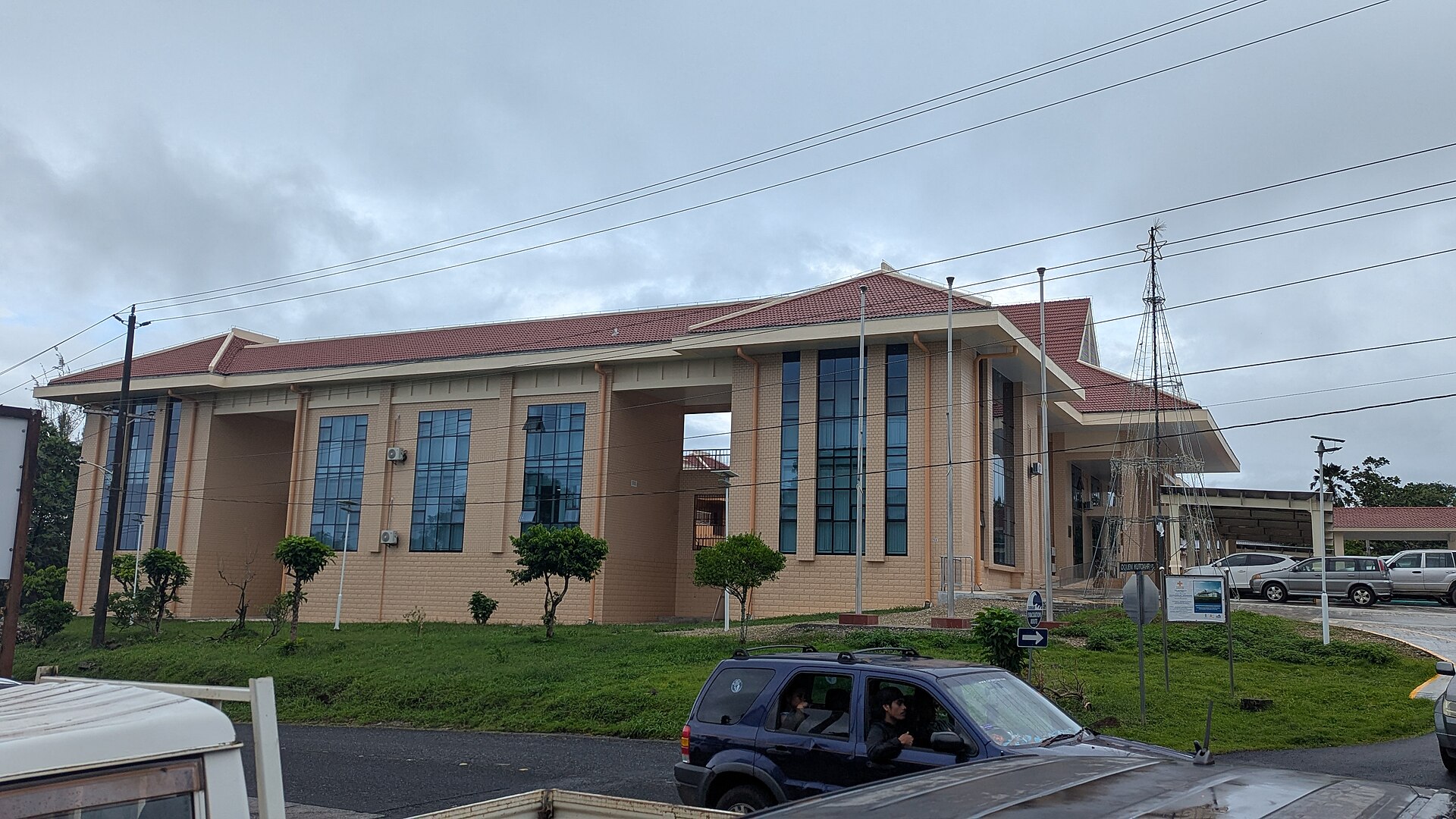
Palikir is a place most travelers pass over without a second thought, a small dot on the map marking the capital of the Federated States of Micronesia. There are no wide avenues, no skyscrapers, no crowds—just the quiet rhythm of life where every building and every stone seems to carry its own story. Among these, the government building of Pohnpei State stands as a subtle but meaningful landmark, where the island’s past and present intersect.
This structure is unassuming in its design. Its low walls of light stone blend with the surrounding hills, while wide windows let in the ocean breeze. The roof, with its gentle slope, echoes the shape of traditional Micronesian homes, fitting naturally into the landscape. There’s no grandeur here, just a quiet appropriateness, as if the building has always belonged to this place.
The history of the building is tied to Pohnpei’s journey toward self-governance. After World War II, Micronesia entered a period of political transformation, and Pohnpei, as one of the four states, began to establish its own administrative identity. The government building became a symbol of this new chapter—not a display of power, but a reflection of the island’s growing autonomy. It was built when Pohnpei was still finding its place within an independent nation, carrying the spirit of that era: cautious optimism and a desire to preserve local identity.
Inside, the building is practical. Wood-paneled halls and simple offices serve their purpose without pretense. What makes this place different is how grounded it feels in the lives of Pohnpei’s people. There’s no sense of detachment; instead, it feels like an extension of the community, where decisions are made with the island’s well-being in mind. It doesn’t tower over the town but sits comfortably within it.
For travelers in Palikir, the government building may not seem like an obvious attraction. There are no guided tours or souvenir stands. But that’s what makes it worth noticing—it’s a living part of the island’s daily life. Walking past, you might see local officials in conversation or residents coming and going. It’s a reminder that even in remote places, life carries on with its own logic.
The area around the building is understated. Nearby, a small park offers a place to sit and watch the sun dip behind the hills. The trees—some rare species from other parts of the Pacific—provide shade. The only sounds are the rustling of leaves and the occasional call of a bird.
The building also serves as a gathering point for events that matter to the island. Community meetings, discussions with representatives from other Micronesian states, and international talks sometimes take place here. For residents, it represents stability; for visitors, it offers a glimpse into how life is organized in this corner of the Pacific.
The government building of Pohnpei State is less about architecture and more about what it represents. It’s a symbol of how even overlooked places have their own stories and ways of doing things. It reminds us that governance can be humble and connected to the people it serves. That’s why it fits so naturally into Palikir, a town where time moves to its own rhythm.