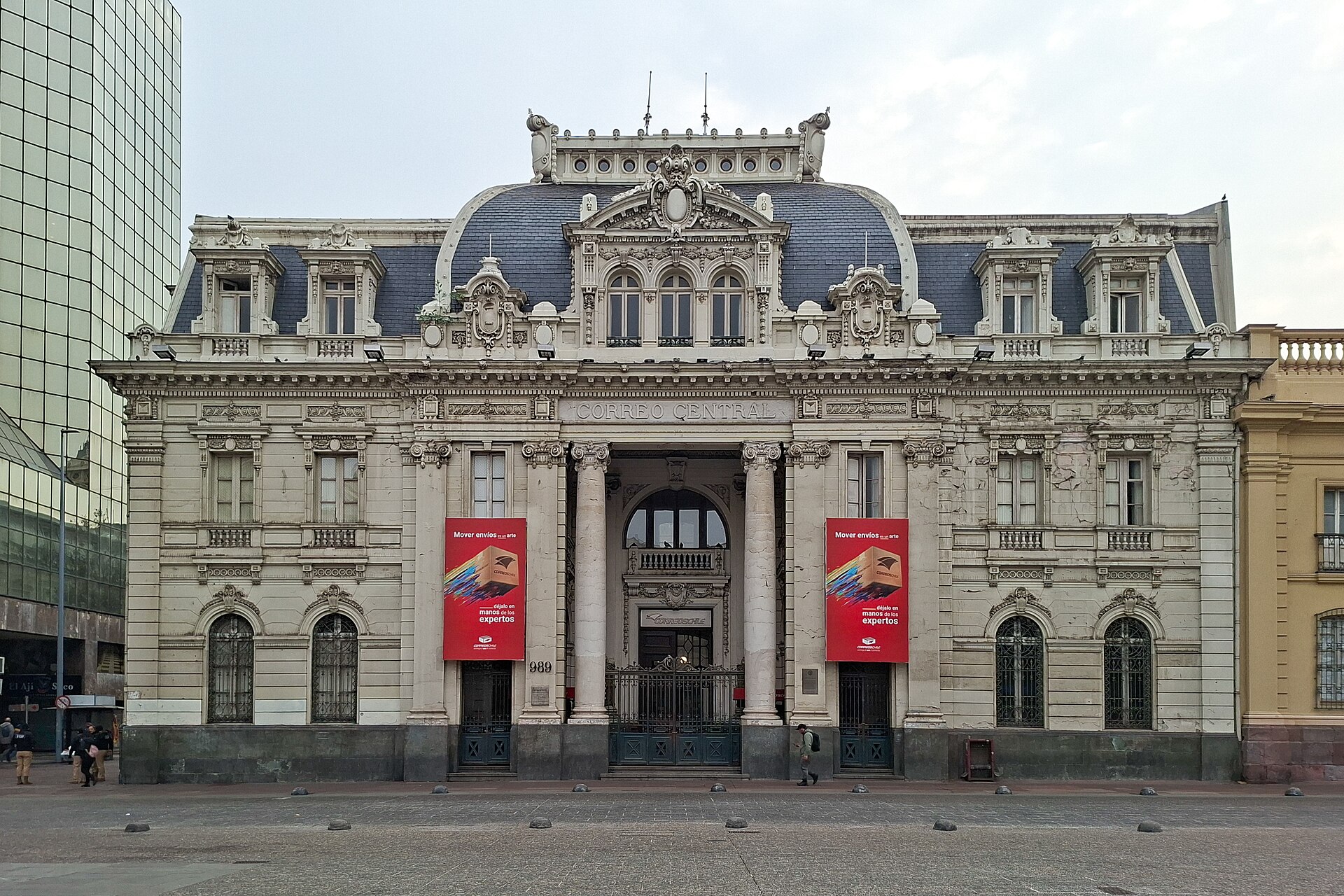
The Central Post Office building in Santiago is one of those places that quietly anchors the city’s identity, blending into the daily rhythm of life while holding layers of history within its walls. Situated on Plaza de Armas, the heart of the Chilean capital, it’s more than just a functional post office—it’s a bridge between the city’s past and its present. The architecture immediately draws the eye, with its blend of classical and neoclassical elements: soaring ceilings, sturdy columns, and ornate facades that convey a sense of permanence. This solidity reflects its original purpose, a place built to endure, much like the institution it houses.
The building’s story begins in the mid-19th century, a time when Santiago was rapidly evolving into the administrative and cultural hub of an independent Chile. Originally, the site was home to the colonial governor’s palace, but as the country established its republican institutions, the need for a modern postal hub became clear. In 1881, the structure was repurposed to serve as the central post office, marking the beginning of its long service to the city. Over the decades, it has undergone several transformations, adapting to new demands while retaining its imposing presence. Each renovation subtly modernized the space without erasing the traces of its earlier iterations, making it a living record of Santiago’s growth.
Inside, the post office feels like a relic of a different era. The spacious halls, with their marble floors and dark wooden paneling, evoke a time when the postal service was more than just a utility—it was a social institution. People once gathered here not only to send letters but to wait for news, exchange stories, or simply pass the time. Even now, when emails and instant messages have largely replaced handwritten correspondence, the building retains a quiet dignity. The hush of footsteps on polished floors and the occasional hum of machinery create an atmosphere that feels almost timeless, as if the building itself is reluctant to let go of its past.
The architectural style is a mix of influences, with a clear nod to European traditions. The facade is adorned with pilasters and pediments, while the entrance is framed by columns that lend it an air of formality. Inside, the design is more practical, though remnants of its former grandeur remain. Ornate chandeliers hang from high ceilings, and the staircases feature intricate woodwork, details that hint at the building’s origins as a place of importance. These elements give the space a sense of continuity, as if the past and present coexist within the same walls.
Plaza de Armas, where the post office stands, is the historical nucleus of Santiago. Surrounded by landmarks like the Metropolitan Cathedral, the city hall, and the National Historical Museum, the square forms a cohesive narrative of the city’s evolution. The post office fits neatly into this context, neither as ancient as the cathedral nor as modern as the skyscrapers that now loom over the city. Instead, it occupies a middle ground, a reminder of the 19th century’s ambitions and the role Santiago played in shaping Chile’s identity.
Today, the Central Post Office still serves its original purpose, though its role has diminished in the digital age. Visitors can still mail letters, purchase stamps, or send packages, but for many, the building’s appeal lies in its historical significance. Tourists often step inside to photograph the interiors, while locals might wander in out of curiosity or nostalgia. It’s a place where the past isn’t preserved behind glass but lives on in the daily routines of those who use it.
Over the years, the building has witnessed key moments in Chile’s history. It has hosted gatherings related to the postal service’s development and, during times of political upheaval, served as a meeting point for citizens. The 20th century brought several renovations, each one carefully balancing modernization with preservation. Today, the post office is recognized as an architectural monument, a status that underscores its importance to Santiago’s cultural heritage.
For those exploring Santiago’s history, the Central Post Office offers a small but meaningful glimpse into the city’s past. Unlike a museum, where artifacts are displayed in isolation, this is a working space where history and function intersect. It’s a place where the grandeur of 19th-century design meets the practicalities of modern life, where the rhythm of a bustling city slows just enough to let visitors appreciate the details. The postal service may no longer hold the same central role it once did, but the building remains a testament to the enduring human desire to connect—whether through a letter, a postcard, or simply the shared experience of standing in a place that has seen generations come and go.