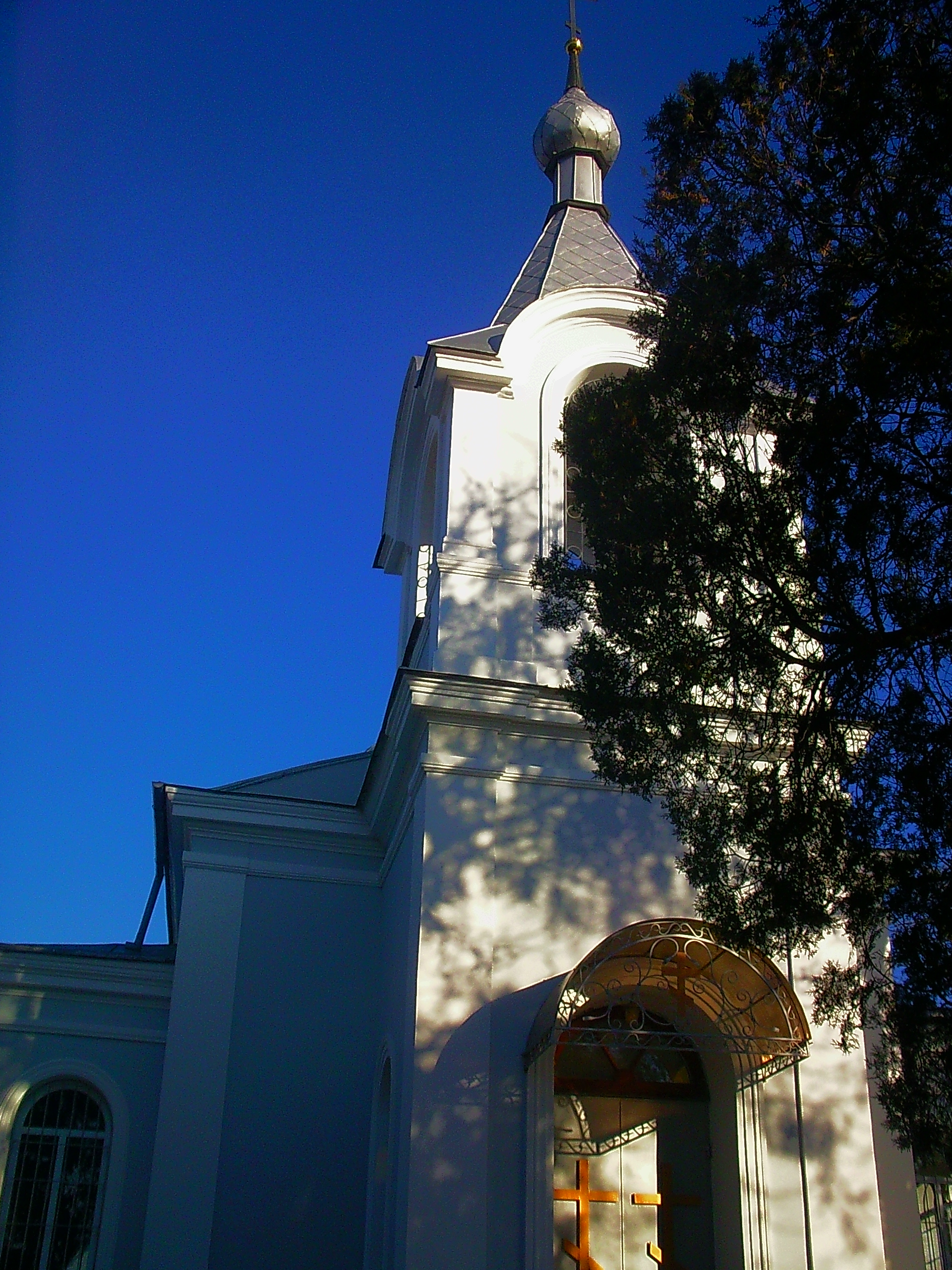
All Saints Church in Simferopol is one of those quiet places that doesn’t demand attention but lingers in the mind long after you’ve left. Tucked away on the edge of the city, where the old neighborhoods gradually give way to private homes, its unassuming architecture stands in contrast to the grand cathedrals Crimea is known for. There’s no attempt here to impress with scale or opulence—just an invitation to step inside and experience something unpretentious and real.
The church’s story begins in the late 19th century, when Simferopol was already a cultural and religious hub of the Taurida Governorate. Built in 1888 with funds from parishioners and local benefactors, it was a modest addition to a city that was still very much a provincial town, with narrow streets, low houses, and churches scattered on its outskirts. At the time, Crimea was just beginning its transformation into a resort destination, but Simferopol remained a place where life moved at its own unhurried pace. All Saints Church became part of that rhythm, a place people visited not for spectacle, but for quiet reflection.
The building itself is simple and functional, designed without excess. A single-domed church in the Neo-Byzantine style, its thick walls and low vaults keep the interior cool even in the summer heat. The facade is adorned with subtle decorative elements—arches, pilasters, small niches—but nothing about it feels extravagant. Inside, the space is small but bright, with an iconostasis that, while not grand in size, was clearly crafted with care. Some of the old icons date back to the church’s founding, their worn surfaces hinting at decades of devotion.
Like many religious sites in Russia, All Saints Church endured a difficult period during the Soviet era. It was closed, repurposed as a warehouse, and eventually abandoned. But in the 1990s, as religious life began to revive across the country, the church was returned to the faithful. Restoration was a slow process—walls and roofs were repaired, lost icons were tracked down, and the interior was gradually brought back to life. Today, the church looks much as it did over a century ago, though the paint may be a little fresher and the surrounding neighborhood has changed.
For Simferopol, this church is more than just a place of worship—it’s a piece of the city’s living memory. Unlike the Vladimir Cathedral or St. Peter and Paul Church, it doesn’t draw crowds of tourists, which is precisely why it retains its quiet charm. On Sundays, locals gather here—elderly women in headscarves, families with children, men who stop by briefly to light a candle. The services are subdued, without the grandeur of choral hymns, but no less sincere for it. On weekdays, the church is often empty, offering a rare moment of stillness in the city.
What makes All Saints Church special is its location, far from the usual tourist routes. Simferopol is often seen as a transit point on the way to the coast or the mountains, but the city has its own character, its own quiet corners where time moves differently. This church is one of them. There’s no rush here, no need to hurry. You can stand by the entrance, watch the old trees in the courtyard, listen to the pigeons circling the dome, and feel the city breathing at its own unhurried pace.
In recent years, new buildings—apartment blocks, shops, cafes—have sprung up around the church, but it remains an island of calm amid the urban bustle. Perhaps that’s because its history is so deeply intertwined with Simferopol’s own story. It has weathered wars, revolutions, neglect, and revival, yet it endures, unassuming but steadfast. Today, it continues to serve those who seek it out, not for fame or spectacle, but for something quieter and more enduring.
If you ever find yourself in Simferopol and want to see the city not as a tourist, but as a local might, this is a place worth visiting. You don’t need to be religious to appreciate its atmosphere. Just sit on a bench in the courtyard, listen to the rustling leaves, watch the people come and go, and you’ll understand why sometimes the simplest places leave the deepest impression.