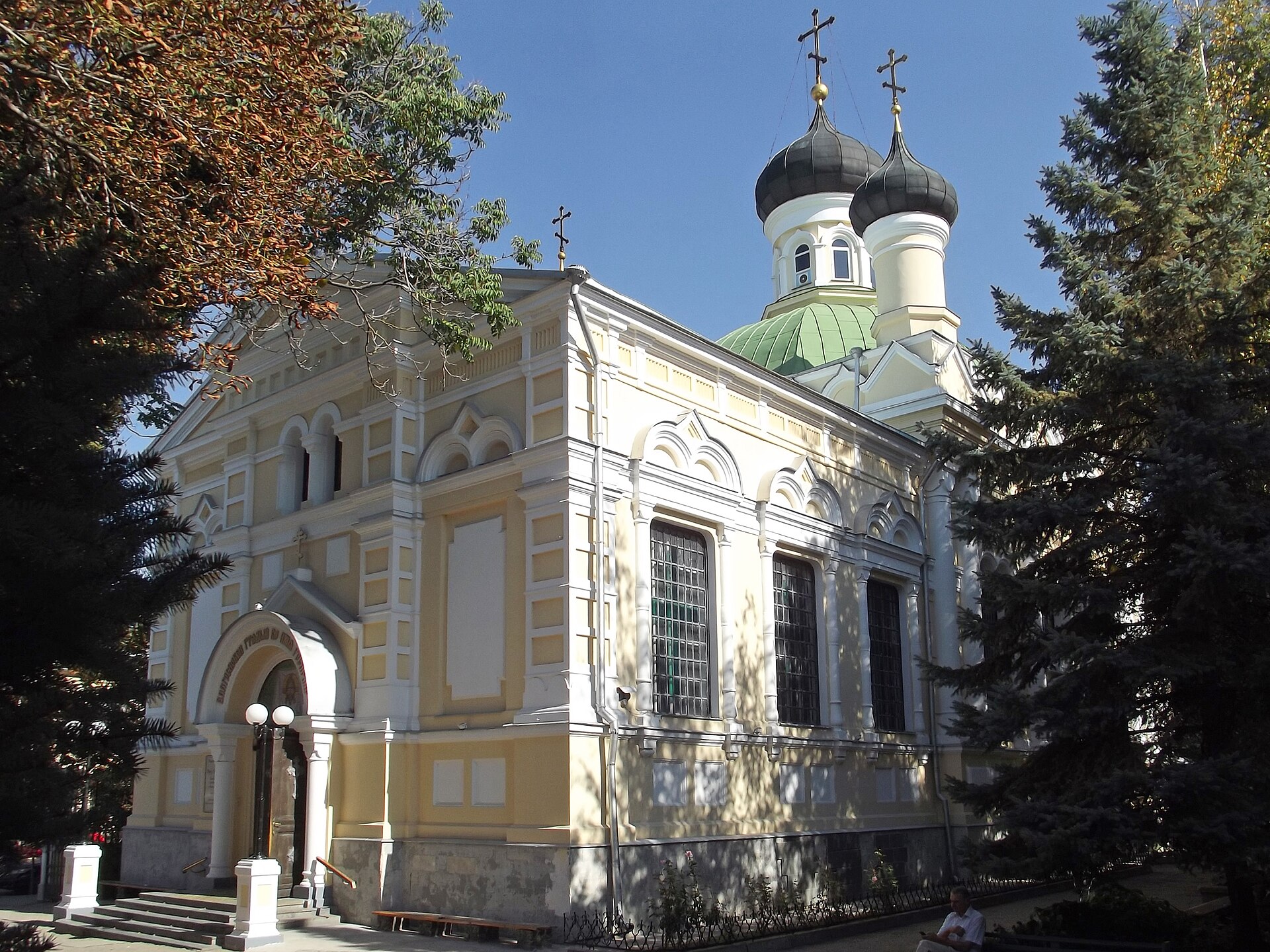
The Church of the Three Holy Hierarchs in Simferopol is one of those quiet places that lingers in your memory long after you’ve left. Tucked away in the heart of the city, where Pushkin Street meets Karl Marx Street, it doesn’t demand attention like some of Crimea’s grander cathedrals. Instead, it offers something subtler—a sense of warmth, as if you’ve stepped into a home where you’re already expected. The whitewashed walls, the modest dome, the small bell tower—everything about it feels unassuming, yet deeply inviting.
The church’s story begins in the mid-19th century, when Simferopol was solidifying its role as the administrative center of the Taurida Governorate. The city was expanding rapidly, and the growing Orthodox community needed a place of worship. Construction began in 1860, and by 1867, the church was consecrated in honor of the Three Holy Hierarchs—Basil the Great, Gregory the Theologian, and John Chrysostom. These saints were revered as the great teachers of the Church, and their names were chosen deliberately. At the time, Simferopol wasn’t just a hub of trade and governance; it was also a cultural center, with new schools, libraries, and theaters shaping the city’s intellectual life.
Architecturally, the church reflects the trends of its era. Built in the Neo-Byzantine style that was popular in 19th-century Russia, it’s a classic example of Orthodox design from that period. From the outside, it appears modest, but the interior is more spacious than you’d expect. The iconostasis, painted in traditional style, the frescoes on the walls, and the soft light filtering through narrow windows all contribute to a sense of quiet reverence. The vaulted ceiling is particularly striking, adorned with scenes from the lives of the saints to whom the church is dedicated.
Like many religious sites in Russia, the church endured a difficult period under Soviet rule. In the 1930s, it was closed, and the building was repurposed as an archive. The interior decorations were lost, icons disappeared, and for decades, the church stood abandoned, slowly deteriorating. It wasn’t until the late 1980s, when religious life in the country began to revive, that the building was returned to the Church. Restoration took several years, and in 1990, the church reopened its doors to worshippers.
Today, the Church of the Three Holy Hierarchs is an active parish, drawing both locals and visitors. Services, baptisms, and weddings are held here regularly, and a Sunday school operates for children. On weekdays, the church is open to anyone who wants to pray, light a candle, or simply sit in silence. The courtyard, with its flowerbeds in summer and snow-covered paths in winter, adds to the peaceful atmosphere. During major holidays like Christmas and Easter, the church comes alive with the sound of bells ringing through the surrounding streets, a moment that even those who aren’t religious often pause to appreciate.
The church is deeply woven into Simferopol’s history. Over the years, it has been a place of mourning for prominent citizens, a site of prayer for soldiers heading to the front during World War II, and a refuge for those seeking comfort in difficult times. During the Soviet era, when religious practice was suppressed, the church became a symbol of enduring faith. Today, it remains a quiet but essential part of the city’s landscape, a place where the past and present intersect.
If you find yourself in Simferopol, it’s worth stopping by, even for a few minutes. You don’t need to be religious to feel the church’s unique atmosphere—calm, unhurried, as if time moves differently here. There are no tourist crowds, no guided tours rushing through, just the quiet streets of the old city and the historic buildings that have witnessed generations of change. This isn’t a place for haste. It’s a place to pause, to reflect, and to let the stillness settle in.