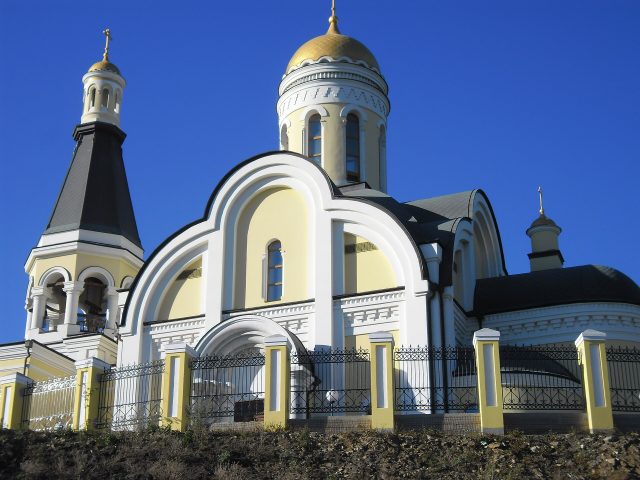
The Holy Trinity Church in Chelyabinsk is one of those rare places where the city’s past feels almost tangible. Built in the early 20th century, it stands at the intersection of streets that were once part of a bustling merchant district. The surrounding buildings, weathered by time, still carry the echoes of pre-revolutionary life—imagine the clatter of horse-drawn carriages, the shouts of traders haggling over goods, and the distant toll of church bells marking the hours. Even now, the area retains a quiet dignity, as if the walls themselves remember the voices that once filled these streets.
The church’s architecture is striking, blending traditional Russian styles with subtle Art Nouveau influences. Its white stone facade, adorned with intricate carvings, rises gracefully, while tall, arched windows filter soft light into the interior. The bell tower, though reconstructed, adds to the building’s fairy-tale charm, its slender silhouette contrasting with the sturdy walls. Inside, the high vaulted ceilings are covered in frescoes depicting biblical scenes, their colors muted yet rich with detail. The iconostasis, a masterpiece of gilded woodwork, draws the eye with its solemn beauty, each icon a testament to the skill of the artists who created them.
Like many religious sites in Russia, the Holy Trinity Church endured a turbulent history. During the Soviet era, it was closed and repurposed—first as a warehouse, then as a workshop. The original bell tower was dismantled, and much of the interior decoration was lost. It wasn’t until the 1990s that the building was returned to the faithful, and a painstaking restoration began. Old photographs and the memories of elderly locals guided the work, helping to recreate the church’s original appearance. Today, it stands as a near-perfect replica of its early 20th-century self, though some details remain forever lost to time.
For Chelyabinsk, the church is more than just a place of worship—it’s a symbol of resilience. The city, known for its industrial might and Soviet-era expansion, often feels disconnected from its past. Yet the Holy Trinity Church serves as a quiet reminder of the layers beneath the modern facade. Here, life moves at a different pace. Weddings and baptisms are celebrated with warmth, and the scent of incense lingers in the air long after services end. In summer, the linden trees around the church bloom, their fragrance mixing with the faint sweetness of candle wax. In winter, snow dusts the domes, softening the edges of the city’s hustle.
The church comes alive during religious festivals. On Trinity Sunday, the courtyard fills with worshippers carrying birch branches, their leaves rustling in the breeze as services stretch into the afternoon. At Christmas, the interior glows with candlelight, reflecting off the gilded icons and casting long shadows across the walls. Even on ordinary days, the church offers a sense of peace. Visitors can sit on the benches outside, listening to the birds or simply watching the world go by. The quiet here feels intentional, as if the space itself invites reflection.
Beyond its spiritual role, the Holy Trinity Church is a landmark in Chelyabinsk’s urban landscape. Perched on a small hill, its golden domes catch the sunlight from afar, standing out against the city’s industrial skyline. Nearby, a small park offers a place for families to stroll, its old poplar trees swaying gently in the wind. Occasionally, the church hosts concerts of sacred music, filling the streets with the sound of choirs or the deep resonance of an organ—a rare moment of harmony in a city built on steel and concrete.
In recent years, the church has also become a gateway to Chelyabinsk’s history. Guided tours share stories of the building’s past, from its construction to its restoration, and the lives of those who once prayed within its walls. For many locals, these visits are a way to connect with the city’s roots, to imagine what life was like a century ago. The church offers a different perspective on Chelyabinsk—not as an industrial hub, but as a place with a soul, shaped by the people who lived, worked, and worshipped here.
Despite the city’s relentless pace, the Holy Trinity Church remains an oasis of calm. Even in the heart of Chelyabinsk, where traffic hums and crowds rush past, the church grounds feel removed from the noise. There’s no urgency here, no need to hurry. Perhaps that’s why it holds such a special place in the hearts of locals. In a city that never seems to slow down, the church offers a quiet corner where time moves differently—a reminder that even in the busiest places, there’s always room for stillness.