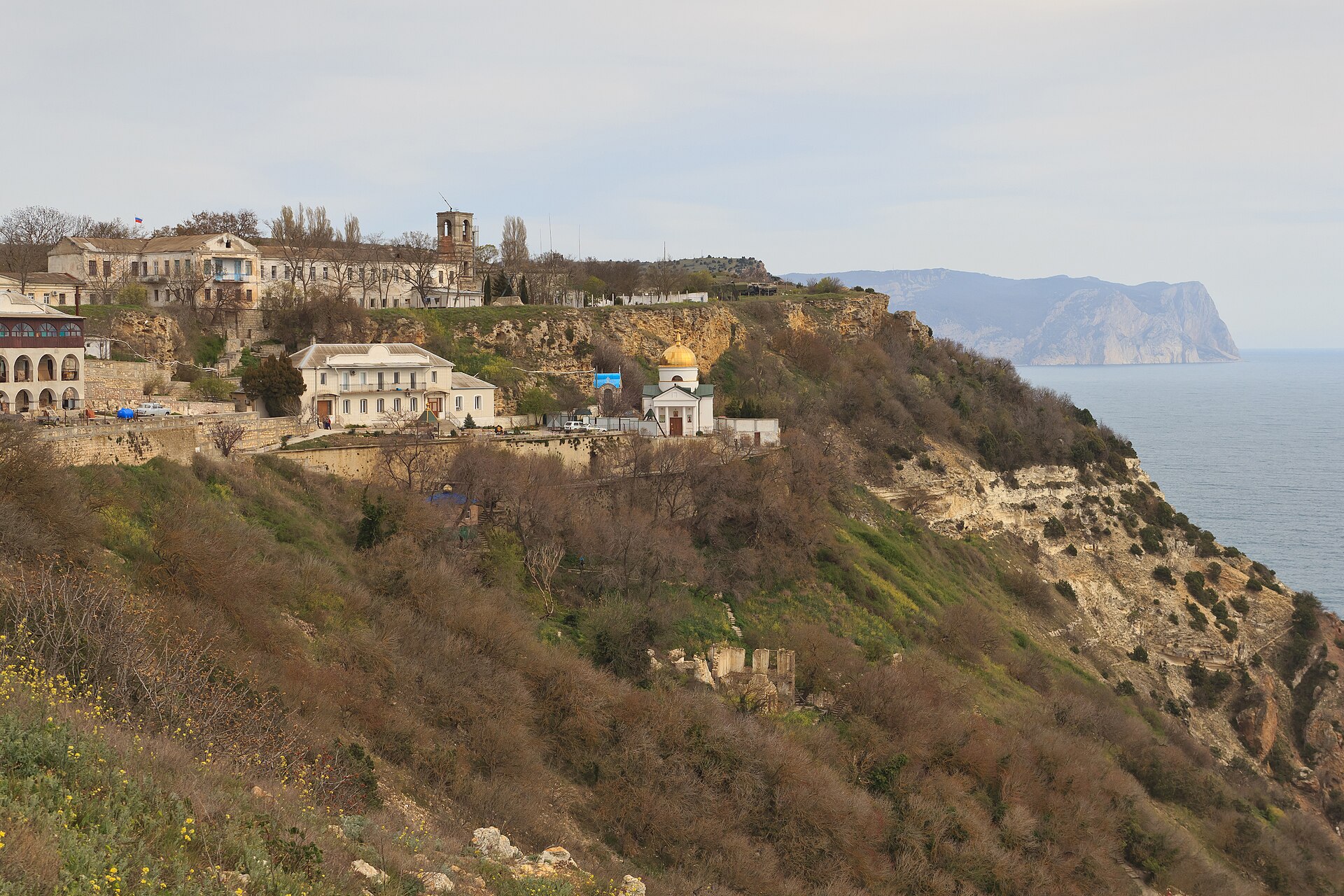
Perched on a rocky outcrop overlooking Balaklava Bay, the Church of St. George the Victorious feels like a place where time moves differently. Its whitewashed walls and red-tiled roof stand out against the deep blue of the sea, while the golden dome catches the sunlight on clear days, sending reflections dancing across the water. The church isn’t grand or imposing—its charm lies in its quiet presence, as if it were built not just for worship but for contemplation, a place where the weight of history and the rhythm of daily life intersect without fanfare.
Balaklava itself has always been a crossroads, a small town with a layered past. Greeks, Genoese traders, Ottoman forces, and Russian settlers all left their mark here, and the church of St. George became another thread in this tapestry. The first records of a church on this site date back to the 19th century, when Balaklava was already known as a quiet harbor where sailors and travelers found respite. That early wooden structure was modest, but even then, it served as a gathering point for the community. Over time, the church was rebuilt in stone, taking on the form it has today. Like many religious sites in the Soviet era, it faced neglect and repurposing, but eventually, it was returned to its original purpose, its doors opening once more to those who sought solace within its walls.
The architecture is simple, almost understated, in keeping with the character of coastal churches. The white stone walls blend seamlessly with the surrounding cliffs, while small windows filter the light, casting a soft glow inside. The interior is equally unadorned: a traditional iconostasis, a handful of old icons, and the flickering light of candles lit by parishioners. At the heart of the church is the icon of St. George, the patron saint of soldiers and travelers—a fitting figure for Balaklava, a town shaped by war and the comings and goings of those who passed through its narrow streets.
Balaklava’s history is one of conflict and resilience. During the Crimean War, the town was the site of fierce battles, and though the church itself wasn’t damaged, it became a place where people prayed for peace. Decades later, in World War II, the town was occupied, yet even in those dark times, some found their way to the church, drawn by the need for quiet reflection. The church has seen generations come and go, its walls bearing silent witness to the joys and sorrows of the community.
Today, the Church of St. George is more than just a place of worship. It’s a landmark that draws visitors who come not only to pray but to experience the sense of continuity it offers. The small garden surrounding the church is a peaceful spot, where benches invite you to sit and listen to the waves below. In summer, the air is filled with the scent of blooming shrubs and saltwater, while the breeze carries the faint sound of boats in the bay. Winter brings a different kind of beauty—the stark contrast of white walls against the gray sky and dark water, the stillness broken only by the occasional cry of a gull.
The church is deeply woven into the fabric of Balaklava’s life. Baptisms, weddings, and services fill its space with the voices of those for whom it holds personal meaning. Locals recall how, during the Soviet years when the church was closed, people would still come in secret, lighting candles or simply standing in silence. Now, there are no such restrictions, but the sense that this place holds memories—of prayers whispered, of hopes shared—remains. It’s why the church feels less like a monument and more like a living part of the town, one that has endured alongside its people.
Balaklava is a place where the sea meets the mountains, where the past lingers in the present. The Church of St. George stands at this intersection, a quiet sentinel between land and water, history and modernity, faith and the everyday. You can visit in any season, in any weather, and each time, it offers something new—not because it changes, but because the way you see it does. It doesn’t demand attention or awe; it simply exists, steady and unassuming, a place where the weight of time feels a little lighter.