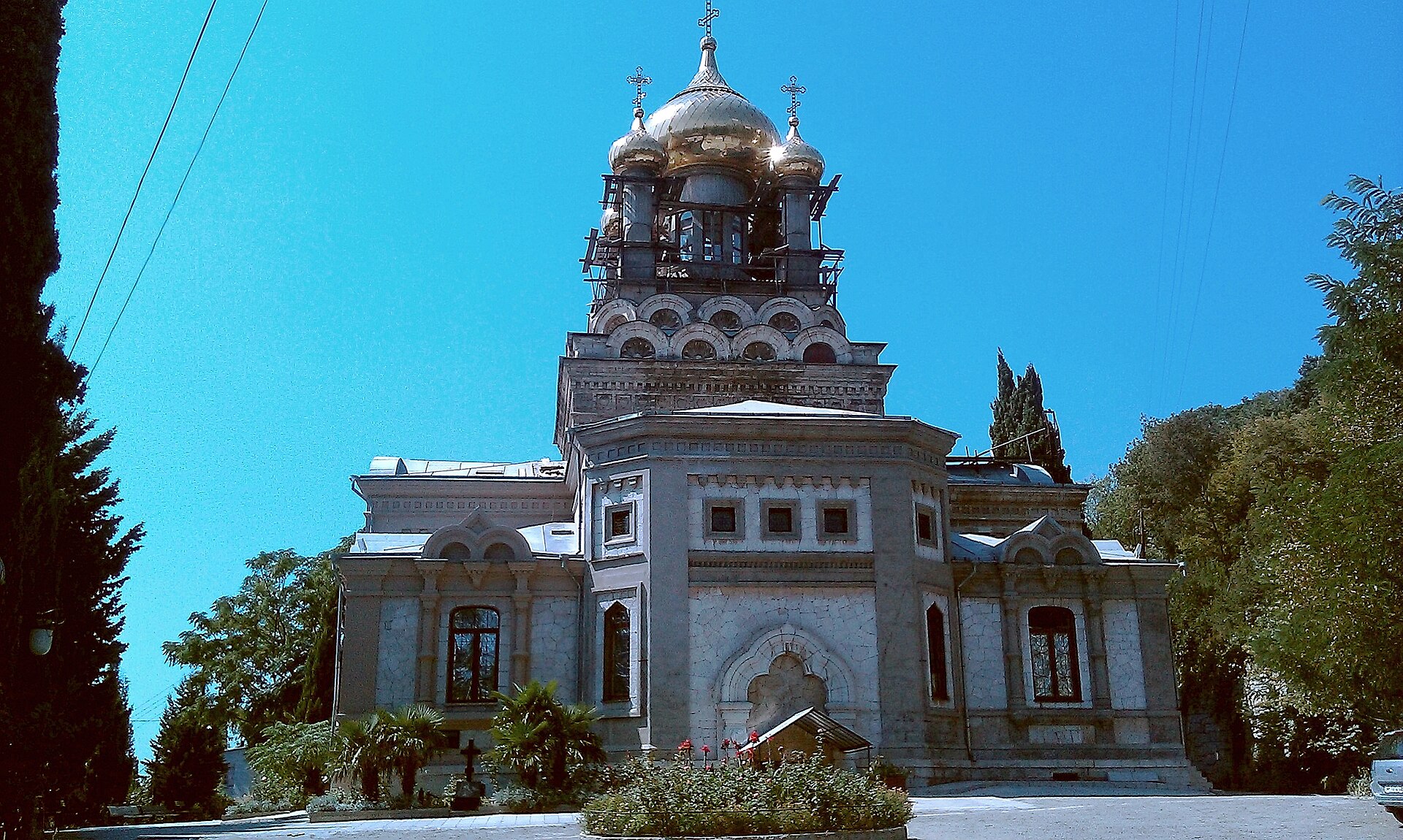
Perched on a gentle hill in Gaspra, the Church of the Holy Archangel Michael feels like a quiet guardian of time. From here, the view stretches across the sea and the surrounding vineyards, as if the landscape itself has settled into a peaceful rhythm. The church is small, its white walls and modest dome standing out against the greenery, while the low bell tower draws the eye from a distance. There’s nothing imposing about it, yet it holds a presence that lingers long after you’ve left.
The story of this place begins in the late 19th century, when Gaspra was a retreat for Russia’s aristocracy, a place where the wealthy came to escape the capital’s bustle and restore their health. The church was built in 1895, funded by local families and supported by the Mordvinovs, a noble family whose estate lay nearby. Its architecture blends Byzantine influences with traditional Russian Orthodox design—rounded arches, a single dome, and an interior adorned with frescoes painted in a style that feels both timeless and unassuming. The church was also meant to commemorate a moment that shook the nation: the miraculous survival of Emperor Alexander III and his family in a train crash in 1888. For many at the time, the event was seen as divine intervention, and the church became a symbol of gratitude.
Inside, the space is simple, almost austere, but that’s where its charm lies. The iconostasis is carved from wood, the icons glow against gold leaf, and the light filtering through narrow windows casts a soft, warm glow. There are no grand chandeliers or marble columns—just quiet dignity. The most revered icon here is that of Archangel Michael, the church’s patron, believed to have been brought from Mount Athos. Over the years, it’s become a focal point for pilgrims, who come seeking solace or a connection to something beyond the everyday.
Like many religious sites in Russia, the church endured hardship during the Soviet era. It was closed, its purpose forgotten, and the building repurposed as a warehouse. The years took their toll, but in the 1990s, the church was returned to the faithful, and a slow, careful restoration began. Today, it’s once again a place of worship, drawing not only locals but also visitors who come to light a candle, sit in silence, or simply take in the atmosphere. Services are held regularly, and on feast days, the church fills with voices raised in prayer, the air thick with the scent of incense.
Gaspra is often seen as just another Crimean resort town, but places like this remind you that its history runs deeper. The Church of the Holy Archangel Michael stands slightly apart from the usual tourist trails, which only adds to its appeal. Around it, a small garden offers a place to sit, listen to the birds, and let your thoughts wander. In summer, roses bloom along the paths, and the air carries the scent of pine and salt from the sea. It’s a spot where time seems to slow down, where the rush of the outside world feels distant.
Winter transforms the church in subtle ways. Snow is rare here, but when it does fall, the white walls blend into the landscape, creating a sense of stillness that feels almost sacred. Even the few visitors who come in the colder months speak in hushed tones, as if reluctant to break the quiet. The church doesn’t demand attention—it doesn’t need to. Its strength lies in its unassuming presence, a silent witness to the passage of time.
For many, this church becomes more than just a landmark. There’s no hustle here, no guided tours or crowds—just the quiet interplay of light and shadow, the faint murmur of prayers, and the sense that you’ve stepped into a place where the past and present coexist. That’s why people return, even after they’ve seen all the usual sights in Crimea. The church doesn’t announce itself loudly, but those who find it understand its quiet power.
Today, the church remains a living part of the community. It’s where children are baptized, couples marry, and the departed are remembered. For locals, it’s woven into the fabric of daily life; for visitors, it offers a glimpse into a Crimea that isn’t just about beaches and resorts, but about history, faith, and the enduring beauty of simplicity. In a world that often feels like it’s moving too fast, places like this endure—unchanged, unhurried, and deeply human.