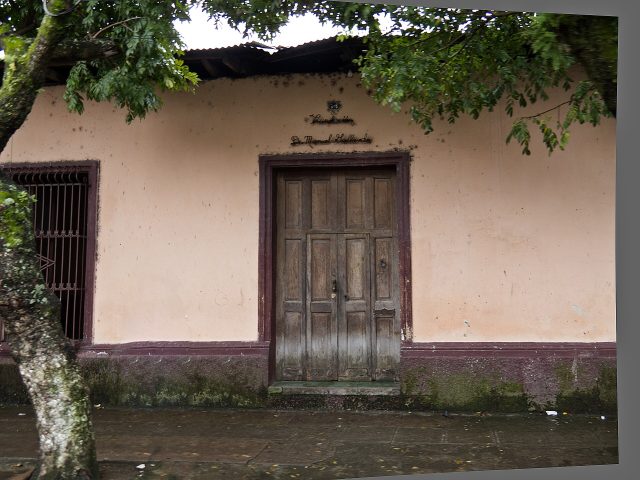
Santa Tecla’s Church of San Salvador doesn’t announce itself. It sits on a gentle rise just off the main streets, its white walls softened by time. The building isn’t grand, nor does it stand out in guidebooks. It’s not a cathedral with spires or a colonial church with gold leaf. Instead, it’s quiet, unassuming.
Santa Tecla has always lived in the shadow of San Salvador, though its history is layered. Founded in the mid-19th century as a short-lived capital of El Salvador, the city retained its sense of purpose. By the early 1900s, when the church was built, Santa Tecla had become a commercial and cultural hub. The church wasn’t meant to be a showpiece—it was built for the community, a place for faith without pretense.
The architecture is straightforward: neoclassical with a Latin American touch. The building is rectangular, with a gabled roof, a small portico, and a single bell tower. The facade is clean, marked by pilasters and a triangular pediment. Inside, high windows let in soft light. There’s no ornate decoration, no frescoes or gilded altars. The simplicity is intentional.
The church’s history is woven into the city’s fabric. The early 20th century was turbulent for El Salvador—political upheavals, economic instability, social unrest. Santa Tecla felt these echoes. The church became a constant, a place for prayer, celebration, or gathering. In 1986, an earthquake damaged it. Repairs were a community effort, done by neighbors who knew one another.
Today, the church isn’t a tourist attraction. It’s part of daily life. People come for services, to sit, to think, or to talk. There are no crowds, no tour groups. The only sounds are leaves rustling, the bell chiming, and quiet voices.
On a weekday, locals light candles, pray, or sit on wooden pews. There’s no formality, no sense of being watched. The atmosphere feels like home. Sometimes, the church hosts small concerts or exhibitions—low-key affairs that don’t disrupt the calm. On holidays like Christmas or Easter, it fills with flowers, families, and hymns, but the mood stays intimate.
This isn’t a place that grabs you immediately. To appreciate it, you have to slow down. Sit on a bench outside, look over the city, listen to the wind in the trees. The church itself is enough.
Santa Tecla moves at its own pace. The Church of San Salvador is part of that rhythm. It doesn’t tell a loud story. What it offers is authenticity—a feeling of being exactly where you’re meant to be. Maybe that’s why people return—not for the sights, but for the quiet that lingers.