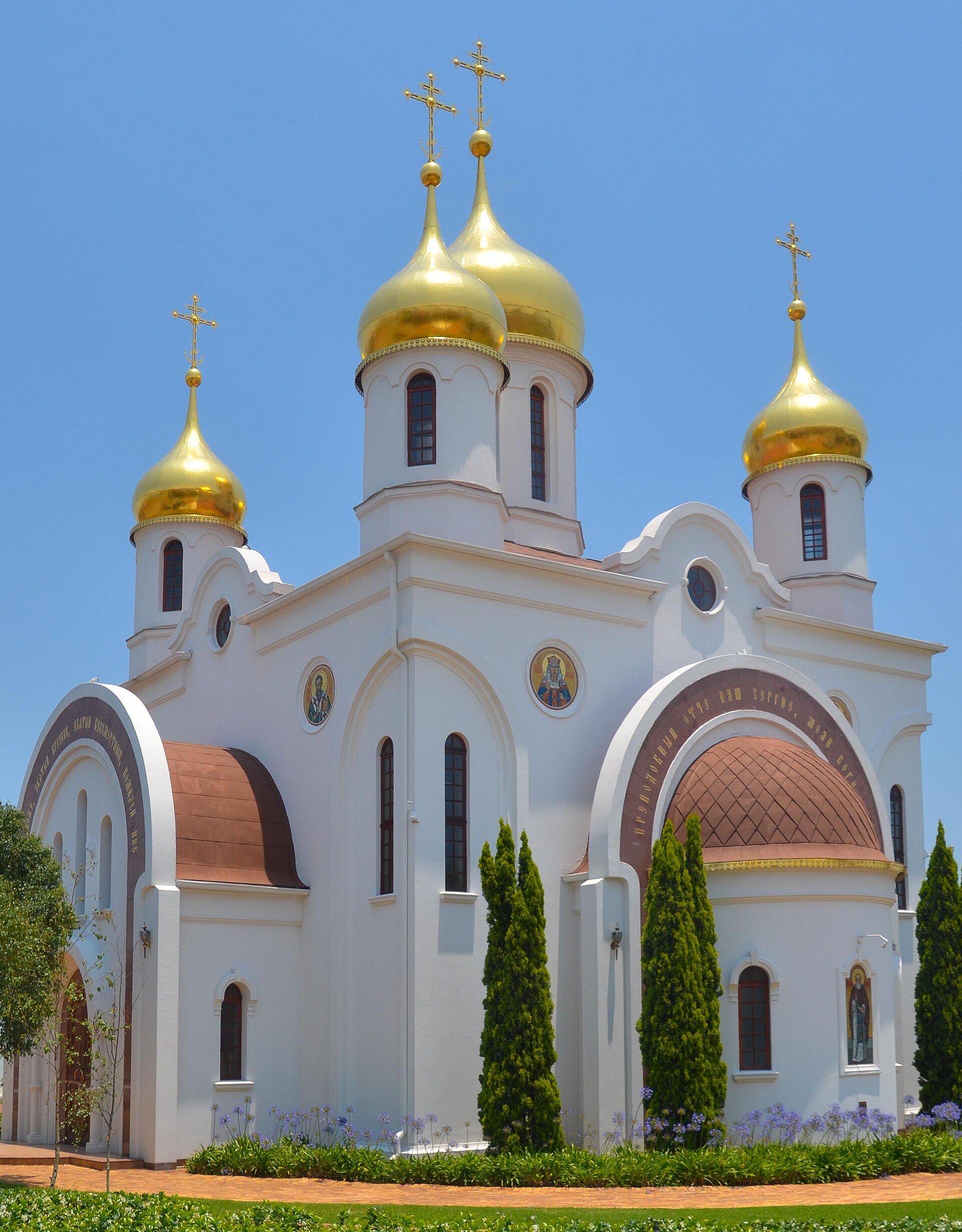
In the heart of Johannesburg, a city known for its bustling streets and modern energy, there stands a quiet reminder of a distant land. The Church of St. Sergius of Radonezh is one of those places that feels unexpected at first glance—an Orthodox Christian sanctuary in a country far from Russia’s borders. Its presence here is tied to the waves of Russian emigration that followed the upheavals of the early 20th century. After the 1917 Revolution, many Russian families scattered across the globe, some finding their way to South Africa. For them, this church became more than a place of worship; it was a connection to home, a way to preserve language, traditions, and a sense of identity in a new and unfamiliar world.
The church is tucked away in Brink’s Estate, a neighborhood where the pace of the city softens. From the outside, it carries the unmistakable features of Russian ecclesiastical architecture—whitewashed walls, golden domes crowned with crosses, and intricate wooden details. The design blends traditional elements with subtle local influences, creating a space that feels both familiar and distinct. Inside, the air is still, the light filtering through stained glass to illuminate the iconostasis. Many of the icons were brought from Russia, while others were painted by local artists who drew from Orthodox traditions. The effect is one of quiet reverence, a contrast to the vibrant life just beyond its doors.
Beyond its religious role, the church serves as a cultural anchor for Johannesburg’s Russian community. Services are held in Church Slavonic, the ancient liturgical language that still resonates with those who grew up hearing it. The church also hosts events that keep Russian heritage alive—concerts of sacred music, exhibitions of iconography, and gatherings where people share stories, news from home, and a sense of belonging. For many, it’s a second home, a place where they can speak their native language, reminisce about the past, or simply find comfort in the company of others who understand their journey.
What makes the church particularly interesting is its openness to those outside the Russian-speaking community. Johannesburg is a city of many cultures, and curiosity about Orthodox traditions has drawn visitors from different backgrounds. Some come to learn, others to listen to the sound of the bells or admire the architecture. The church has become a small but meaningful bridge between worlds, a place where faith and culture intersect in unexpected ways.
The story of the church is closely tied to the broader history of Russian emigration to South Africa. By the mid-20th century, a growing number of Russian families had settled in the country, creating a need for a permanent Orthodox place of worship. Before the church was built, services were held in private homes or temporary spaces. The decision to construct a dedicated building came in the 1950s, and it was consecrated in honor of St. Sergius of Radonezh, one of Russia’s most revered saints. The choice of patron saint underscored the church’s role as a spiritual and cultural center for the community.
Today, the church remains a living link to the past for those who value their Russian heritage. Its congregation spans generations—older emigrants who remember pre-revolutionary Russia, their children and grandchildren born in South Africa, and newer arrivals who have come in recent decades. For each of them, the church is more than a building; it’s a repository of memory, a place where traditions are passed down, and a reminder that cultural roots matter, no matter how far one travels.
Visiting the church offers a moment of stillness in a fast-moving city. Inside, the quiet is broken only by the murmur of prayers and the soft singing of the choir. The light through the windows casts a gentle glow on the icons, creating an atmosphere of peace. Even for those unfamiliar with Orthodox Christianity, there’s a sense of something deeper at work here—a connection across time and distance, a quiet testament to the enduring power of faith and culture.
In a city as diverse as Johannesburg, where dozens of nationalities and traditions coexist, the Church of St. Sergius of Radonezh stands as a small but significant symbol. It’s a reminder that no matter where life takes us, the places and traditions we carry with us shape who we are. For the Russian community, it’s a piece of home. For others, it’s a window into a world they might not otherwise encounter. And for all who visit, it offers a moment of reflection on the ways culture and faith can transcend borders.