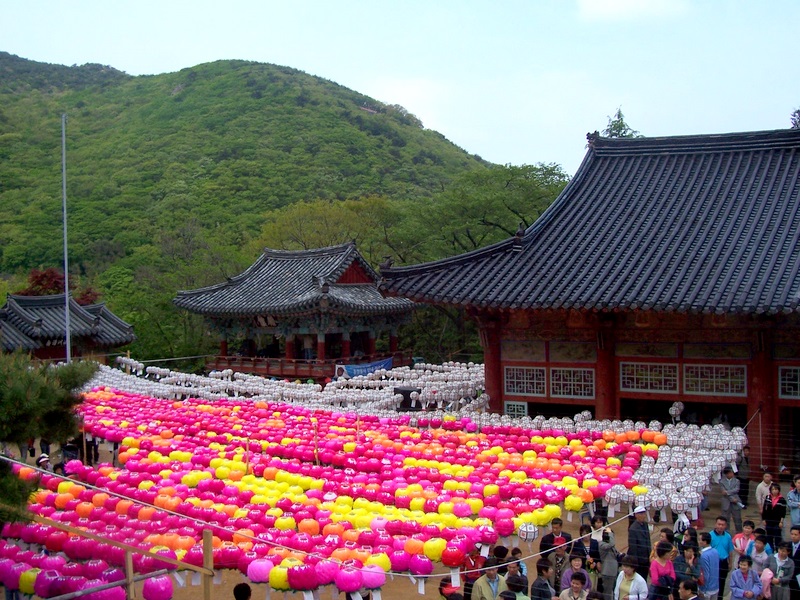
Perched on the slopes of Geumjeongsan, a mountain that rises like a quiet guardian over Busan, Pomosa Temple has watched over the city for centuries. Its story begins in the seventh century, when the kingdom of Silla was still young and Buddhism was taking root in Korea. Over the years, wars swept through, dynasties rose and fell, and fires reduced parts of the temple to ashes, yet it endured. Today, it remains a place of worship, a sanctuary for those seeking stillness, and a living piece of history that refuses to fade into the past.
The architecture here is a quiet conversation between tradition and faith. The main gate, painted in bold yet weathered hues, opens onto a path that winds past pavilions with gently sloping roofs. Inside, the air is cool and dim, the scent of aged wood mingling with the faint aroma of incense. The most striking structure is the Daeungjeon Hall, one of the largest wooden temple buildings in the country. Its massive pillars and dark beams seem to hold up not just the roof, but the weight of centuries. When sunlight filters through the paper-covered windows, it softens the edges of the ancient murals and statues, as if time itself is breathing.
At the heart of Pomosa lies one of Korea’s most revered Buddhist relics—a fragment of the Buddha’s remains, enshrined in a small pagoda in the temple courtyard. Pilgrims from across the country come to pay their respects, their footsteps muffled by the gravel paths. Around the pagoda, stone lanterns stand like silent sentinels, their surfaces worn smooth by time. Nearby, old pine trees twist and bend, their gnarled branches echoing the contours of the mountains behind them. The garden here feels like a place where nature and devotion have grown together, each shaping the other over the years.
The seasons leave their mark on Pomosa in subtle ways. In spring, azaleas and cherry blossoms burst into color, their petals drifting onto the temple grounds like confetti. Summer brings a thick canopy of green, the leaves so dense they obscure the narrow paths that lead to hidden viewpoints. When autumn arrives, the trees blaze with red and gold, their reflections shimmering in the temple’s ponds. Winter is the quietest time, when snow dusts the rooftops and the only sounds are the distant call of a bell and the crunch of footsteps on frozen earth. Each season offers a different kind of peace, as if the temple itself is breathing in rhythm with the world around it.
For many in Busan, Pomosa is more than a place of worship. It’s a refuge from the city’s relentless pace, a place to walk without hurry, to sit on a wooden bench and listen to the wind in the trees. Locals come here to escape the noise of daily life, to find a moment of clarity in the mountain air. Some bring their children, who run along the paths or peer curiously at the statues. Others come alone, seeking nothing more than the quiet company of the temple’s ancient stones.
Pomosa is deeply woven into the cultural fabric of Busan. During major Buddhist festivals, like Buddha’s Birthday, the temple transforms. Thousands of paper lanterns are hung along the paths, their soft glow turning the grounds into a sea of light. Monks lead processions, their chants rising into the night air, while visitors and devotees walk together in quiet reverence. On ordinary days, the temple hums with a different kind of life—monks meditate in the halls, novices study ancient texts, and visitors wander, pausing now and then to watch a ritual or simply to sit in silence.
Reaching Pomosa is part of the experience. From central Busan, a bus winds its way up the mountain, the road twisting through forests and past rocky outcrops. Along the way, glimpses of the city and the sea appear and disappear, like scenes from a slowly unfolding scroll. By the time the bus reaches the temple gates, the noise of the city feels distant, almost unreal. There are no crowds here, no jostling for space—just the quiet rustle of leaves and the occasional murmur of voices.
Once inside, time seems to stretch. Some visitors stay for an hour, wandering the paths before heading back down the mountain. Others linger longer, drawn in by the temple’s unhurried rhythm. In the small tea house, traditional Korean tea is served in simple ceramic cups, the warmth of the drink seeping into tired hands. Occasionally, a monk might give a talk on Buddhist teachings, the words measured and calm, as if each one has been weighed before being spoken. For those who wish to stay overnight, guest rooms are available—plain but clean, with thin futons and paper screens. The mornings here are especially peaceful, the air filled with the sound of a distant bell and the songs of birds.
What makes Pomosa special is the way it holds so many things at once. It is a place of history, where the past is not just remembered but lived. It is a place of nature, where the mountains and trees feel as much a part of the temple as the buildings themselves. And it is a place of quiet devotion, where the rituals of daily life—whether a monk sweeping the courtyard or a visitor lighting incense—carry a weight of meaning. There is no rush here, no need to fill the silence. The temple has stood for over a thousand years, and it will stand for a thousand more. For those who come, it offers something rare: the chance to step outside of time, if only for a little while.