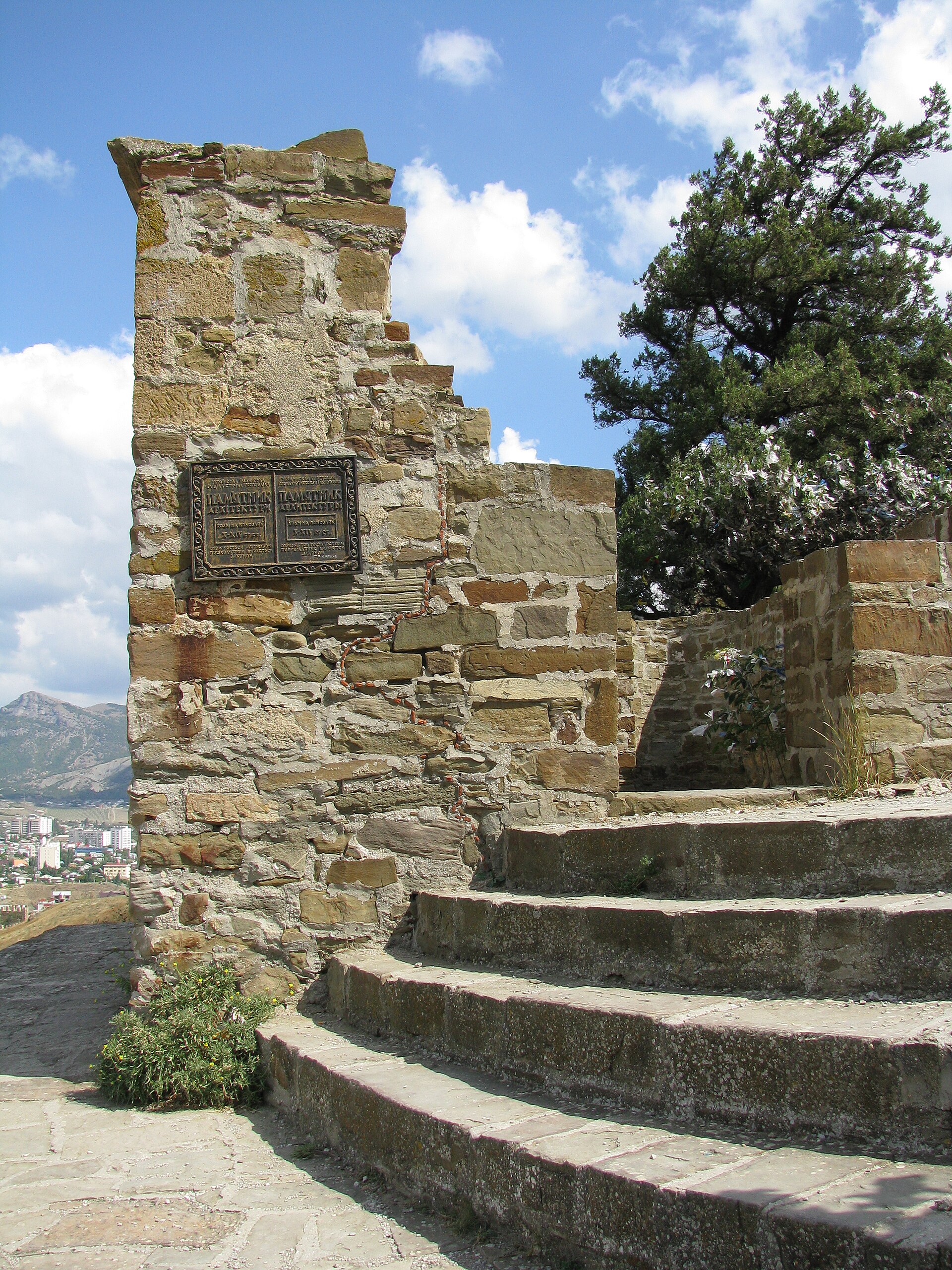
Perched on the rocky slopes of Sudak’s Fortress Mountain, the Cliffside Chapel feels like a fragment of the past suspended in time. It’s easy to miss at first glance, tucked away among the limestone outcrops as if deliberately hidden from casual eyes. Those who make the climb to the Genoese Fortress might walk right past it, unaware of the small medieval sanctuary carved directly into the stone. Its unassuming size and weathered appearance belie a history that stretches back to the Byzantine era, when this stretch of the Crimean coast was a crossroads of empires and faiths.
The chapel’s architecture is striking in its simplicity. A single modest chamber with a semicircular apse, it clings to the cliffside several meters above the ground. Centuries ago, access would have been possible only by a wooden ladder or even a rope bridge, making it nearly impregnable. Today, no trace of those structures remains, but the very idea of its isolation speaks volumes. It likely served not just as a place of worship but as a refuge during times of danger. Inside, faint traces of frescoes still cling to the walls, though time and damp have worn them almost beyond recognition. Only fragments remain—ghostly outlines of figures that hint at the chapel’s former beauty.
The exact origins of the chapel are still debated among historians. Some place its construction in the 6th or 7th century, when Byzantine influence in Crimea was at its height. Others argue for a later date, between the 9th and 10th centuries, when the region was under Khazar control. There’s even a theory that it was built by the Genoese in the 14th or 15th century, when Sudak flourished as a Black Sea trading hub. The proximity to the Genoese Fortress lends some weight to this idea, though the chapel’s style aligns more closely with early Byzantine traditions. Whatever its true age, it stands as one of the oldest Christian sites in Crimea, a silent witness to centuries of conquest and change.
Local legends have long shrouded the chapel in mystery. One tale claims that a saint, whose name has been lost to history, once took refuge in the very rock where the chapel now sits, evading pursuers who sought his life. Another suggests that monks hid here during raids by nomadic tribes, using the chapel as a final sanctuary. The place does feel charged with history—an eerie quiet broken only by the wind and the cries of gulls circling overhead. From this height, the view stretches across Sudak Bay, where the sea meets the sky in a haze of blue, and the distant mountains frame the horizon. It’s easy to imagine medieval worshippers here, seeking solace or protection in this remote sanctuary.
Today, the Cliffside Chapel is part of a broader historical landscape that includes the Genoese Fortress, one of Sudak’s most iconic landmarks. Built in the 14th century by Italian merchants, the fortress was a vital stronghold for trade between Europe and the East. Its massive walls, towers, and gates still dominate the skyline, offering a glimpse into a time when Sudak was a bustling port city. The chapel complements this setting perfectly, adding another layer of intrigue to the site. Together, they create a sense of stepping back in time, where every stone tells a story.
Reaching the chapel requires some effort. The only way up is on foot, following a steep path that winds along the cliffs. The climb isn’t easy, especially under the summer sun, but the reward is worth it. At the top, the view alone is breathtaking—a sweeping panorama of the bay and surrounding hills that makes the journey feel almost effortless. Inside the chapel, the air is cool and damp, so even in warm weather, a light jacket is a good idea. Photography is allowed, but without flash, to preserve the fragile remnants of the frescoes.
What makes the Cliffside Chapel special is its sense of untouched history. Unlike many restored monuments, this one remains largely as it was centuries ago, its rough-hewn walls and faded paintings bearing the marks of time. It’s not grand or ornate, but that’s part of its charm. There are no crowds here, no tourist chatter—just the sound of the wind, the distant murmur of the sea, and the occasional footsteps of visitors. It’s a place where the past feels tangible, where you can almost hear the echoes of prayers offered long ago.
For those drawn to Crimea’s layered history, the chapel is a rare find. It offers a direct connection to eras that feel distant and almost mythical—the Byzantine Empire, the Khazar Khaganate, the Genoese merchants who once ruled these shores. Each of these cultures left its mark here, and the chapel stands as a quiet testament to their presence. Yet it’s more than just a relic. Locals still visit, not just as tourists but to pay their respects or simply to find a moment of peace. In that way, the chapel remains alive, a bridge between the past and the present. It doesn’t just tell a story—it lets you feel it.