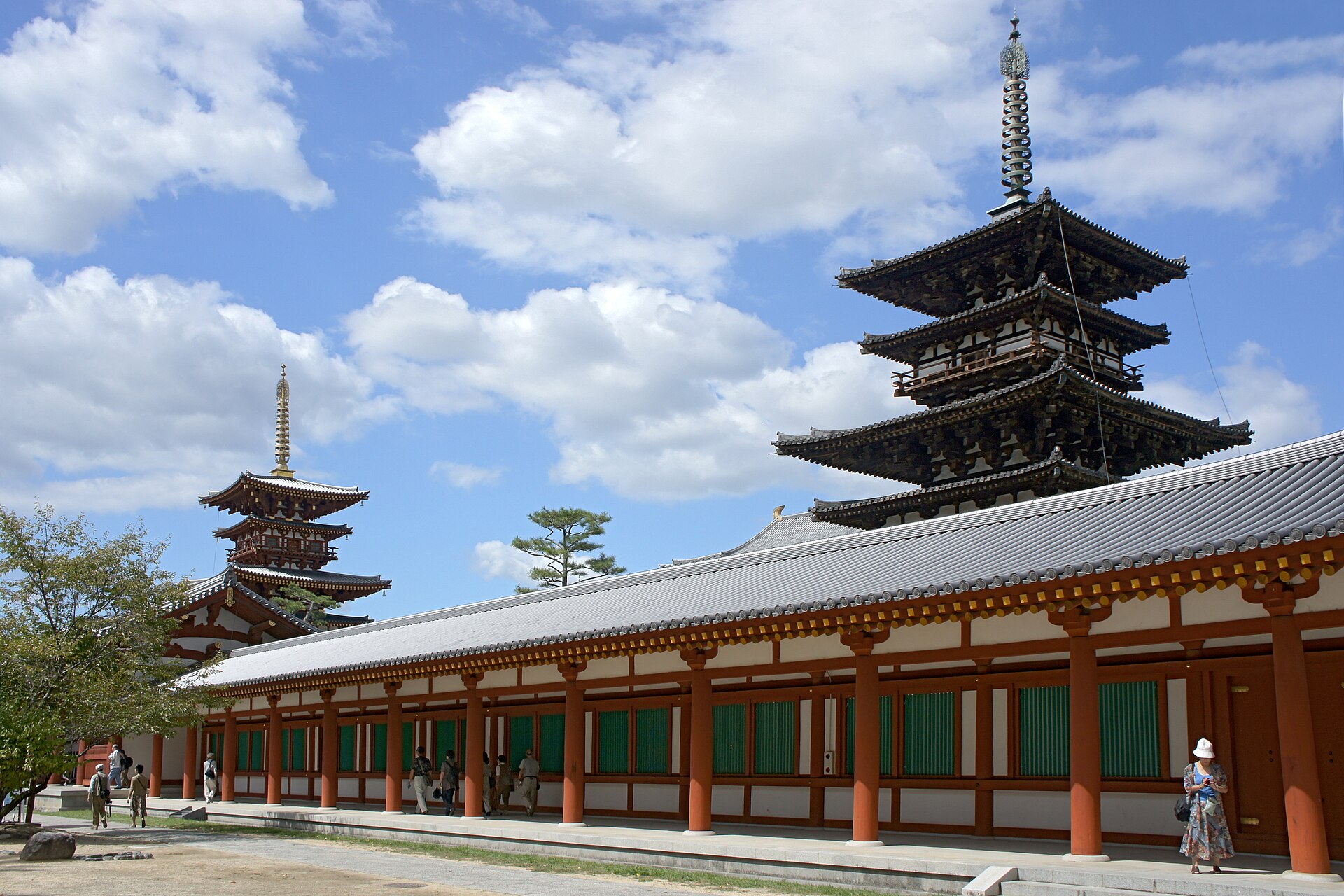
Yakushi-ji is where the weight of centuries settles on your shoulders. Founded in the late 7th century by Emperor Temmu, it was built to aid the recovery of his gravely ill wife, Empress Jito. The temple takes its name from Yakushi Nyorai, the Buddha of healing, and legend claims its very existence helped restore the empress to health. Fires and time have destroyed much of the original structures, but what remains carries the quiet dignity of its past. Today, it stands as one of the Seven Great Temples of the southern capital and a cornerstone of Japanese Buddhism’s Hosso sect.
The temple’s architecture balances symmetry without demanding attention. The main gate, Niomon, is flanked by two guardian statues, their expressions stern yet protective. Beyond the gate, an open courtyard unfolds, dominated by the Eastern Pagoda, the only surviving structure from the 8th century. Its three tiers rise gracefully, each level slightly smaller than the last, creating an illusion of lightness. Beside it stands the Western Pagoda, reconstructed in the 20th century but faithful to the original design. One is ancient, the other renewed—yet both feel timeless.
At the heart of the complex is the Kondo, the main hall, where the temple’s most revered treasures reside. The central figure is a gilded bronze statue of Yakushi Nyorai, flanked by two bodhisattvas, Nikko and Gakko. Carved in the 8th century, these sculptures are masterpieces of Japanese Buddhist art. The hall is dimly lit, the flickering glow of candles casting long shadows across the wooden beams. The air feels heavier with devotion.
Have you ever stood in a place where time seems to pause?
The lecture hall, or Kodo, once a place where monks studied sacred texts, now houses rare Buddhist scrolls and statues. The wooden floors creak underfoot, and the scent of aged timber lingers. Unlike crowded tourist spots elsewhere in Nara, Yakushi-ji retains solitude, even when visitors fill its courtyards. The temple has witnessed too much history to be hurried.
The temple grounds include a small garden. Moss-covered stones and carefully placed trees create the illusion of a larger space. Throughout the year, the garden changes—plum blossoms in spring, azaleas in summer, maples in autumn. There’s no grand spectacle, just an invitation to pause.
Yakushi-ji is tied to Nara’s history as Japan’s first permanent capital in the 8th century. The city, then called Heijo-kyo, was a center of politics and culture. The temple was part of an imperial effort to establish Buddhism as a unifying force. Walking through the complex, you can imagine the grand ceremonies, the pilgrims who traveled from afar, and the chants that filled the air.
Despite its age, Yakushi-ji remains a living place of worship. Services dedicated to Yakushi Nyorai are held regularly, and visitors come seeking blessings for health and healing. During festivals like New Year or Buddha’s Birthday, pilgrims fill the grounds with prayers and incense. Monks sweep the courtyards, tend the garden, or recite sutras. This is more than a historical site—it’s an active spiritual center.
For many, Yakushi-ji is a quiet revelation. Unlike Todai-ji or Nara Park, it doesn’t draw crowds. There’s no rush, no jostling for photos. You can wander the grounds, trace the lines of the pagodas, or sit on a bench, letting the silence settle around you. Time moves differently here, with the steady rhythm of something that has endured.