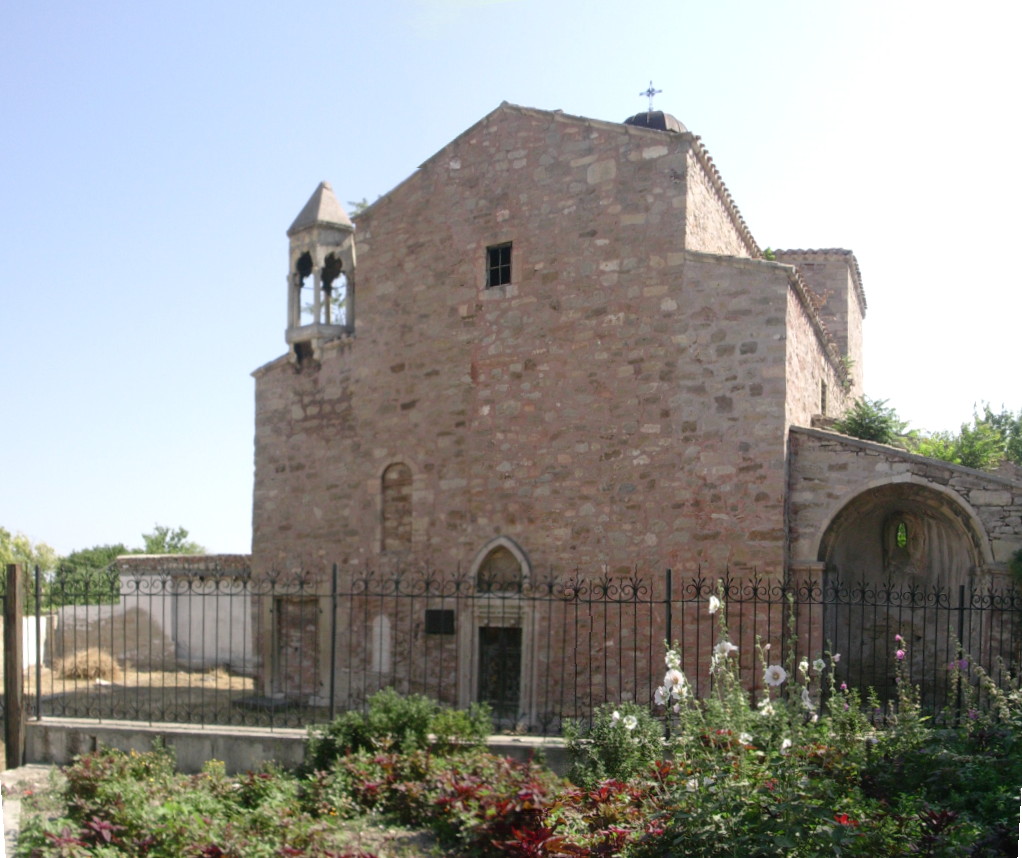
Feodosia is a city where time seems to fold in on itself, layers of history settling quietly into its streets and seashores. Among its many unassuming corners, the Church of the Archangels Michael and Gabriel stands as a quiet witness to centuries of change. Long before the current building took shape, this spot was home to an earlier Greek church, a remnant of the days when Feodosia was known as Caffa, a bustling Genoese port where trade, faith, and the sea shaped daily life. The city has always been a crossroads, and this church, in its many forms, has been part of its spiritual heartbeat.
The present structure dates to the 19th century, a time when Crimea had become part of the Russian Empire and Feodosia was evolving into a retreat for artists, writers, and those seeking the warmth of the southern coast. The architecture reflects this transition, blending the clean lines of neoclassicism with the familiar forms of Orthodox tradition. There’s a restraint to the design—whitewashed walls, uncluttered facades, and a simplicity that feels deliberate. It doesn’t demand attention like the grand cathedrals of Moscow or St. Petersburg, but there’s a quiet dignity in its presence, a sense of place that feels rooted rather than imposed.
Inside, the church holds fragments of its past in the form of icons and frescoes, each telling a story of devotion across generations. The iconostasis, dark wood gilded with gold, anchors the space, its weight contrasting with the lighter, almost ethereal murals on the walls. There’s no opulence here, no attempt to overwhelm with grandeur. Instead, the atmosphere is one of intimacy, shaped by the hands of those who have prayed, lit candles, and sought solace within these walls. Even during the most turbulent periods of the 20th century, when churches across the Soviet Union were closed or repurposed, this one remained open, a rare continuity in a time of upheaval.
Feodosia is a city where history lingers in the air, and the Church of the Archangels Michael and Gabriel is one of those places where it feels especially close. Unlike the crowded tourist spots of Yalta or Sevastopol, this church exists without fanfare. There are no guided tours, no souvenir stalls, just an open gate leading to a small courtyard where old trees sway in the breeze and the distant murmur of the sea is never far away. It’s a place to pause, to step out of time for a moment, whether you come to pray, to reflect, or simply to sit in the quiet.
The church has always been woven into the fabric of the city. In the Soviet era, when religious life was suppressed, it managed to endure, though its role was diminished. Locals remember how, during the hardships of war and repression, it became a refuge for those in need of hope. After the collapse of the USSR, services resumed in full, and today it remains an active part of Feodosia’s spiritual life. People come for different reasons—some for worship, others to connect with the past, to imagine the lives of those who stood here before them, or just to find a moment of stillness in a world that moves too quickly.
The architecture, though modest, has a harmony that feels intentional. The bell tower, added later, blends seamlessly with the original structure, and the small courtyard with its flowerbeds and benches adds to the sense of welcome. In summer, the thick walls keep the interior cool, while in winter, the warmth of candles and the murmur of prayers fill the space. There’s no imposing fence, no security—just a low wall separating the church from the street, which leads down toward the sea. It feels like a place that belongs to the city, not set apart from it.
Feodosia has long been a haven for artists, and this church has likely been a source of inspiration for many. Ivan Aivazovsky, the renowned marine painter, lived nearby, and it’s easy to imagine him walking these streets, perhaps stopping here before returning to his studio. The light in his paintings—soft, luminous, almost spiritual—might well have been shaped by moments spent in places like this, where the glow of the sun through narrow windows turns the ordinary into something transcendent.
Today, the church remains open to all who wish to visit. There are no grand ceremonies, no crowds, just the quiet rhythm of daily life. It’s not a place for spectacle, but for those who seek it, it offers something far more valuable: a connection to the past, a moment of peace, and the sense that history isn’t just something to be observed—it’s something that continues, quietly, in the lives of those who pass through its doors. In a city full of stories, this church is one of the most enduring.