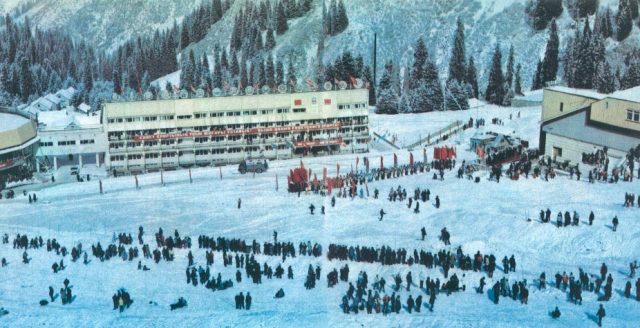
Perched in the folds of the Zailiysky Alatau mountains, Medeu is where the thin air of the highlands meets the precision of sport. At nearly fifteen hundred meters above sea level, the complex sits in a natural amphitheater of rock and ice, a place where the past and present of Kazakh winter sports intersect. The air here carries a crispness even in summer, while winter transforms the valley into a vast, shimmering stage framed by snow-dusted peaks. It’s a setting that feels both intimate and grand—whether you’re lacing up skates for the first time or watching athletes push the limits of speed.
The story of Medeo began in the mid-20th century, when Soviet engineers and athletes sought to create the perfect venue for speed skating. High-altitude training was seen as a key advantage in winter sports, and Kazakhstan’s unique climate—cold, stable, and sheltered from wind—made it an ideal location. Construction started in 1949, and within a few years, Medeo had earned its reputation as one of the fastest ice rinks in the world. The natural conditions—low temperatures, high pressure, and minimal wind—allowed skaters to glide effortlessly, setting records that stood for decades. By the 1970s, the rink was upgraded with artificial ice, ensuring year-round use and cementing its place as a global hub for the sport.
The architecture of Medeo is unassuming but purposeful. The centerpiece is the vast oval of the rink, encircled by stands that can hold thousands of spectators. Above them looms a massive concrete canopy, designed to shield the ice from sun and snow. The surrounding buildings—locker rooms, offices, a handful of cafes—are functional rather than ornate, blending into the rugged landscape. The real drama lies in the approach: winding up the mountain road, the complex suddenly comes into view, suspended above the valley like a frozen mirage, with jagged peaks rising behind it.
Medeo isn’t just a sports venue; it’s a living archive of Kazakh athletic achievement. Over the decades, it has hosted world and European championships, the Winter Asian Games, and countless other competitions. During the Soviet era, more than a hundred world records were set here, a legacy that still lingers in the smooth, fast ice. For Kazakh athletes, skating at Medeo is more than a competition—it’s a rite of passage, a chance to step into a lineage of champions. But the rink isn’t reserved for professionals alone. In winter, it draws casual skaters, families, and tourists, while summer turns the complex into a quiet retreat for walks and photography.
The atmosphere shifts with the seasons. Winter brings a buzz of activity—announcements crackling over loudspeakers, the scrape of blades on ice, the roar of crowds during races. The stands fill and empty in waves, mirroring the rhythm of the competitions. Come summer, the rink falls silent, and the focus shifts to the mountains. The slopes turn lush and green, the air thick with the scent of pine and alpine herbs. Visitors stroll along the paths, pausing to take in the view of Almaty sprawled below, or to snap photos against the backdrop of snow-capped peaks. On clear days, the city feels close enough to touch, yet worlds away from the high-altitude stillness.
For locals, Medeo is more than a landmark—it’s a piece of collective memory. Many Almaty residents remember childhood trips here, whether to watch competitions on TV or to visit in person. In Soviet times, it was a pilgrimage site for sports fans, and today it remains a place that bridges generations. You might see retired athletes reminiscing near the rink, young skaters training for their next race, or tourists soaking in the history. In recent years, the complex has expanded its role, hosting concerts and festivals that draw new crowds, adding layers to its identity.
Getting to Medeu is straightforward. A paved road winds up from Almaty, offering glimpses of the mountains at every turn. You can drive, take a bus, or in winter, ride the cable car that connects the city to the complex. Entry to the grounds is usually free, though tickets may be required for skating or events. Around the rink, a few viewpoints offer sweeping panoramas, and small cafes serve hot drinks to ward off the chill. The journey itself is part of the experience—the higher you climb, the more the city recedes, replaced by the quiet grandeur of the mountains.
Medeu is where sport, nature, and history converge. It’s a place to skate, to watch world-class athletes, or simply to stand in the shadow of the peaks and breathe in the thin, cold air. The energy here is subtle but unmistakable, a current that runs through the ice and the rocks, through the stories of those who’ve trained and competed here. Whether you visit in winter or summer, the complex has a way of making you feel both insignificant and connected—small against the vastness of the mountains, yet part of something enduring. It’s the kind of place that stays with you long after you’ve left.