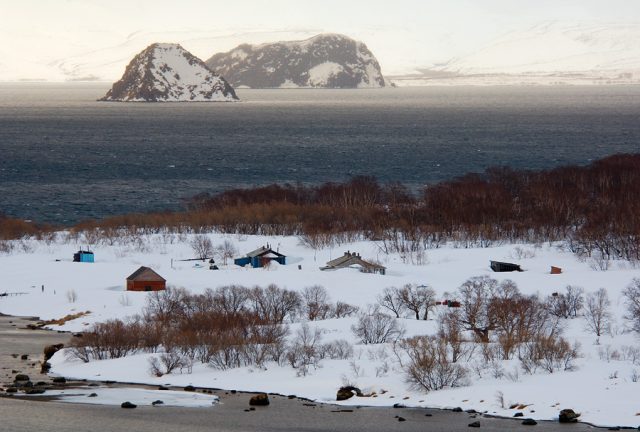
Avacha Volcano rises just beyond the edge of Petropavlovsk-Kamchatsky, its broad, snow-dusted cone visible on clear days from nearly anywhere in the city. Alongside its neighbor, Koryaksky Volcano, it forms a familiar silhouette against the horizon—so familiar that locals call them the home volcanoes. At 2,741 meters, Avacha is one of Kamchatka’s most accessible active volcanoes, though its quiet demeanor can be deceptive. The last major eruption in 1991 filled the crater with lava, which cooled into a solid plug, sealing in the heat beneath. Steam still rises from fumaroles, a reminder that the mountain is very much alive.
The climb itself is straightforward by Kamchatka’s rugged standards, but it demands patience. From the base camp at the pass, the route covers about 1,500 meters of elevation gain, winding through loose volcanic scree and shifting ash. The loose footing makes every step a small battle, especially on the descent, when gravity seems to pull harder. Most hikers take eight to ten hours round trip, starting before dawn to avoid the unpredictable afternoon weather. Sturdy boots are essential, as is a tolerance for the kind of exertion that leaves your legs heavy by the end of the day.
The trail begins where the road ends, at a dry riverbed where only off-road vehicles can pass. From there, it’s a steady march upward, past patches of hardy alpine vegetation that cling to the slopes. The higher you go, the more the landscape opens up, revealing the vastness of the Kamchatka Peninsula. By the time you reach the crater rim, the view is worth every slip and stumble: the ocean glints in the distance, Koryaksky looms nearby, and below, the crater itself is a stark, otherworldly bowl of hardened lava. The air smells faintly of sulfur, and wisps of steam escape from cracks in the rock, a quiet sign of the forces still at work beneath the surface.
Weather is the great wildcard here. Kamchatka’s climate is famously mercurial, with clear skies giving way to fog or rain in a matter of hours. Even in summer, temperatures at the summit can drop sharply, and wind can make the final approach feel far more exposed than it looks. Most groups plan for extra days in their itinerary, knowing that conditions might delay the climb. Those who do reach the top often linger, soaking in the silence and the scale of the landscape. There’s a sense of standing on the edge of something vast and untamed, a place where the earth’s raw power is still very much on display.
The logistics of the climb are simple but non-negotiable. All ascents must be registered with the local rescue service—a rule that’s strictly enforced, not just a formality. Water is only available at the start of the trail, so hikers carry their own supplies. The season is short, running from July to September, when the snow has melted enough to make the route passable. Even then, the mountain can be unforgiving. Those who attempt it usually spend the night before at the base camp, waking well before sunrise to begin the climb in the cool, still hours of early morning.
At the foot of the volcano, the landscape feels almost gentle by comparison. Small ground squirrels, known locally as evrazhki, dart between the rocks, their curiosity often outweighing their caution. Visitors are warned not to feed them, though it’s tempting—they’re one of the few signs of life in an otherwise stark environment. The contrast between the playful animals and the imposing bulk of the volcano is striking, a reminder of how life persists even in the shadow of such a powerful natural force.
For all its challenges, Avacha is a climb that stays with you. It’s not just the physical effort or the views, though both are memorable. There’s something about the way the mountain reveals itself slowly, layer by layer, that makes the experience feel earned. The loose scree, the shifting winds, the way the light changes as you ascend—it all adds up to a sense of being in a place that’s still very much in the process of becoming. And when you finally stand at the crater’s edge, looking out over the vastness of Kamchatka, it’s hard not to feel a quiet awe at the sheer scale of it all.