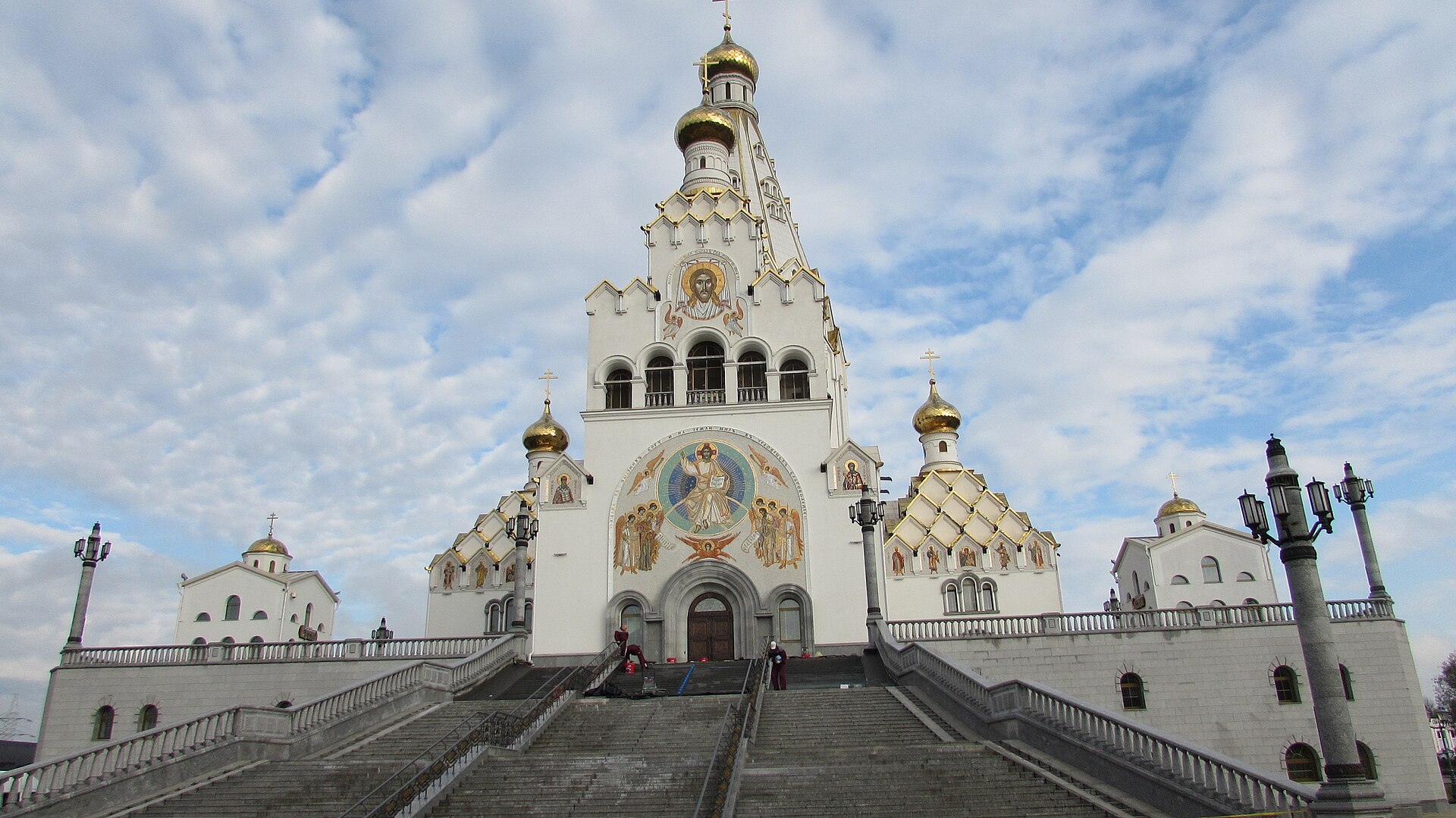
All Saints Church in Minsk is one of those quiet places where the city’s past lingers in the air. Built in the early 20th century, it stands where the edges of old Minsk once blurred into the countryside—an area that has since become part of the capital’s bustling core. Unlike the grand cathedrals that dominate tourist itineraries, this church is unassuming, its significance lying not in scale but in its quiet persistence. It has watched the city transform around it, a silent witness to the shifts of time.
The architecture blends elements of the Neo-Russian style with early modernist influences, a combination typical of religious buildings from that era. The warm red brick gives the structure an almost domestic feel, while arched windows and decorative kokoshnik gables nod to traditional Russian church design. Inside, the simplicity continues—no gilded altars or elaborate frescoes, just a sense of calm that settles over visitors as soon as they step through the doors. The space feels intimate, as if designed for reflection rather than spectacle.
Consecrated in 1914, just before the outbreak of World War I, the church has endured its share of upheavals. During the Soviet era, it was closed like so many others, yet it survived when others were demolished or repurposed. In the 1990s, it was returned to the faithful, and today it functions as an active parish, hosting services, baptisms, and weddings. The rhythm of religious life here is unhurried, a contrast to the city’s constant motion just beyond its walls.
The church hasn’t always looked as it does now. In the mid-20th century, renovations altered its original appearance—some decorative details were lost, and the bell tower, once a prominent feature, was removed. Recent efforts have sought to restore elements of its historic design, though the process is careful, guided by archival records to preserve the building’s original harmony. The work is ongoing, a slow return to what once was.
For locals, All Saints Church is more than a place of worship; it’s a fragment of old Minsk. The surrounding neighborhood still holds traces of the past—wooden houses that once defined the city’s skyline, now dwarfed by modern apartment blocks. Walking these streets, it’s easy to imagine the Minsk of a century ago, before subways and high-rises, when life moved at the pace of horse-drawn carriages and church bells.
Perched on a slight elevation, the church offers a view of the city’s layers. On clear days, the contrast is striking: historic buildings stand alongside new construction, while old streets have been widened into busy thoroughfares. Yet the church remains unchanged, a steady presence amid the flux. That sense of continuity draws not only the faithful but also those seeking a moment of quiet, a connection to something enduring.
Inside, the atmosphere is one of understated reverence. Wooden pews, simple icons, and soft light filtering through stained glass create a space that feels both sacred and personal. Services here are subdued, free of grandeur, as if the church’s purpose is less about spectacle and more about offering a pause—a chance to breathe, to think, to step away from the noise outside.
All Saints Church isn’t a major tourist attraction, and that’s part of its appeal. There are no crowds, no lines, just the quiet of an ordinary parish. It’s a place for slow walks, for contemplation, or simply for sitting on a bench in the courtyard, watching the play of light on the old brick walls. In a city of constant change, it offers something rare: stillness.
Minsk is a city of contrasts, where the past and present exist side by side, and All Saints Church is one of the few places where that tension feels tangible. It stands as a reminder that history doesn’t vanish, even when it’s ignored or erased. Here, the past isn’t confined to museums or plaques—it’s alive in the walls, in the quiet hum of daily life, in the knowledge that this small church has seen wars, revolutions, and reinventions, yet remains itself.