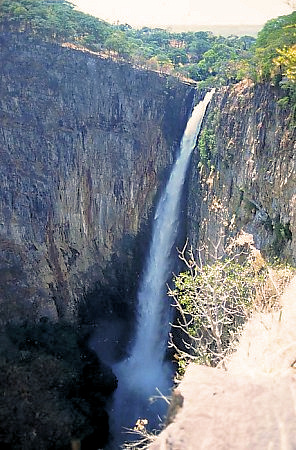
Kalambo Falls is one of those rare places where time seems to stand still. Tucked along the border between Zambia and Tanzania, just outside the small town of Mbala, the falls are a quiet giant in a continent known for its dramatic landscapes. The Kalambo River winds through rocky gorges before plunging nearly 240 meters into the valley below, making it one of the tallest waterfalls in Africa. Unlike Victoria Falls, which overwhelms with its sheer volume and thunderous roar, Kalambo offers something different—a sense of solitude, raw beauty, and an almost untouched wilderness.
The history of this place stretches back thousands of years. Archaeological digs near the falls have uncovered traces of early human life, including stone tools, remnants of ancient fires, and rock art left behind by hunter-gatherers. These findings suggest that Kalambo was more than just a landmark; it was a vital gathering point for some of the earliest communities in the region. Later, during the colonial era, European explorers took notice of the falls, but its remote location kept it from becoming a tourist hotspot. Even today, it remains largely unknown to the wider world, a hidden gem for those willing to seek it out.
Reaching Kalambo is not for the faint of heart. The journey from Mbala takes you along rough, unpaved roads that turn into muddy traps during the rainy season. Local drivers navigate these paths with skill, but even they often have to stop to clear debris or push a stuck vehicle. The best time to visit is during the dry season, from May to October, when the roads are more passable and the river’s flow is reduced to a slender cascade, revealing the sheer cliffs and lush greenery of the gorge. In the wet season, from November to April, the falls are at their most powerful, but the journey becomes far more challenging.
There’s no mistaking the grandeur of Kalambo, though it doesn’t announce itself with the same fanfare as other famous waterfalls. There are no clouds of mist hanging in the air, no rainbows arcing across the sky for hours on end. Instead, there’s a profound stillness, broken only by the sound of rushing water and the calls of birds echoing through the valley. Dense forests surround the falls, and at the base, the river pools into a small lake framed by boulders. The area is rich with wildlife, and while fishing isn’t officially permitted, locals sometimes cast their lines into the water, adding to the sense of a place where nature still sets the rules.
Kalambo has no grand architecture or man-made attractions—its beauty lies entirely in its untouched landscape. There are no crowds, no souvenir stalls, no guides hustling for business. Just the falls, the rocks, the water, and the sky. That said, there is a modest amount of infrastructure: a few simple huts built by locals for overnight stays and a small viewing platform that offers the best vantage point. At night, the darkness is absolute, with only the stars illuminating the gorge, creating an atmosphere that feels both ancient and timeless.
For many Zambians, Kalambo is more than just a natural wonder; it’s a place steeped in legend. Some believe the spirit of an ancient chief resides in the waters, watching over the land. Local tribes still visit the falls to offer prayers for rain or a good harvest, their traditions woven into the fabric of the place. These stories don’t deter visitors—in fact, they add to the mystique. Still, there’s a quiet understanding that some parts of Kalambo are best left undisturbed, especially after dark.
This isn’t a destination for those seeking comfort or convenience. There are no luxury lodges, no restaurants with multilingual menus, no guided tours with air-conditioned buses. Kalambo is for travelers who are willing to put in the effort to experience something real, something untouched by modern development. It’s for those who don’t mind long, bumpy rides, the occasional insect, or the absence of cell service. In return, you get something rare: the chance to stand alone in a place where nature still dictates the rhythm of life.
In recent years, there have been attempts to promote tourism in the region, but progress has been slow. The roads remain rough, and the infrastructure is minimal. Yet, in some ways, this is a blessing. Kalambo’s remoteness has preserved its wild, untamed character, a quality that’s increasingly hard to find in today’s world. Here, you can step away from the noise of everyday life, from the constant rush of time, and simply listen to the water falling into the abyss, carrying away everything but the present moment.