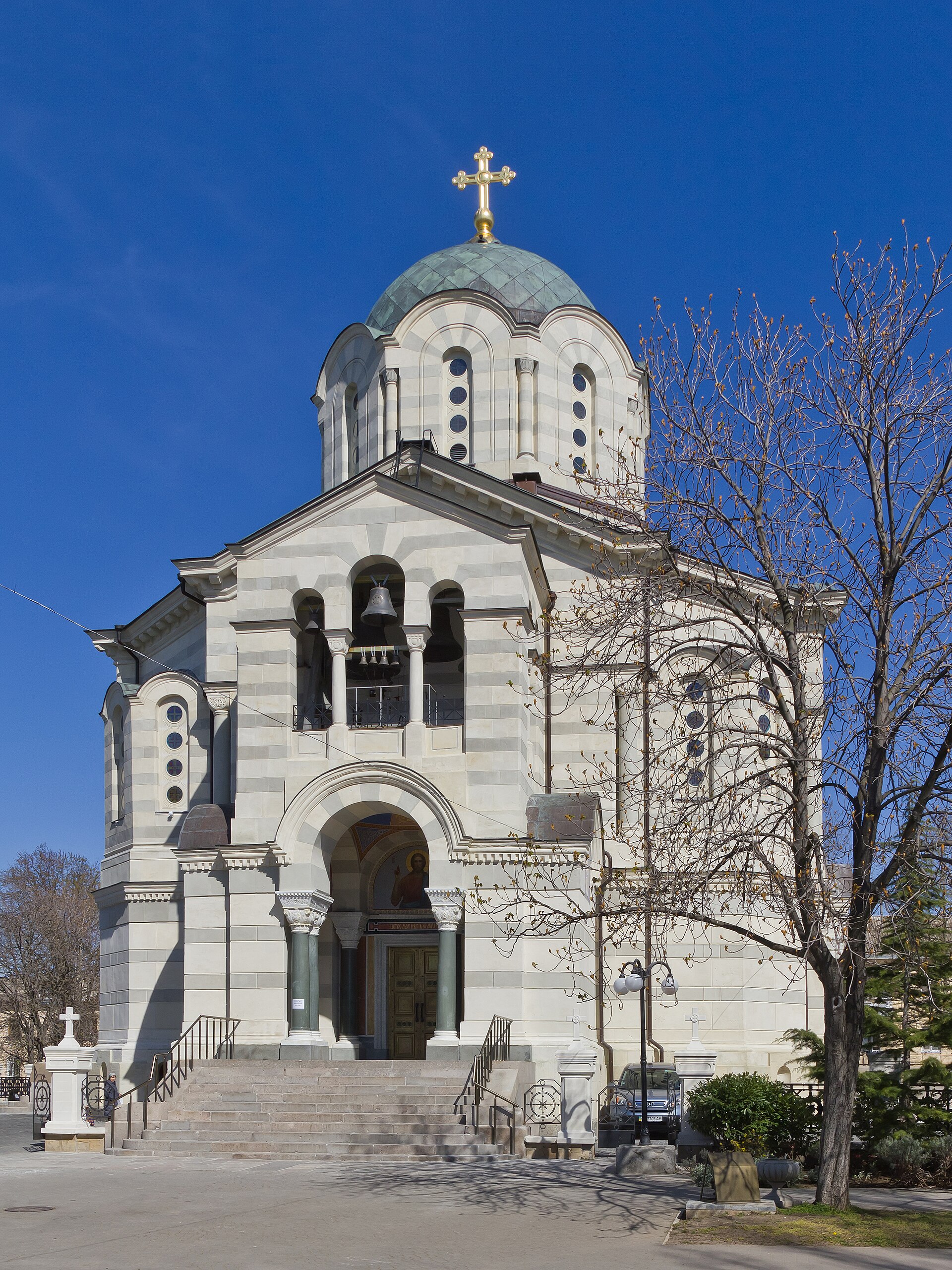
Perched on a gentle rise in the heart of Sevastopol, St. Vladimir’s Cathedral is one of those rare places where the weight of history feels almost tangible. The city spreads out below in layers of stone and water, its past etched into the very landscape. The cathedral wasn’t built in a single era but evolved over decades, shaped by wars, political upheavals, and the slow passage of time. Its walls hold more than just religious significance—they carry the memory of a city that has repeatedly risen from destruction.
The architecture is a striking example of the Russo-Byzantine style that flourished in the mid-19th century. Broad domes rise above the skyline, their curves softened by time, while arched galleries and intricate stonework give the building a sense of solidity and grace. Inside, the space opens up into a vast, airy hall where light filters through stained glass, casting muted patterns across the marble floors. The iconostasis, a blend of bronze and marble, stands as a quiet centerpiece, flanked by frescoes that tell stories of faith and endurance. But what lingers most are the tombs of admirals buried here—men whose names are woven into Sevastopol’s identity.
The idea for the cathedral took root in the aftermath of the Crimean War, when the city needed a symbol of resilience. The original design came from Konstantin Thon, the same architect behind Moscow’s Cathedral of Christ the Saviour, though the project soon outgrew his vision. Construction began in 1862, but progress was halting. Wars and revolutions interrupted the work, and by the time the cathedral was finally consecrated in 1888, it had passed through the hands of multiple architects, each leaving their mark. The delays only deepened its connection to the city’s turbulent history.
The 20th century brought new trials. In the 1930s, the Soviet authorities closed the cathedral, repurposing it as a warehouse and later a cinema. During World War II, bombs rained down on Sevastopol, and though the building suffered damage, it survived. Post-war restoration returned it to some semblance of its former self, but it wasn’t until 1991 that the cathedral was returned to the church. Today, it functions as both a place of worship and a memorial, its walls lined with plaques honoring admirals like Nakhimov, Kornilov, and Istomin—figures who shaped the city’s fate.
The hill where the cathedral stands has always been a crossroads of history. Long before the first stones were laid, this was the site of ancient Chersonesus, a Greek colony that later became a Byzantine stronghold. By the 19th century, the hill had taken on strategic importance, offering a commanding view of the bay and the city’s defenses. Now, visitors can stand on the steps and look out over Sevastopol’s layered past—the harbor where ships have come and gone for centuries, the winding streets of the old town, and the quiet dignity of the cathedral itself.
There’s a stillness here that’s hard to find in other parts of the city. Unlike the bustling markets or the crowded waterfront, the area around St. Vladimir’s feels set apart, as if time moves a little slower. In summer, the trees cast dappled shade over the paths, while in winter, a light frost dusts the domes, softening the edges of the stone. Locals often come not just for services but to walk, to sit, or simply to be in a place where the past isn’t just remembered—it’s present.
The cathedral has outlasted empires and ideologies, standing as a testament to the city’s ability to endure. It’s more than a monument; it’s a living part of Sevastopol’s identity. For some, it’s a place of prayer. For others, a reminder of the sacrifices that shaped the city. And for many, it’s simply a quiet corner where the noise of the present fades, and the echoes of history become a little clearer. Whether you come for the architecture, the stories, or the view, the cathedral offers something rare—a moment of reflection in a city that has seen so much.