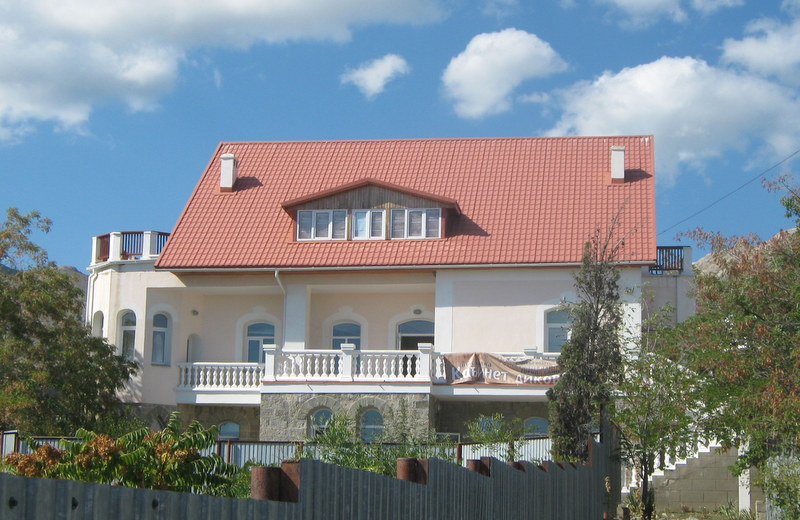
Perched on the slopes of Mount Kреpostnaya in Sudak, Villa Funka feels like a quiet witness to another era. Built in 1889, it was one of the first private residences in the area designed not for business or trade, but purely for leisure—a retreat where its owner could escape the bustle of life and soak in the natural beauty of Crimea. The villa stands apart from the region’s many wineries and commercial buildings, a rare example of a home built simply for the pleasure of its inhabitants and their guests.
The architecture blends European romanticism with local influences, creating something both familiar and distinctly Crimean. From the outside, it resembles an Italian country estate, with its two stories, mansard roof, and balconies overlooking the sea. Yet the details—wrought-iron railings, stucco ornamentation, and tall windows framed by the surrounding greenery—give it a character all its own. Inside, the layout still hints at the grandeur of the past: high ceilings, fireplaces, and wide wooden staircases, though much of the original furnishings have been lost over time.
The villa’s first owner was Alexander Funk, a German entrepreneur and winemaker who settled in Crimea in search of a climate better suited to his business. While he played a significant role in developing Sudak’s wine industry, he also contributed to the town’s growth, funding infrastructure and civic projects. Villa Funka became his personal sanctuary, a place where he entertained artists, scholars, and travelers. Some say notable figures of the time visited, though no records confirm these stories. What remains clear is that the villa was a gathering place for those who appreciated both nature and culture.
Like many historic buildings in Crimea, Villa Funka has had a turbulent history. After the revolution, it changed hands multiple times, serving various purposes under Soviet rule. By the late 20th century, the building had fallen into disrepair until private owners took over in the 1990s and began restoration efforts. Today, it isn’t a museum or a hotel, but rather a preserved piece of history, open to visitors only on rare occasions. Most people content themselves with admiring the exterior, though those who manage to step inside find a space that still carries the echoes of its past.
The villa’s surroundings are as striking as the building itself. It sits on a terraced hillside, surrounded by an overgrown garden of ancient trees and vineyards. From here, the view stretches across the Sudak Valley to the sea and the nearby Genoese Fortress, a medieval stronghold that looms over the town. On clear days, the distant mountain peaks are visible, while in the evenings, the lights of Sudak twinkle below, creating a sense of timelessness.
What makes Villa Funka special isn’t just its architecture or history, but the atmosphere it preserves. Unlike the crowded beaches or tourist-heavy spots in Crimea, this place feels untouched by time. There are no souvenir stalls or noisy cafes, just the quiet rustle of pine trees and the faint saltiness of the sea breeze. It’s a spot for slow walks, thoughtful photographs, and moments of reflection on how this land has changed over the centuries.
In recent years, the villa has become a sought-after location for weddings and small cultural events. Occasionally, classical music concerts or local art exhibitions are held here, though access to the interior remains limited. Even so, a stroll through the garden or a glance at the weathered facade is enough to leave a lasting impression. There’s a sense of authenticity here, a connection to the people who once called this place home.
Sudak is a town steeped in history, where every corner seems to hold a story. Yet Villa Funka stands out even among its many landmarks. It serves as a reminder that Crimea was once a crossroads of cultures—a place where European influences mingled with local traditions, where languages and lives intertwined. While many historic buildings in the region have been lost or altered beyond recognition, the villa remains a rare survivor, a fragment of the past that refuses to fade.
If you find yourself in Sudak, take a moment to step away from the usual tourist paths. Walk up the hill to Villa Funka, sit on one of the benches in its garden, and breathe in the scent of herbs and sea air. Here, you might just catch a glimpse of what Crimea has always been: not just a land of sun and sand, but a place where history lingers in the quiet corners, waiting to be discovered.