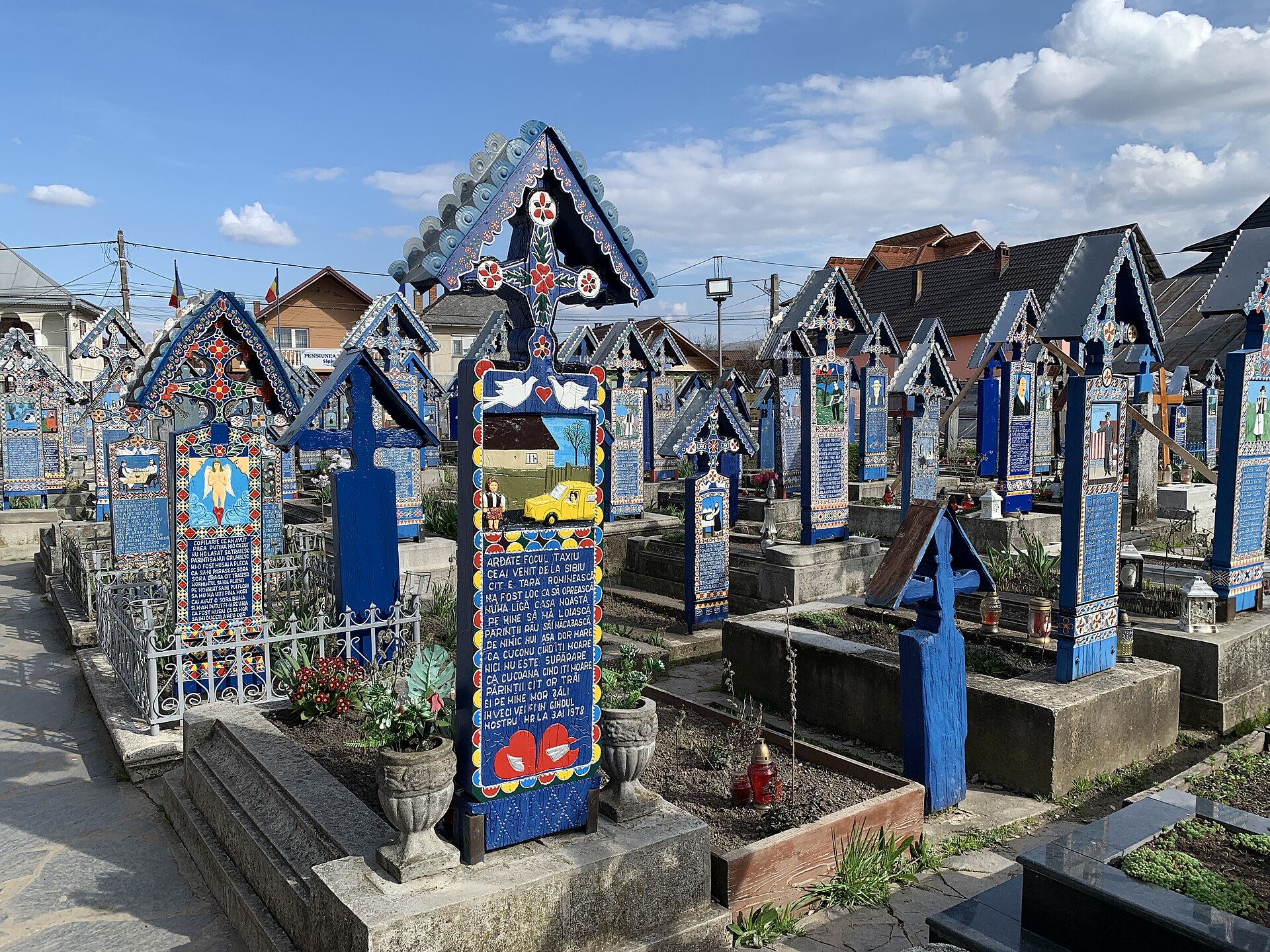
In the quiet town of Sighetu Marmației, tucked away in the northern reaches of Romania, there’s a place that turns the idea of a cemetery on its head. The Merry Cemetery, as it’s known, is unlike any other burial ground. Here, death isn’t met with silence or sorrow but with color, humor, and stories that celebrate the lives of those who’ve passed. The graves are marked not by somber stone but by vibrant wooden crosses, each one a canvas for scenes from the lives of the departed—some touching, some funny, and some so absurd they make you smile despite yourself.
The cemetery’s origins trace back to the mid-20th century, when a local woodcarver named Ion Stan Pătraș began crafting its first distinctive crosses. Pătraș wasn’t just an artisan; he was a man with a philosophy. He believed death wasn’t an end but a transition, one that didn’t have to be feared or mourned in the usual way. Instead, he saw it as an opportunity to remember people as they were—flawed, funny, and full of life. His first crosses appeared in 1935, but it wasn’t until later that the cemetery grew into the cultural landmark it is today. Now, with over eight hundred crosses, it stands as a testament to his vision, each one a small masterpiece of folk art.
The crosses themselves are made from oak, a wood deeply tied to the traditions of Maramureș, the region where Sighetu Marmației lies. Painted in bold blues, reds, yellows, and greens, they stand out against the landscape like a field of wildflowers. The dominant blue isn’t just for show—it’s a color that carries meaning here, symbolizing hope, the sky, and protection in local folklore. The carvings on each cross tell a story: a farmer with his plow, a woman baking bread, a man chasing after his hat in the wind. Some are simple, others elaborate, but all of them capture a moment, a quirk, or a passion that defined the person beneath the soil.
What makes the Merry Cemetery truly unique, though, aren’t just the images but the words that accompany them. The epitaphs, written in the local dialect, are often witty, ironic, or even gently mocking. They don’t shy away from the truth, even when it’s unflattering. One might read, *Here lies my husband. He was a good man, but he drank like a fish.* Another says, *I always said I’d die young, but I didn’t think it would be this soon.* These aren’t just jokes; they’re a way of keeping the memory of the dead alive in a way that feels honest and human. They remind visitors that life is made up of small, imperfect moments, and that’s worth celebrating.
Maramureș is a region that has always marched to the beat of its own drum. Isolated by mountains and dense forests, it has preserved traditions that have faded elsewhere in Europe. Wooden churches with intricate carvings dot the landscape, handwoven textiles still adorn homes, and festivals are filled with music and dance that haven’t changed in centuries. The Merry Cemetery fits right into this world. It’s not just a place to bury the dead; it’s a reflection of how the people here see life and death—as part of the same natural cycle, neither to be feared nor ignored. Death, in this corner of Romania, isn’t the end of a story but just another chapter, one that can be told with a smile.
Visiting the cemetery is an experience that stays with you. There’s no hushed reverence here, no sense of grief hanging in the air. Instead, people wander among the graves, laughing at the epitaphs, snapping photos, and sharing the stories they’ve read. It’s a place that draws not just tourists but artists, folklorists, and anyone curious about how different cultures approach the same universal themes. While Romania’s more famous attractions—Transylvanian castles, Black Sea beaches—often steal the spotlight, the Merry Cemetery offers something rarer: a glimpse into a way of life that refuses to take itself too seriously.
What’s striking about the cemetery is how alive it feels. This isn’t a static museum piece; it’s a living tradition. New graves are still added in the same style as the old ones, with crosses carved and painted by artisans who’ve learned the craft from those who came before them. For the people of Sighetu Marmației, the cemetery isn’t just a tourist attraction—it’s a point of pride, a symbol of their culture’s resilience and its unique perspective on life and death. It’s a place where the past and present coexist, where every cross tells a story, and where even the most ordinary lives are remembered in extraordinary ways.
If you find yourself in Maramureș, the Merry Cemetery is worth the trip. It’s a short walk from the center of Sighetu Marmației, and the best time to visit is in the warmer months, when the colors of the crosses stand out against the green hills. There’s no rush here; you’ll want to take your time, reading the epitaphs, studying the carvings, and soaking in the atmosphere. It’s a place that makes you think about how we remember those we’ve lost—and whether there might be a better way to do it. By the time you leave, you might just find yourself looking at death, and life, a little differently.