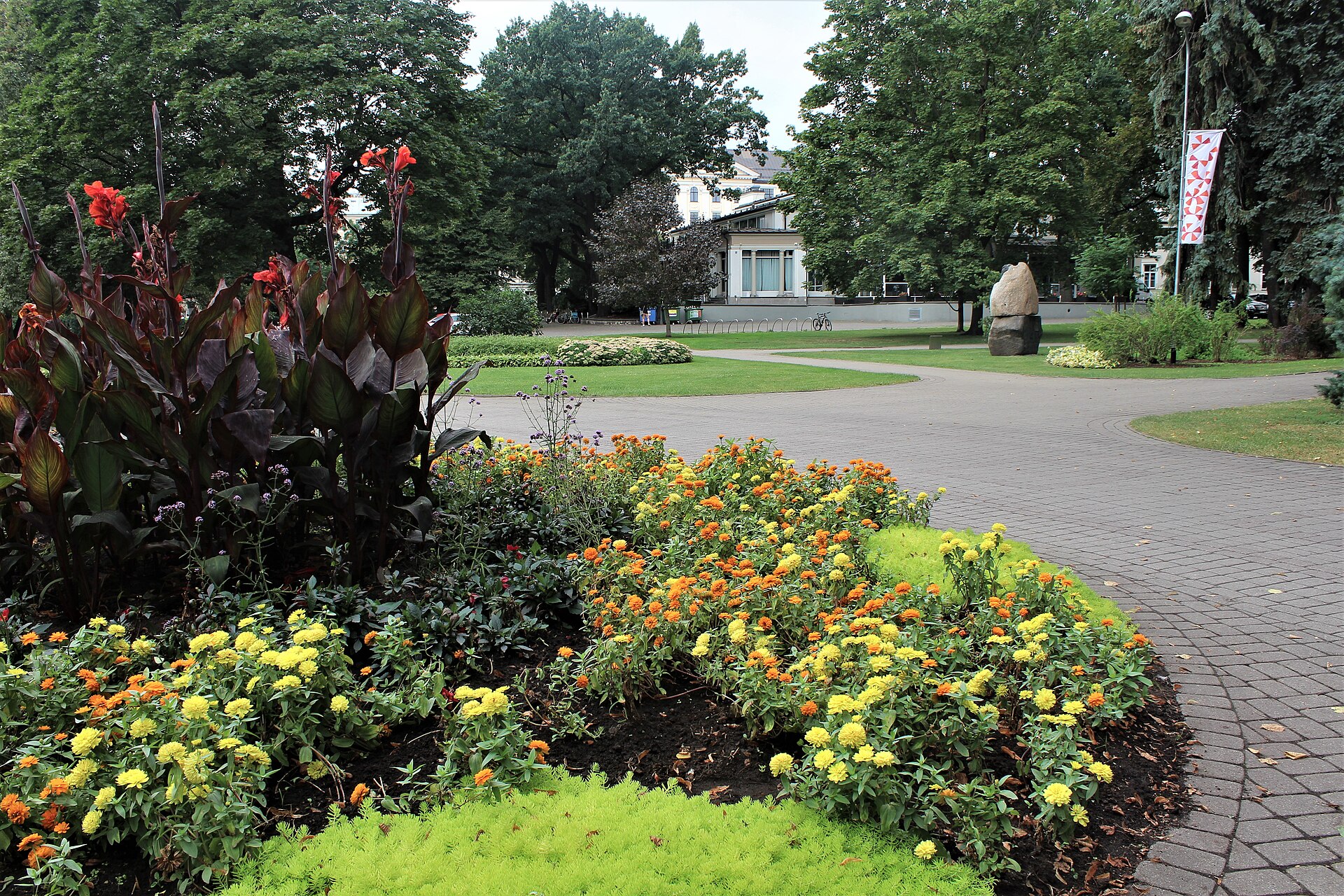
Vērmanes Garden is one of those quiet corners in Riga where people come not for grand monuments or bustling attractions, but simply to be alone with the city. Tucked between Elizabetes and Merķeļa streets in the heart of the capital, it feels like a pocket of stillness amid the constant hum of urban life. There are no towering statues or exotic plants here—just something far more valuable: the sense that this park has always been part of Riga’s rhythm, even as the city itself has transformed beyond recognition.
The park’s story begins in the early 19th century, when Riga was expanding rapidly. Johann Christoph Wöhman, the city’s mayor at the time, purchased the land and donated it to the public on the condition that it be turned into a green space for everyone. This was unusual for the era, when private gardens were the domain of the aristocracy, and ordinary citizens had little more than narrow streets and squares. Vērmanes Garden became one of the first places in Riga where anyone could stroll, regardless of social standing—a small but meaningful step toward public space as we know it today.
The park’s design is unassuming, even modest, but that’s part of its charm. The paths are paved with cobblestones, once hauled from nearby rivers, and the trees—mostly lindens and maples—are planted in a way that creates a natural canopy over the walkways. At its center lies a small pond with a fountain, a gathering spot in warmer months. People sit by the water with books, feed the ducks, or watch the sunlight dance across the surface. In winter, the pond freezes over, and skaters take to the ice, though there’s no official rink—just the quiet joy of a city adapting to the season.
Vērmanes Garden has long been woven into Riga’s cultural life. In the 19th century, it hosted concerts and literary readings, and later, the city’s first open-air theater was built here. Those days are gone now, but the park still carries a creative energy. On summer afternoons, you might find art students sketching under the trees or musicians rehearsing for performances on nearby streets. Occasionally, small festivals or craft fairs pop up, but more often than not, the park moves at its own unhurried pace, a backdrop to everyday life rather than a spectacle.
The park has also played a quiet role in Riga’s turbulent history. In the early 20th century, as Latvia fought for independence, it became a meeting place for rallies and gatherings. Later, during the Soviet era, its trees and benches offered a rare sense of privacy in the heart of the city—a place where people could talk without fear of being overheard. Today, there are no plaques or memorials to mark these moments, but if you look closely, some of the older trees bear the scars of time: bullet marks from long-ago conflicts or notches carved by unknown hands decades ago.
Architecturally, the park is a bridge between different eras. On one side stand the grand Art Nouveau buildings of the early 1900s, their facades adorned with intricate details; on the other, more utilitarian Soviet-era structures. The garden itself acts as a buffer, softening the contrast between these worlds and blending them into a single, cohesive image of Riga. There’s no clear divide between past and present here—just a seamless flow, as if the park has always been part of the city’s fabric.
For visitors, Vērmanes Garden might seem too ordinary at first glance. There are no manicured flowerbeds or dramatic sculptures, no guided tours or souvenir stands. But that’s precisely what makes it special. This isn’t a place for posing in front of landmarks; it’s a place to feel the pulse of the city. In the mornings, locals jog along the paths; by afternoon, families with children wander the alleys; and in the evenings, groups of friends gather with guitars, their laughter mingling with the rustling leaves. The park doesn’t try to impress—it simply exists, as it has for nearly two centuries.
Remarkably, Vērmanes Garden has changed very little since it was first laid out. New benches have been added, paths have been repaired, but the overall design remains the same. This is rare in modern cities, where public spaces are often redesigned to fit the latest trends. The park feels like a living museum, a glimpse of what Riga looked like a hundred or even two hundred years ago. It may not have the fame of the Dome Cathedral or the Old Town, but for many locals, it’s far more meaningful—a place that feels like home.
Winter transforms the park entirely. The trees glisten with frost, the paths disappear under a blanket of snow, and the pond becomes a mirror reflecting the gray sky. The air is still, and time seems to slow down. In summer, the garden comes alive with sounds: children playing, leaves whispering in the breeze, distant voices drifting in from the streets. Yet no matter the season, Vērmanes Garden remains a place to pause, catch your breath, and remember that Riga isn’t just about its architecture or its history. It’s about the people who shape it, day by day, in quiet, unassuming ways.