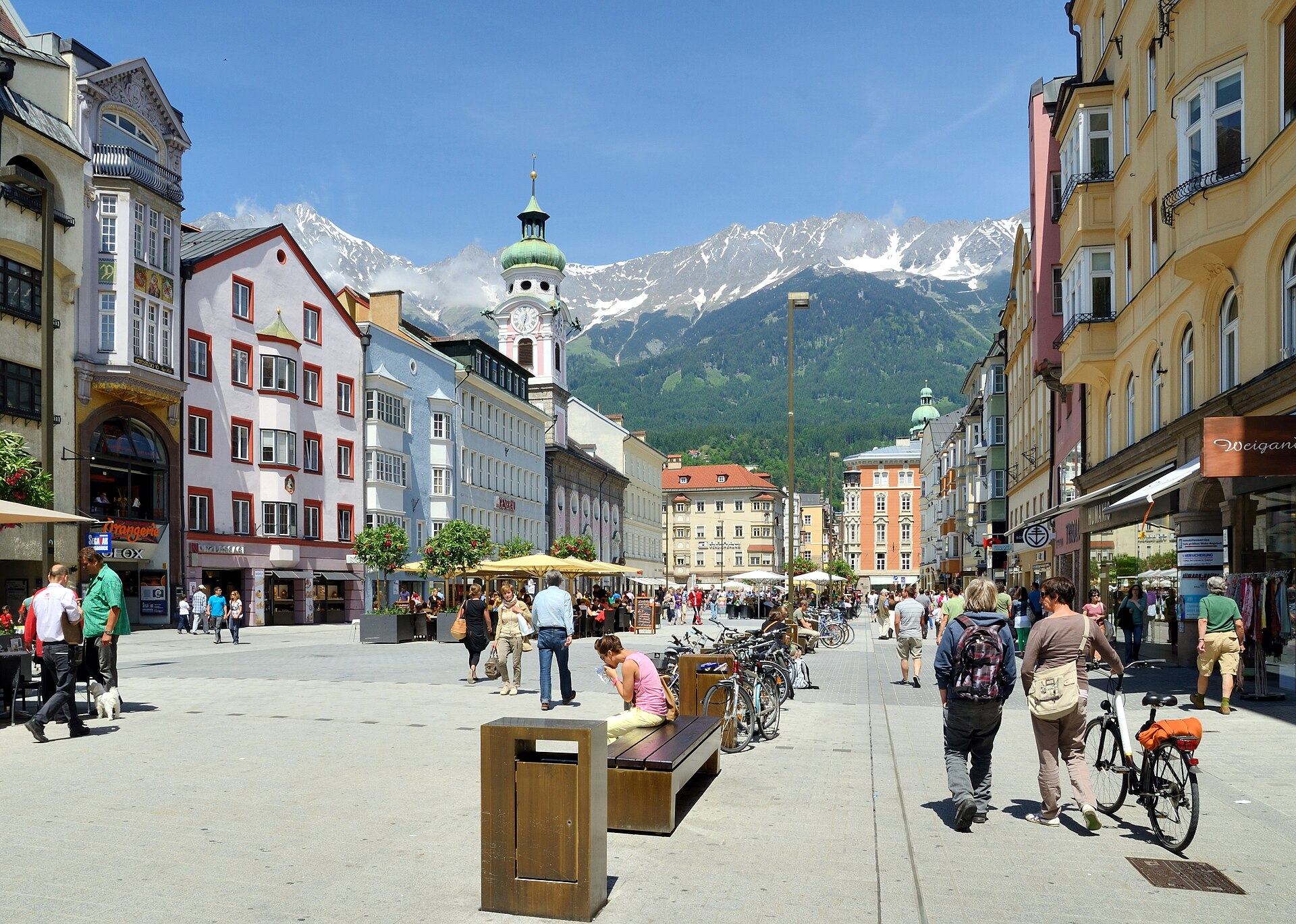
Maria-Theresien-Strasse is where Innsbruck unfolds in all its layered charm. Stretching from the Triumphal Arch in the south to the Old Town in the north, it bridges centuries of history with the pulse of modern life. The street isn’t just a thoroughfare—it’s a stage where the city’s character plays out in quiet moments and grand gestures alike. Here, you might find yourself lingering over coffee at a sidewalk café, browsing boutique windows, or simply watching the rhythm of daily life unfold beneath the shade of plane trees. Named after Empress Maria Theresa, one of Austria’s most formidable rulers, the street carries her legacy in its very stones—a place where imperial grandeur meets the easygoing spirit of a mountain town.
The architecture along Maria-Theresien-Strasse reads like a condensed history of European urban design. The street begins at the Triumphal Arch, built in the 18th century to commemorate the marriage of Archduke Leopold to Spanish princess Maria Luisa. Its ornate reliefs and coats of arms set the tone for what follows: a procession of buildings that balance elegance with restraint. Baroque facades stand alongside neoclassical townhouses, many rebuilt after fires or wars but retaining their original character. One of the most striking sights is the Golden Roof, visible from the street though technically part of the Old Town. Its gilded balcony, commissioned in the 15th century by Emperor Maximilian I, has become an emblem of Innsbruck itself—a shimmering relic of a time when the city was a crossroads of empire.
The street hasn’t always been the grand boulevard it is today. In the Middle Ages, this was the site of Innsbruck’s city walls, beyond which lay vineyards and open fields. It wasn’t until the 16th century, when the city became a key trading and administrative hub, that stone houses began to line the route. The real transformation came in the 18th century, when Innsbruck served as a residence for the Habsburgs. Under their influence, Maria-Theresien-Strasse took on its current form: wide sidewalks, uniform facades, and spacious squares designed for strolling rather than hustle. By the 19th century, cafés and shops had sprung up, and by the 20th, the street had become the city’s commercial heart. Yet even as it evolved, it never lost its connection to the past.
Walking along Maria-Theresien-Strasse is as much about atmosphere as it is about sights. In summer, the street hums with energy—tourists posing for photos at the Triumphal Arch, locals pushing strollers, street musicians filling the air with accordion tunes or violin melodies. Winter brings a different kind of magic. Strings of lights drape the trees, the scent of roasted chestnuts and mulled wine drifts from market stalls, and in December, one of Austria’s most picturesque Christmas markets takes over the street. Even on ordinary days, the street retains its warmth. Outdoor cafés spill onto the sidewalks, boutiques display local designs, and antique shops invite lingering. It’s a place where time seems to slow, where every corner offers something worth pausing for.
At the heart of the street lies the square in front of the town hall, a gathering place that feels more like a living room than a public space. Throughout the year, it hosts concerts, festivals, and impromptu performances. In summer, a stage is set up for local bands; in winter, an ice rink appears, drawing skaters of all ages. Nearby, a statue of Archduke Leopold V, founder of the Tyrolean Habsburg line, stands as a quiet reminder of the city’s deep ties to imperial history. On warm evenings, the square fills with people—students chatting on benches, artists sketching portraits, groups of friends sharing a bottle of wine. It’s a spot where the city’s past and present converge effortlessly.
Maria-Theresien-Strasse is also a vital artery for the city’s movement. Trams glide along its tracks, connecting neighborhoods, while buses depart for alpine villages and ski resorts. Yet despite the activity, the street never feels chaotic. Wide sidewalks, bike lanes, and plenty of benches make it a pleasure to explore on foot. In summer, cyclists weave through the crowds, and in winter, the street becomes a gateway to the mountains, with cable cars just a short walk away. Cars are present, but they don’t dominate—the priority here is clearly given to pedestrians, to those who want to take their time.
One of the street’s most compelling features is the way it frames the Nordkette mountains. From nearly any point along Maria-Theresien-Strasse, the jagged peaks rise in the distance, a constant reminder of Innsbruck’s dramatic setting. The mountains aren’t just a backdrop; they’re part of the city’s identity. At sunset, when the light turns the snow-capped ridges gold and pink, the view becomes almost surreal. Many visitors come to Innsbruck precisely for this combination of urban life and alpine grandeur, and Maria-Theresien-Strasse is often their first introduction to it. It’s no wonder the street serves as a starting point for hikes and ski trips—from here, the mountains feel tantalizingly close.
The street has a rhythm that shifts with the hours. Mornings begin with the scent of fresh bread from bakeries, where locals pick up croissants and dark rye loaves. By midday, shops and cafés are in full swing, their awnings casting shade over sidewalk tables. As evening falls, the glow of streetlamps and shop windows transforms the street into something softer, more intimate. Even late at night, Maria-Theresien-Strasse doesn’t sleep. Bars and restaurants stay open, their warm light spilling onto the pavement, while the illuminated facades of historic buildings create a scene that feels almost theatrical. It’s a place where you might encounter students hurrying to class, elderly couples taking an after-dinner stroll, or travelers returning from a day in the mountains. Each person seems to find their own reason to be here.
What makes Maria-Theresien-Strasse special isn’t just its beauty or its history, but the way it feels alive in every season. It’s a street that doesn’t try too hard—it simply exists, offering whatever you’re looking for, whether that’s a quiet moment with a book, a shopping spree, or a glimpse into Innsbruck’s layered past. You could spend an hour wandering without purpose or lose a whole afternoon in its cafés and shops. There’s no script here, no pressure to perform. The street invites you to slow down, to notice the details—the way the light hits the cobblestones in the afternoon, the sound of a street musician’s violin drifting from a nearby square, the way the mountains seem to watch over everything. It’s a place where the city reveals itself without pretense, where history and modernity coexist as naturally as the Alps and the Inn River. For locals and visitors alike, Maria-Theresien-Strasse isn’t just a street; it’s the heart of Innsbruck.