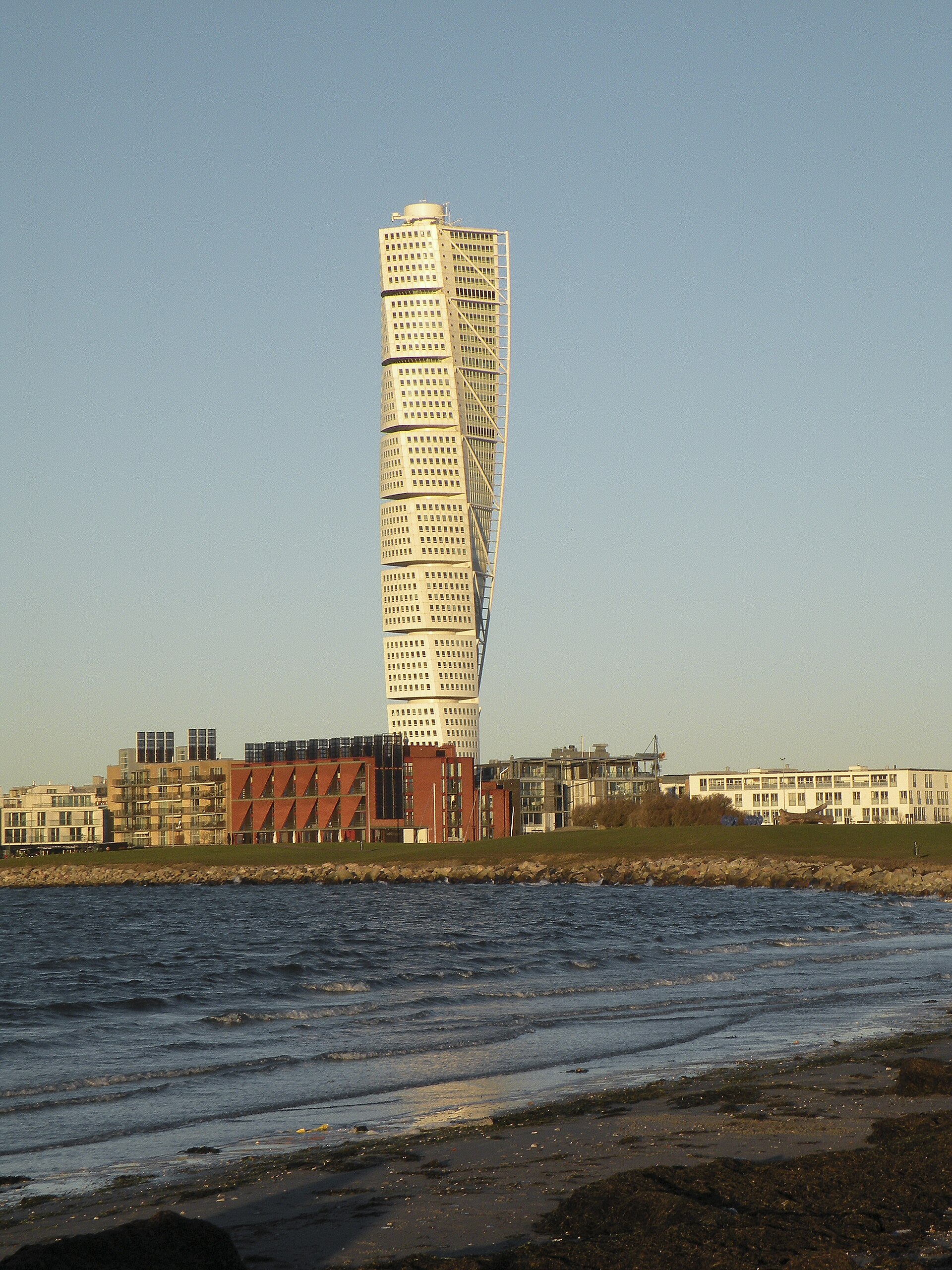
Malmö’s skyline changed forever when the Turning Torso rose along the waterfront, its twisting form defying the flat horizons of southern Sweden. Completed in 2005, it was the world’s first twisted residential skyscraper, a bold experiment in engineering that still feels fresh nearly two decades later. Standing at 190 meters with 54 floors, the building spirals upward like a spine caught mid-motion, its nine offset segments creating the illusion of perpetual movement. Designed by Santiago Calatrava, the Spanish architect known for structures that blur the line between sculpture and functionality, the Turning Torso wasn’t just an architectural statement—it became a symbol of Malmö’s reinvention.
The site itself tells a story of transformation. Where the tower now stands, shipyards once dominated the landscape, their cranes and dry docks shaping Malmö’s industrial identity. The Western Harbour, once a hub of maritime activity, has since been reimagined as a modern district where people live, work, and relax. The Turning Torso anchors this change, its sleek silhouette contrasting with the brick warehouses and low-rise buildings nearby. The area around it has been carefully designed for pedestrians and cyclists, with parks and promenades encouraging people to linger. On a clear day, the view from the waterfront stretches across the Öresund Strait to Copenhagen, where the Danish capital’s spires appear almost close enough to touch.
What makes the Turning Torso remarkable isn’t just its height or its twist, but the way it engages with its surroundings. The building’s glass and steel facade reflects the shifting light of the Baltic sky, its panels catching the sun at different angles as the day progresses. At dusk, the tower’s illumination accentuates its curves, making it seem almost weightless against the darkening horizon. Inside, the apartments are spacious and filled with natural light, their floor-to-ceiling windows offering panoramic views of the strait, the distant Danish coast, and the open sea. While the building is primarily residential and not open to the public, its presence is felt everywhere in the Western Harbour. Locals pass it on their way to work, joggers circle its base in the park, and visitors pause to photograph its striking silhouette.
The tower’s creation was as much about ambition as it was about architecture. In the late 1990s, Malmö was looking for a way to signal its evolution from an industrial city to a modern, forward-thinking urban center. Calatrava’s design, inspired by one of his own sculptures—a twisting human figure—won the competition, but bringing it to life required solving complex engineering challenges. Stabilizing a building that appears to defy gravity wasn’t simple; the structure had to withstand strong winds off the strait while ensuring the comfort of its residents. The result was a feat of modern construction, one that demonstrated how far architectural innovation could push the boundaries of what a skyscraper could be.
For those who live in Malmö, the Turning Torso has become part of the city’s daily rhythm. It’s a landmark that orients you as you move through the Western Harbour, a reference point in a neighborhood that’s still finding its identity. Some locals claim that on the clearest days, you can see the Swedish flag flying on the island of Ven from the upper floors, though the building’s height makes that unlikely. Others swear they’ve felt the tower sway in a storm, though engineers insist the movement is imperceptible. These stories, whether true or not, add to the building’s mystique, turning it into something more than just steel and glass.
Despite being less than twenty years old, the Turning Torso has already embedded itself in Malmö’s cultural fabric. It appears on postcards, in advertisements, and even in films, its distinctive shape instantly recognizable. For architecture enthusiasts, it’s a must-see, a real-world example of how form and function can merge in unexpected ways. Yet it doesn’t feel out of place in a city where medieval churches stand alongside contemporary office buildings. The tower’s success lies in its ability to bridge the old and the new, proving that innovation doesn’t have to erase history—it can coexist with it.
The best way to experience the Turning Torso is to walk along the Western Harbour’s waterfront. From here, the building reveals itself gradually, its full height only apparent when you stand directly beneath it. As you move along the promenade, the perspective shifts—the tower seems to twist and turn with you, its segments aligning and realigning like a living organism. In the evening, when the lights come on, the reflections dance on the water, blurring the line between the structure and its surroundings. Nearby cafés offer a place to sit and watch the scene unfold: cyclists gliding past, boats cutting through the strait, and the occasional tourist adjusting their camera to capture the perfect shot.
The Turning Torso isn’t just a building; it’s a statement about what Malmö aspires to be. It represents a city that’s comfortable with change, one that embraces the future without forgetting its past. Whether you’re admiring it from afar or standing at its base, the tower invites you to think about how architecture shapes our perception of a place. It’s a reminder that even in a country known for its understated design, bold ideas can take root—and in doing so, redefine a city’s skyline forever.