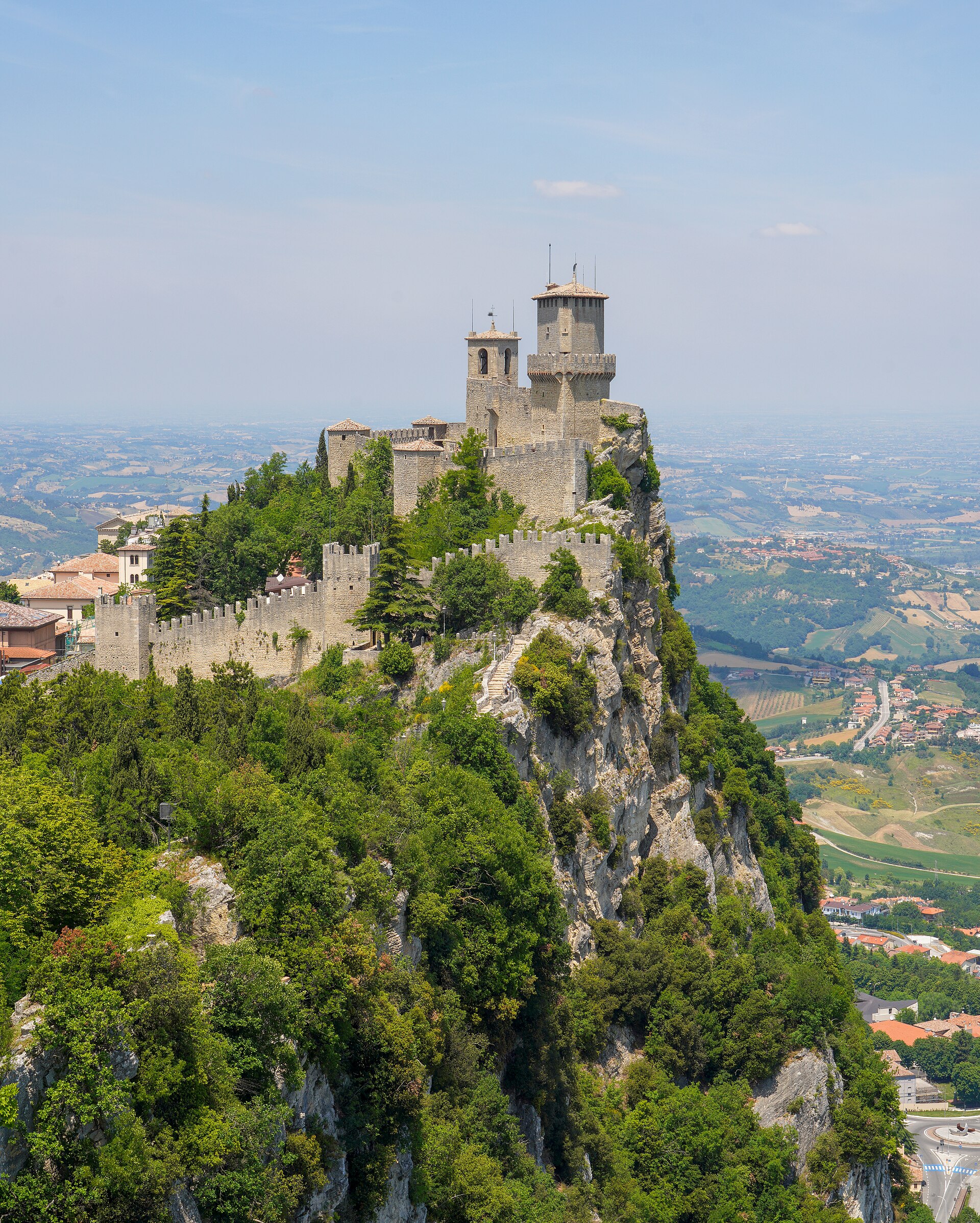
Perched atop the rugged slopes of Mount Titano, the three towers of San Marino stand as silent sentinels over one of Europe’s smallest and oldest republics. These medieval fortresses—Guaita, Cesta, and Montale—are more than just stone structures; they are symbols of a nation’s enduring independence, a testament to its resilience through centuries of shifting borders and political storms. From their weathered battlements, the view stretches across rolling green hills and distant valleys, offering a perspective that feels both timeless and humbling.
Guaita, the oldest and most imposing of the trio, dates back to the 11th century, though its foundations may be even older. Built as a refuge for the early settlers of San Marino, it served as both a fortress and a prison, its thick walls and strategic position making it nearly impregnable. Walking through its narrow passageways and climbing its steep staircases, you can almost hear the echoes of medieval life—the clatter of armor, the murmur of guards, the occasional cry of a prisoner locked in one of its dark cells. The tower’s simple, functional design reflects its original purpose: survival. Yet there’s a certain elegance in its austerity, a reminder that beauty often lies in necessity.
Cesta, the second tower, sits on the highest peak of Mount Titano and feels like a natural extension of the mountain itself. Constructed in the 13th century, it was later reinforced to withstand the advances of more sophisticated siege weaponry. Unlike Guaita, Cesta has a more refined appearance, with a slender, almost delicate silhouette that belies its military origins. Inside, the Museum of Ancient Arms houses a collection of weapons and armor spanning several centuries, from simple crossbows to ornate suits of plate. The exhibits are arranged with care, each piece telling a story of conflict, craftsmanship, or the slow evolution of warfare. The tower’s position offers the most breathtaking views of the surrounding countryside, where the patchwork of fields and villages seems to stretch endlessly toward the Adriatic.
Montale, the smallest and least accessible of the three, is often overlooked by visitors, and that’s part of its charm. Built in the 14th century, it was designed primarily as a lookout post, its narrow windows framing the horizon like a painter’s canvas. Unlike its siblings, Montale was never intended for prolonged occupation, and its sparse interior reflects that. There are no grand halls or museums here, just the raw, unadorned stone and the wind whistling through its openings. It’s a place that invites quiet reflection, a reminder of the solitude that must have been part of a guard’s duty centuries ago. The climb to Montale is steeper and less trodden, rewarding those who make the effort with a sense of discovery and a view that feels like a secret.
The towers are connected by a network of paths that wind along the ridge of Mount Titano, offering a route that feels both ancient and well-worn. The most famous of these is the *Passo delle Streghe*, or Witches’ Path, a narrow trail that snakes between Guaita and Cesta. The name is said to come from local legends of witches who once gathered on these slopes, though the truth is likely more prosaic—perhaps a reference to the tower guards who patrolled the area under the cover of darkness. Whatever its origins, the path adds a layer of mystery to the journey, its uneven stones and sudden drops making it feel like a relic of another era.
San Marino’s towers have witnessed nearly a thousand years of history, from the struggles of a fledgling republic to the quiet rhythms of modern life. They’ve seen wars come and go, empires rise and fall, and yet they remain, steadfast and unyielding. In the 15th century, when the republic was threatened by the expansionist ambitions of the Malatesta family, the towers served as a rallying point for San Marino’s defenders. Later, during the Italian unification in the 19th century, they became a symbol of the republic’s refusal to be absorbed into the new Kingdom of Italy. Even today, they appear on the national flag and coat of arms, a constant reminder of the country’s sovereignty and resilience.
Visiting the towers is as much about the journey as it is about the destination. The walk from the historic center of San Marino up to Guaita is a gradual ascent through narrow streets lined with souvenir shops and cafés, where the scent of espresso mingles with the cool mountain air. Along the way, you’ll pass the Basilica di San Marino, a neoclassical church that houses the relics of the republic’s founder, Saint Marinus. The contrast between the basilica’s polished marble and the towers’ rough stone is striking, a reminder of how San Marino has balanced its spiritual and secular identities over the centuries.
The towers are not just relics of the past; they are living parts of San Marino’s identity. On clear days, locals and visitors alike gather on their ramparts to watch the sunset, the golden light spilling over the hills like liquid honey. In the summer, the towers are illuminated at night, their silhouettes standing out against the dark sky like something from a fairy tale. And though they no longer serve a military purpose, they remain a place of vigilance—not against invaders, but against the passage of time. To stand within their walls is to feel connected to something larger than oneself, to a story that began long before we arrived and will continue long after we’re gone.
There’s a quiet dignity to the towers of San Marino, a sense that they’ve seen enough of the world to know its follies and its triumphs. They don’t demand attention like the grand castles of Europe’s monarchies; instead, they wait patiently, offering their stories to those who take the time to listen. Whether you’re drawn by history, architecture, or simply the promise of a view that takes your breath away, the towers deliver something rare: a moment of stillness in a world that often feels too loud. And perhaps that’s their greatest legacy—not just as guardians of a nation, but as keepers of perspective.