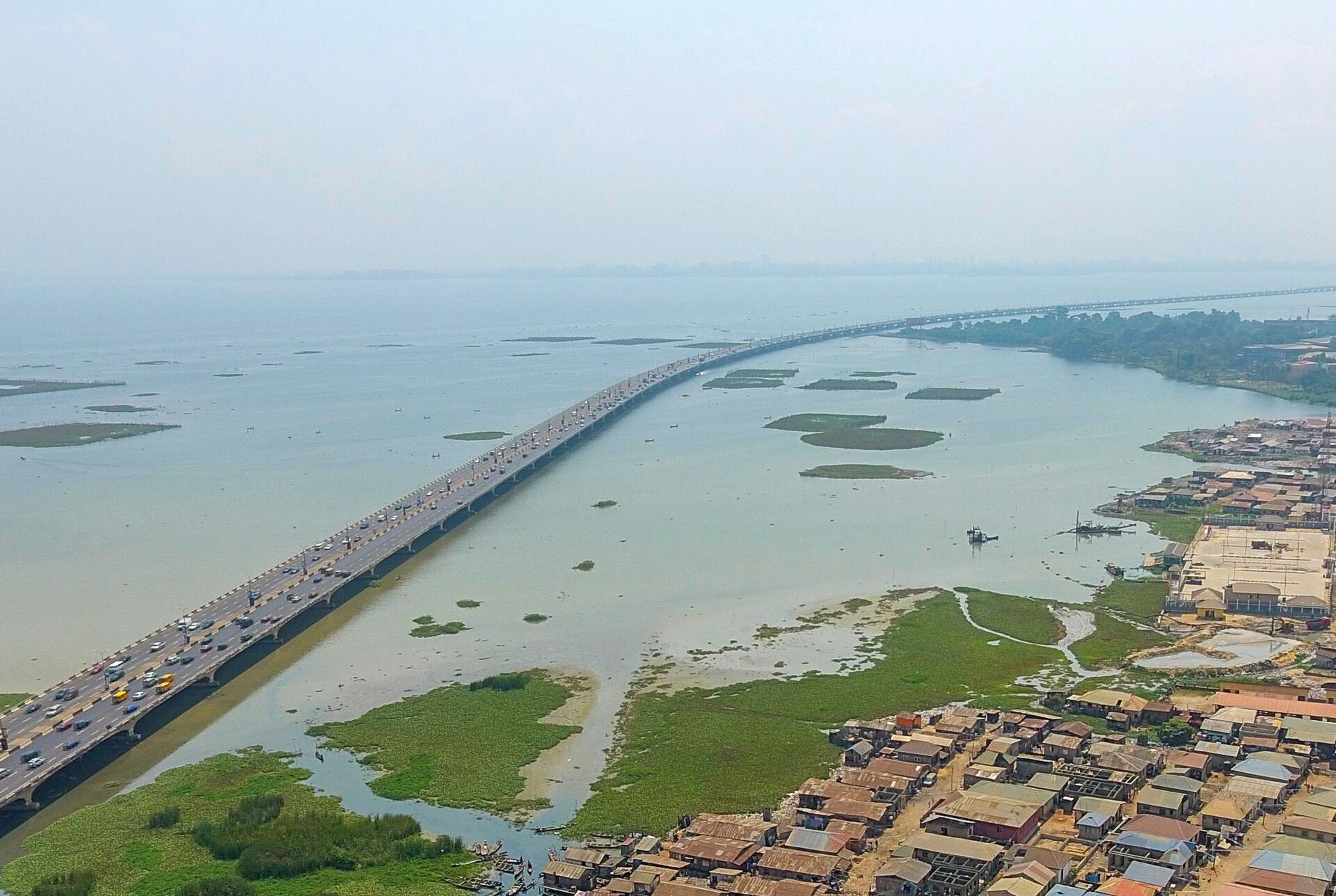
The Third Mainland Bridge is one of those places in Lagos that doesn’t just connect two points on a map—it connects the city to itself. Stretching over 11 kilometers, it’s the longest of the three bridges linking Lagos Island to the mainland, a vital artery in a metropolis where movement is both a necessity and a way of life. For many Lagosians, this bridge is more than concrete and steel; it’s a daily companion, a witness to the rhythm of the city, and sometimes, the only stretch of road where you can catch a moment of quiet above the water before plunging back into the chaos below.
Built in the early 1990s, the bridge was a response to the city’s relentless growth. By that time, Lagos had already outgrown its colonial-era infrastructure, and the existing bridges—Eko and Carter—could no longer handle the weight of its expansion. The Third Mainland Bridge was designed to ease congestion, but like many grand solutions in a city that refuses to stand still, it quickly became a victim of its own success. Today, it carries an estimated 120,000 vehicles daily, a number that only hints at the sheer scale of Lagos’s movement. The bridge isn’t just a route; it’s a microcosm of the city’s energy, where every hour brings a new wave of taxis, danfos, private cars, and motorcycles, all weaving through the lanes with a kind of practiced urgency.
The structure itself is unassuming in its design—functional, rather than striking. There are no grand arches or decorative flourishes, just a long, steady span supported by concrete pillars that rise from the lagoon. Yet, in its simplicity, there’s a certain elegance. The bridge curves gently as it approaches the mainland, offering fleeting glimpses of the water below, where fishing boats and occasional cargo ships drift beneath. At night, the bridge comes alive with the glow of headlights and streetlamps, a ribbon of light that stretches into the distance, mirroring the city’s own luminosity.
For those who cross it regularly, the Third Mainland Bridge is a barometer of Lagos’s mood. On a good day, traffic moves at a steady clip, and the drive is almost pleasant, with the breeze off the lagoon cutting through the heat. On a bad day—well, Lagosians know the drill. Rush hour can turn the bridge into a parking lot, with hours lost in standstill traffic, the air thick with exhaust fumes and the occasional blare of horns. Yet even then, there’s a strange camaraderie in the gridlock. Vendors weave between cars selling everything from plantain chips to phone chargers, while passengers in danfos pass the time with conversations that range from the mundane to the philosophical. The bridge, in these moments, becomes a temporary village, a place where strangers share the same frustration and the same fleeting hope that the next exit will bring relief.
Beyond its practical role, the bridge has also become a symbol of Lagos’s resilience. It has weathered years of heavy use, occasional closures for repairs, and the constant wear of a city that never stops moving. There have been times when sections of the bridge were shut down for maintenance, forcing the city to adapt, rerouting traffic through already congested alternatives. These disruptions are a reminder of how fragile even the most essential infrastructure can be, and how much Lagos relies on these connections to keep its heart beating. Yet, each time the bridge reopens, it’s met with a collective sigh of relief, as if the city itself can breathe easier knowing its lifeline is intact.
The Third Mainland Bridge also offers a unique perspective on Lagos. From its height, you can see the city in a way that’s impossible from the ground. To the south, the skyline of Lagos Island rises, a mix of modern high-rises and older buildings that hint at the city’s layered history. To the north, the mainland sprawls outward, a patchwork of neighborhoods, markets, and industrial zones that stretch as far as the eye can see. The lagoon below is a world of its own, dotted with fishing communities and the occasional luxury yacht, a contrast that speaks to the city’s extremes. On clear days, the view can be almost serene, a rare moment of calm in a place that’s usually anything but.
For visitors, crossing the bridge is often one of the first real introductions to Lagos’s scale and energy. It’s not the kind of landmark that makes it onto postcards, but it’s the kind of place that leaves an impression. There’s something about the way the city unfolds around you as you drive—how the water gives way to the density of the mainland, how the noise and movement build until you’re fully immersed in it—that captures the essence of Lagos. It’s a place where the journey is just as important as the destination, where the act of moving through the city is as much a part of the experience as any museum or monument.
The bridge has also found its way into the city’s culture, appearing in music, films, and literature as a backdrop to stories of love, struggle, and ambition. In Nollywood movies, it’s often the setting for dramatic scenes—lovers parting ways, friends reuniting, or characters making life-changing decisions against the hum of traffic. In music, it’s been name-dropped in lyrics that speak to the daily grind of Lagos life, a symbol of the hustle and the hope that defines the city. For many artists, the bridge is more than just a structure; it’s a character in its own right, a silent witness to the dreams and dramas that play out in its shadow.
Over the years, there have been discussions about expanding or even replacing the Third Mainland Bridge, as Lagos continues to grow and its infrastructure strains under the weight of its population. But for now, it remains a constant, a familiar presence in a city that is always changing. It’s not the most glamorous landmark, nor the most historic, but it’s one of the few places in Lagos where you can feel the pulse of the city in its rawest form. Whether you’re crossing it at dawn, when the first light hits the water, or at midnight, when the traffic finally thins and the city exhales, the bridge offers a moment of connection—to the city, to its people, and to the relentless energy that keeps Lagos moving forward.