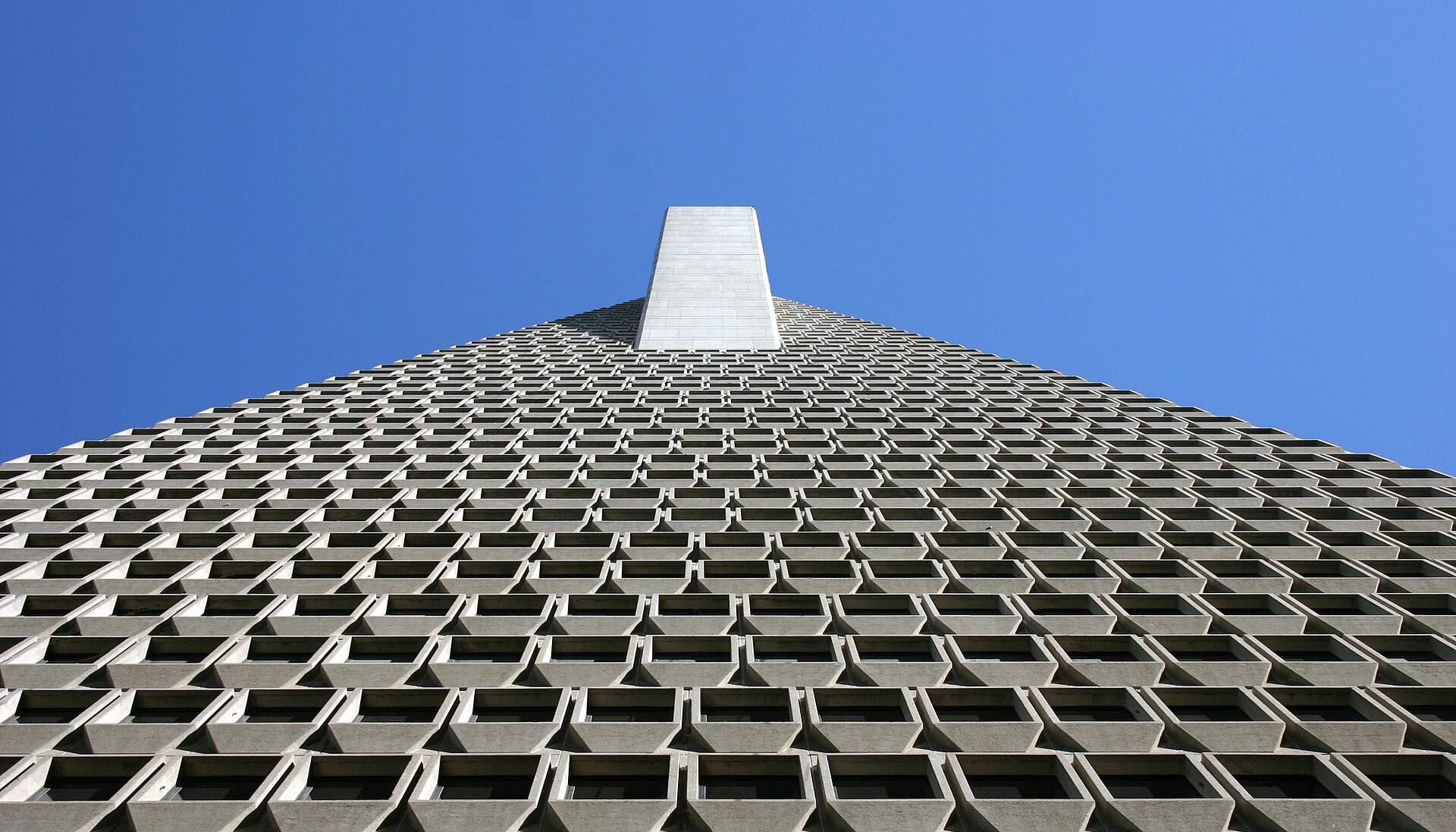
The Transamerica Pyramid is one of those rare buildings that doesn’t just occupy space in a city—it defines it. Rising above San Francisco’s Financial District, its sharp, angular silhouette cuts through the skyline in a way that feels both deliberate and unexpected. Though it’s no longer the tallest structure in the city, the pyramid hasn’t lost its ability to command attention. Completed in 1972, it was designed by architect William Pereira, whose vision gave the city an enduring symbol, one that has come to represent not just corporate ambition but the very spirit of San Francisco’s willingness to embrace the unconventional.
What makes the Transamerica Pyramid stand out isn’t just its height, but its shape. Unlike the boxy, utilitarian skyscrapers that dominate most American downtowns, this building is a four-sided pyramid with a truncated top, tapering toward the sky in a way that feels almost sculptural. At 260 meters, it’s imposing, yet its white quartz facade gives it a certain lightness, especially when sunlight catches its surface, turning it silver. The narrow windows near the top enhance the illusion of upward movement, as if the building is reaching for something just beyond the clouds. It’s a design that manages to feel both futuristic and timeless, a rare balance in architecture.
When it was first proposed, the pyramid wasn’t universally loved. Many San Franciscans worried it would disrupt the city’s character, that its bold geometry would clash with the more traditional buildings around it. But over time, it became clear that the pyramid didn’t just fit into the skyline—it elevated it. Today, it’s hard to imagine San Francisco without it. The building was originally commissioned by the Transamerica Corporation, which occupied its offices until 2020, when it was sold to new owners. Now, the space is leased to various tenants, though the public rarely gets a glimpse inside. There’s a small museum on the ground floor dedicated to the building’s history, but access is limited, and most visitors have to content themselves with admiring it from the outside.
San Francisco is no stranger to earthquakes, and the Transamerica Pyramid was built with that reality in mind. The structure was engineered to withstand significant seismic activity, with a steel and reinforced concrete frame designed to flex rather than fracture. At its base, massive shock absorbers help dissipate the energy of tremors, a feature that has proven its worth over the years. The building has weathered several major quakes without serious damage, a testament to both its engineering and the foresight of its designers. It’s a quiet kind of resilience, the kind that doesn’t announce itself but simply endures.
While the pyramid sits in the heart of the Financial District, the area around it offers a few pockets of calm. A small park nearby, with its fountains and benches, provides a place to pause amid the city’s hustle. From there, it’s a short walk to the waterfront, where the view opens up to the bay. On clear days, the upper floors of the pyramid must offer breathtaking panoramas, though the public isn’t allowed access. For those who want a different perspective, the observation deck of the nearby Salesforce Tower offers a sweeping view of the city, with the Transamerica Pyramid standing out as a geometric counterpoint to the softer lines of the hills and water beyond.
Over the years, the pyramid has transcended its role as an office building to become a cultural landmark. It’s appeared in films, television shows, and even album covers, often serving as a shorthand for San Francisco itself. In disaster movies, it’s been dramatically destroyed—most notably in *San Andreas*—though in reality, it has stood firm through every tremor. That kind of recognition doesn’t come easily, and it speaks to the building’s unique presence in the city’s identity. Tourists flock to photograph it, especially at sunset, when the light plays off its facets, turning the structure into something almost luminous.
What’s perhaps most interesting about the Transamerica Pyramid is how it reflects the era in which it was built. The 1970s were a time of architectural experimentation, a period when cities were still figuring out what the modern skyline should look like. Most skyscrapers of the time followed a predictable formula, but the pyramid broke the mold. It wasn’t just a building; it was a statement. And while some of its contemporaries have aged poorly, the pyramid has retained a certain elegance, a reminder that good design doesn’t have to be flashy to be memorable.
Today, the Transamerica Pyramid feels like a relic of a different time, yet it hasn’t lost its relevance. It’s a building that invites questions—about architecture, about urban identity, about how cities evolve. For locals, it’s a familiar landmark, a point of reference in a city that’s always changing. For visitors, it’s a curiosity, something that doesn’t quite fit the usual expectations of what a skyscraper should be. And maybe that’s the point. In a city known for its hills and bridges, the pyramid offers something else: a sharp, unapologetic edge, a reminder that sometimes the most enduring landmarks are the ones that dare to be different.