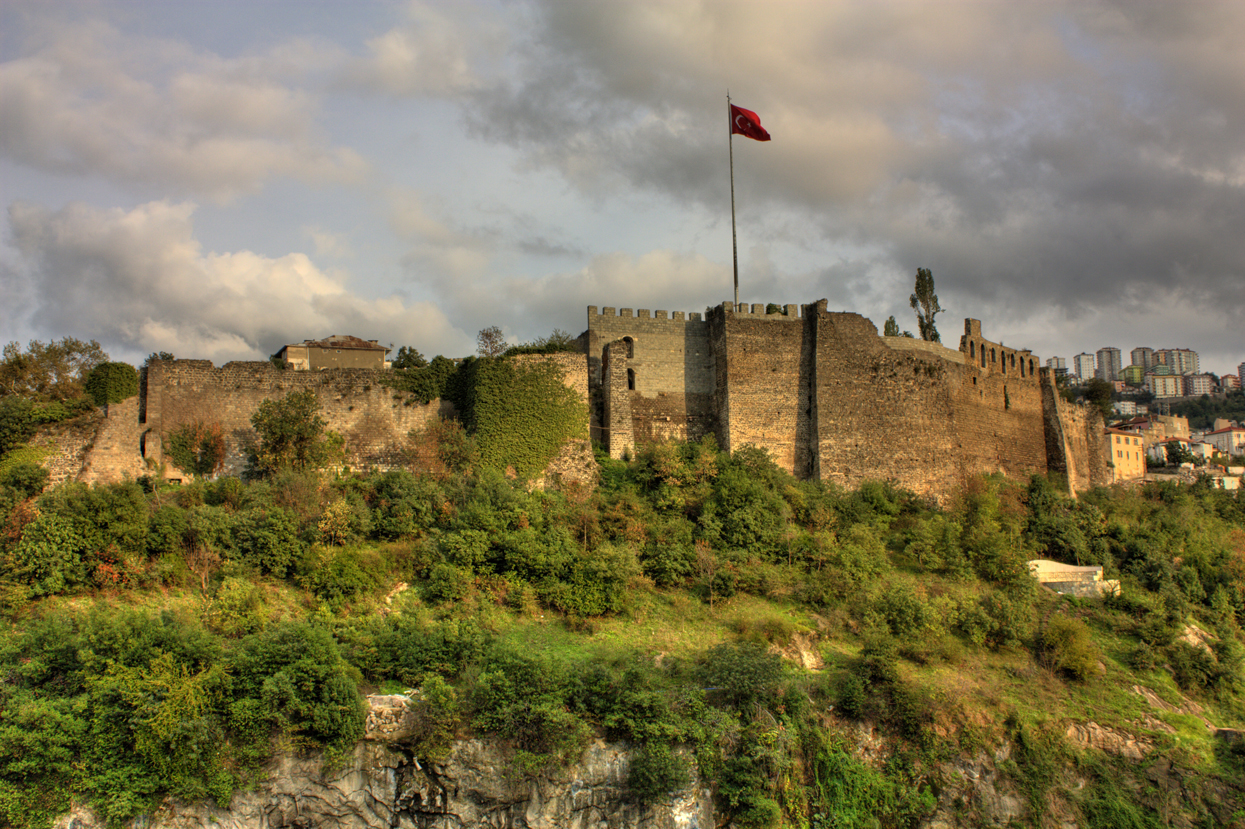
Trabzon Castle is one of those rare places where time seems to stand still, a quiet witness to the city’s layered past along the Black Sea coast. Unlike the more famous fortresses of Istanbul or Ankara, it doesn’t draw crowds, and that’s part of its charm. The stones here carry the weight of centuries, each one a silent record of the empires, traders, and travelers who once passed through this crossroads of cultures. Perched on a hill overlooking the city and the sea, the castle offers a view that shifts with the light—especially at sunset, when the fading sun turns the old walls gold and the distant waves shimmer like liquid metal.
The origins of the castle are lost in the mists of antiquity, though historians agree it has stood here in some form since Roman times. Trabzon was already an important port on the Silk Road, and the first fortifications were likely built to protect its growing wealth. By the Byzantine era, the fortress had expanded, its walls reinforced to fend off raids from nomadic tribes and Arab armies. But its golden age came in the 13th century, when Trabzon became the capital of the Trebizond Empire—the last remnant of Byzantium, clinging to existence until the mid-15th century. It was during this period that the castle took on the shape we see today, though time and neglect have since softened its edges.
Walking through the ruins, you can trace the layers of history in the architecture. The lower walls, built from massive stone blocks, are unmistakably Roman, their rough surfaces worn smooth by centuries of wind and rain. Higher up, the crenellated battlements and towers bear the marks of Byzantine and Ottoman craftsmanship, their once-sharp lines now blurred by time. Inside the fortress, little remains of the palaces, churches, and barracks that once filled the space—just scattered foundations overgrown with grass and wildflowers. The most striking feature is the central tower, rising above the rest like a sentinel. From its heights, guards once scanned the horizon for approaching ships or armies, their voices long since faded into the wind. Now, the tower is empty, its stairs worn hollow by the footsteps of countless soldiers, but if you listen closely, you can almost hear the echoes of their commands.
The castle was once a city unto itself, divided into three distinct sections. The Upper City was the heart of power, home to the imperial palace and the grandest religious buildings. Today, only fragments of the palace walls remain, their arches framing views of the modern city below. The Middle City was where the nobility and merchants lived, their homes built close to the seat of power. The Lower City, meanwhile, was the domain of artisans and laborers, its narrow streets lined with workshops and markets. Though the boundaries between these areas have blurred over time, you can still sense the hierarchy in the way the land slopes and the ruins are arranged. In the Lower City, the remains of ancient baths and water cisterns hint at the daily life that once thrived here, while in the Upper City, the occasional mosaic tile or carved stone speaks of a lost grandeur.
What makes Trabzon Castle so compelling is its lack of polish. There are no signs, no roped-off paths, no carefully curated exhibits—just the raw, unfiltered presence of history. You’re free to wander, to climb the crumbling walls, to run your fingers over stones that were laid centuries ago. Some parts of the fortress are dangerously unstable, their steps slick with moss or their foundations eroded by rain, but that only adds to the sense of authenticity. It’s a place where you’re trusted to explore at your own risk, where the past isn’t sanitized for tourists but left to speak for itself.
From the castle’s heights, the modern city unfolds like a living map. Below, the minarets of mosques punctuate the skyline, their calls to prayer drifting upward on the breeze. The bazaars hum with activity, their narrow alleys filled with the scent of spices and fresh bread. Beyond the city, the Pontic Mountains rise in a tangle of green, their slopes dotted with ancient monasteries and villages that seem untouched by time. On clear days, the snow-capped peaks of the Caucasus shimmer in the distance, a reminder that Trabzon has always been a meeting point—of empires, of trade routes, of cultures.
Most visitors to Trabzon never make it up to the castle, preferring the comfort of the seaside promenade or the shade of the city’s parks. That means the fortress is usually quiet, its silence broken only by the occasional tourist or the cry of a seagull circling overhead. The best time to visit is early morning, when the air is cool and the light soft, or in the evening, when the setting sun casts long shadows across the ruins. If you’re lucky, you might catch the distant glow of ship lights on the horizon, a reminder that this was once one of the busiest ports on the Black Sea.
Trabzon Castle isn’t the kind of place that dazzles with grand reconstructions or interactive displays. Instead, it offers something rarer: a direct, unmediated connection to the past. The stones here remember emperors and sultans, merchants and soldiers, the hands that built them and the wars that scarred them. There’s no need for plaques or audio guides—just the wind, the sea, and the quiet weight of history pressing against your skin. If you listen closely, you might hear it too.