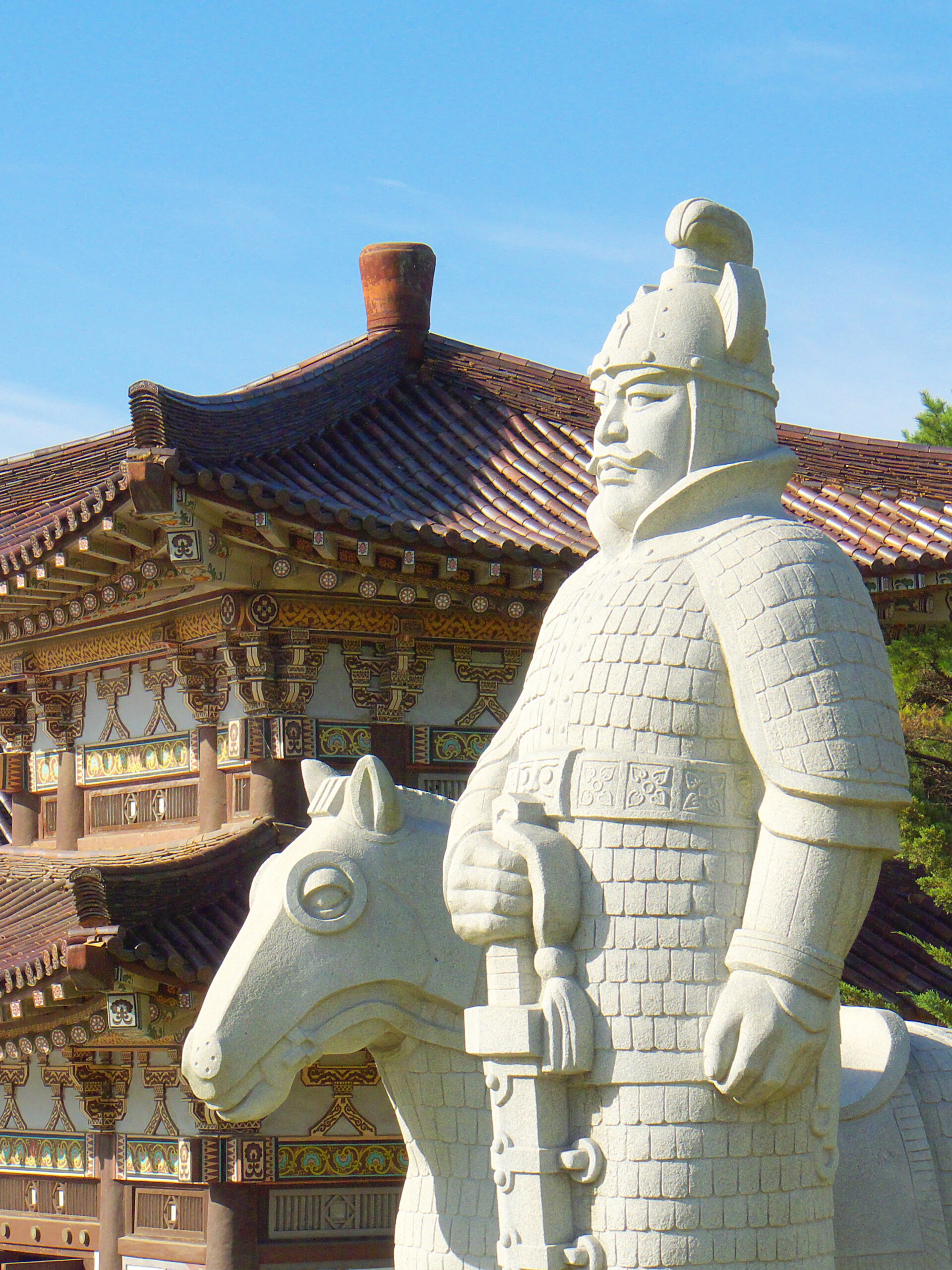
The Tomb of King Tongmyong sits on the outskirts of Pyongyang, where the city’s modern edges give way to low, rolling hills. There’s a quietness here, as if the land itself has settled into a slower rhythm. This isn’t just an ancient monument—it’s a remnant of Koguryo, one of the earliest Korean kingdoms, which once stretched across the northern part of the peninsula. King Tongmyong, who founded the kingdom in the first century BCE, lies buried beneath this earthen mound, and the site has become more than a grave. It’s a symbol of a past that North Korea holds close, a physical link to an era when this land was a center of power and culture.
The tomb’s architecture is imposing yet restrained. A massive burial mound rises from the ground, its slopes reinforced with stone slabs carved with faded symbols and patterns. The entrance remains hidden, but the sheer scale of the structure speaks for itself. Smaller mounds nearby suggest the resting places of royal family members or high-ranking officials, a tradition common in ancient Korean burial practices. The simplicity of the design doesn’t diminish its grandeur—it only makes the weight of history feel more tangible.
This site wasn’t chosen by accident. The area around Pyongyang was the heart of Koguryo, and the tomb was once part of a larger complex that included temples, altars, and ceremonial spaces. Today, little remains of those structures, but their absence doesn’t erase their significance. Archaeological work over the years has confirmed the tomb’s authenticity, tying it firmly to the Koguryo period. For North Korea, this isn’t just an archaeological site—it’s a point of national pride, a reminder of a time when Korea was a dominant force in the region.
In a country where history is often woven into the fabric of national identity, the Tomb of King Tongmyong serves a purpose beyond preservation. It’s presented as proof of Korea’s ancient roots, a testament to a civilization that was advanced and independent long before modern borders took shape. For visitors, it offers a rare glimpse into a chapter of history that’s often overshadowed by more recent events. There’s no grand narrative here, no polished tourist experience—just the quiet persistence of the past.
The atmosphere around the tomb is one of stillness. Pine trees dot the hills, and the only sounds are the wind through the grass and the occasional rustle of leaves. On clear days, the view from the top of the mound stretches across the landscape, making it easy to imagine how this place might have looked two thousand years ago. There’s no crowd, no noise—just the sense of being somewhere untouched by time. Even with other visitors nearby, the experience feels personal, whether you’re here to pay respects to an ancient ruler or simply to reflect on how quickly eras pass.
This isn’t the kind of place where tourists pose for endless photos or rush from one attraction to the next. There are no souvenir stands, no flashy signs—just the tomb and the land around it. It demands a different kind of attention, one that goes beyond dates and names. The stones and carvings hold stories that aren’t always written in textbooks, and that’s part of what makes the site compelling. For those who visit, it often becomes one of the most memorable stops in Pyongyang, not because it’s grand or dramatic, but because it feels real.
Access to the tomb, like many historical sites in North Korea, is usually arranged through guided tours. This isn’t just about preservation—it’s how tourism works in the country. Visitors are accompanied by a guide who explains the site’s history and its importance to the Korean people. The format has its limitations; you can’t wander freely or ask questions that stray too far from the official narrative. But it also provides context, a way to understand why this place matters in a way that might not be obvious at first glance.
Despite these constraints, the Tomb of King Tongmyong remains a meaningful stop for anyone interested in Korea’s past. It’s a reminder that even in a country often defined by its present, there are places where history isn’t just remembered—it’s alive in the earth, the stones, and the air. This isn’t a destination for those looking for spectacle. It’s for those who want to see history not as a distant concept, but as something that endures, waiting to be noticed by those who take the time to look.