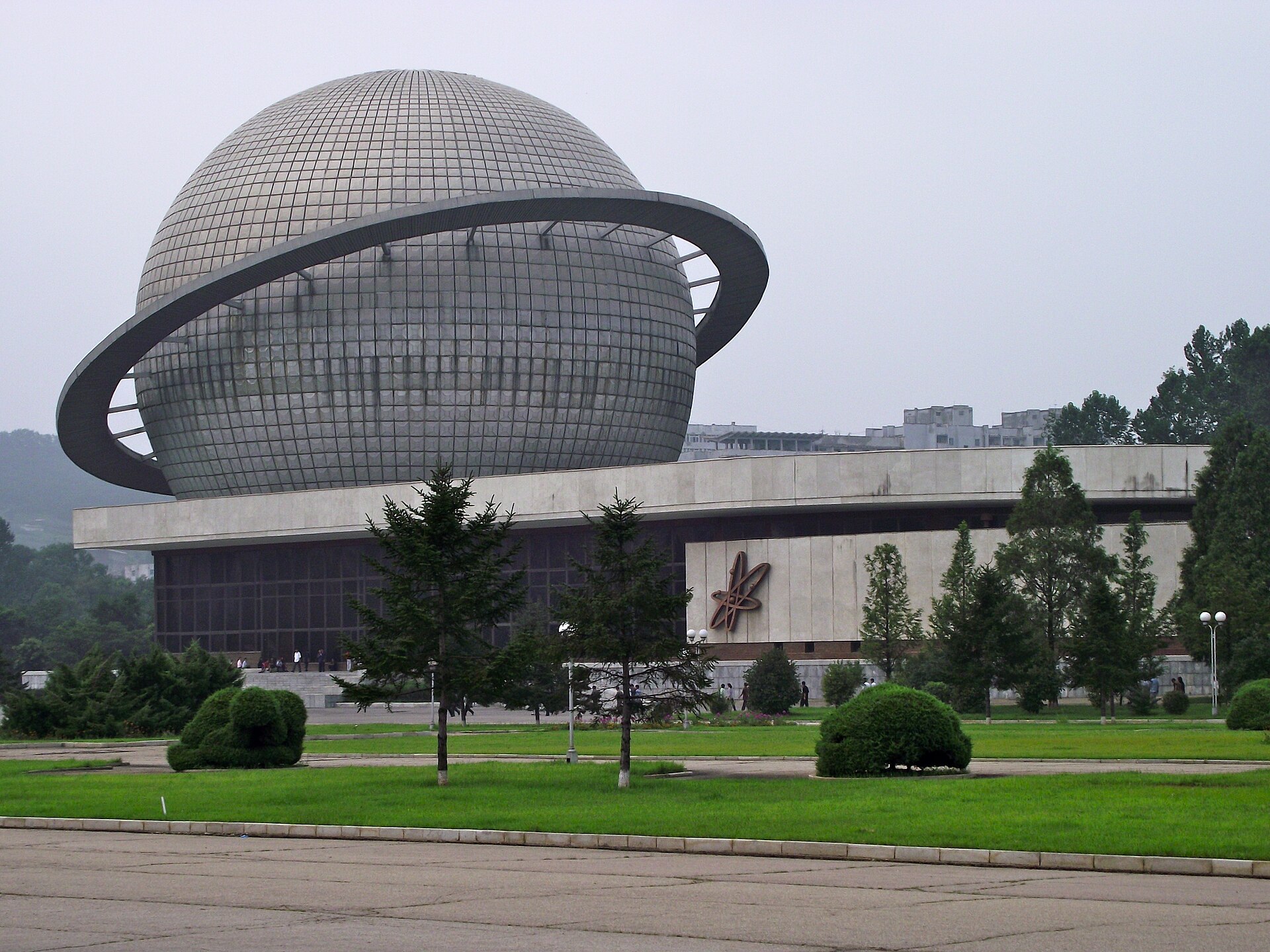
The Three Revolutions Exhibition in Pyongyang is one of those places where ideology and architecture merge into something far grander than its physical form. Built in the 1990s, it was conceived as a monument to North Korea’s progress in three key areas: ideology, technology, and culture. The complex sprawls across a vast area on the outskirts of the capital, its presence announced by towering sculptures of workers, farmers, and intellectuals, all striding forward as if leading the nation into the future. There’s nothing accidental about its design—every hall, every display, every carefully arranged detail serves a single purpose: to demonstrate how the country transforms under the guidance of the Workers’ Party.
The architecture here is imposing, almost overwhelming in its scale and symbolism. The central building resembles a colossal pavilion, its wide staircases and light stone columns framing an entrance dominated by the national emblem of the DPRK. Flanking the doors are murals depicting labor and unity, their bold strokes reinforcing the narrative of collective effort. Inside, the pavilions house exhibits showcasing industrial achievements—scale models of factories, agricultural machinery, and samples of domestically produced goods. It’s an attempt to craft an image of progress, where even modest advancements are presented as monumental victories.
One of the most striking sections is dedicated to the ideological revolution. Here, visitors encounter walls of quotes from Kim Il Sung and Kim Jong Il, photographs of mass rallies, and miniature replicas of the country’s memorial complexes. The message is clear: the leaders are the architects of change, the driving force behind every success. For North Koreans, this isn’t just a museum—it’s a place of pilgrimage, where they can see firsthand the righteousness of the nation’s path. Foreign visitors, meanwhile, are shown a carefully curated version of reality, one that leaves no room for doubt or criticism.
The technological revolution is represented through displays of engineering, energy, and construction. One pavilion features models of hydroelectric dams, another showcases agricultural machinery supposedly designed and built in North Korea. There’s a particular emphasis on the country’s nuclear program, though it’s framed exclusively in terms of peaceful applications. The exhibits include explanatory plaques in Korean and English, but the information often leans heavily into propaganda, glossing over challenges or failures.
Culture takes center stage in halls devoted to education, art, and sports. School textbooks, traditional crafts, and photographs of athletic achievements line the walls, while exhibits highlight mass festivals like the Arirang Games, where thousands perform synchronized routines with military precision. The displays are meant to convey societal unity and devotion to the principles of *juche*, the state ideology of self-reliance. It’s a vision of harmony, where every citizen plays their part in the grand narrative.
The atmosphere at the exhibition is tightly controlled. Visitors are escorted by guides who recite rehearsed accounts of the country’s accomplishments. Photography is permitted only in designated areas, and questions that stray from the official script go unanswered. For outsiders, the place offers a glimpse into a closed world, where reality is replaced by a meticulously constructed story. For locals, it’s a familiar part of life—schoolchildren come here on field trips, and adults visit to reaffirm their loyalty to the system.
Despite its ideological weight, the complex is undeniably impressive in its sheer scale. The towering sculptures, expansive plazas, and cavernous halls create a sense of grandeur, even if that grandeur doesn’t always reflect tangible progress. Nothing here is left to chance—every element is designed to reinforce the intended effect. Even the landscaping serves this purpose: manicured lawns, symmetrically planted trees, and flowerbeds arranged in patterns resembling national symbols all contribute to the illusion of order and control.
The Three Revolutions Exhibition is more than a museum—it’s a tool of propaganda, designed to sustain the cult of personality and the ideological cohesion of North Korean society. At the same time, it reflects the country’s effort to craft its own myth, one where achievements are exaggerated and problems are ignored. For those who accept the official narrative, it may feel convincing. For others, it stands as another example of how ideology can reshape reality, turning history into a collection of symbols and slogans.
In Pyongyang’s landscape of monuments, this exhibition holds a unique place. It’s less famous than the Juche Tower or the Arch of Triumph, but no less revealing. There are no tourists snapping photos for social media—just organized groups following their guides. In that sense, it feels less like a museum and more like a ritual space, a place where the state’s version of history is performed rather than simply observed. For anyone trying to understand North Korea from the inside, it’s one of the most intriguing stops on the itinerary.