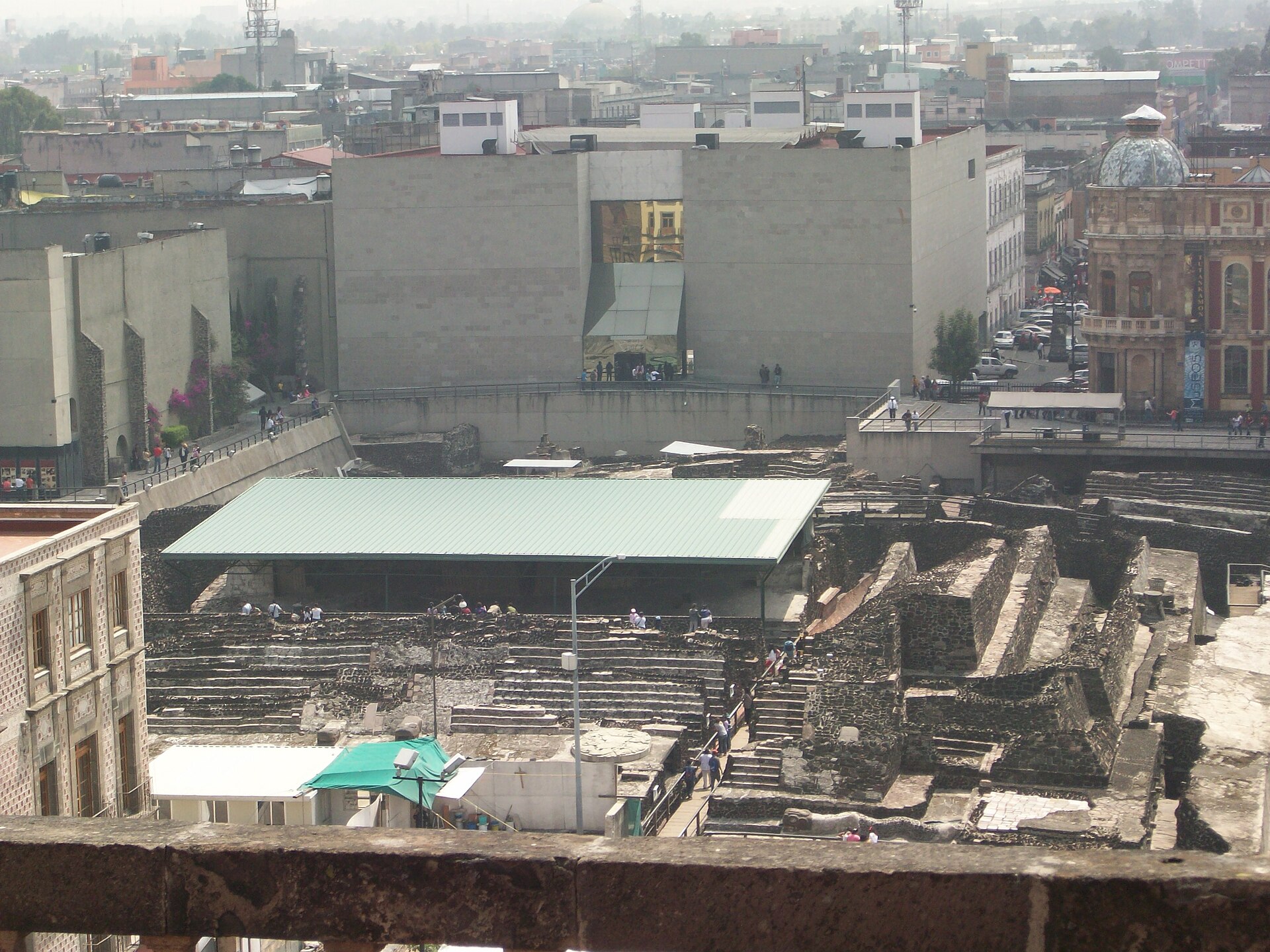
Standing in the heart of Mexico City, the ruins of Templo Mayor offer a rare glimpse into the world of the Aztecs, a civilization that once dominated the Valley of Mexico. This was no ordinary temple—it was the sacred core of Tenochtitlan, the capital of an empire that stretched across Mesoamerica. Built in layers over centuries, the great pyramid was dedicated to two deities: Huitzilopochtli, the fierce god of war and sun, and Tlaloc, the rain-bringer whose favor meant life or famine. The dual sanctuaries at its summit embodied the Aztec view of the universe, where opposing forces—destruction and renewal, fire and water—were not just balanced but intertwined. For the people who built it, this was the center of the world, the place where the heavens, earth, and underworld met.
The temple’s rediscovery in 1978 was nothing short of miraculous. Workers digging beneath the city streets stumbled upon a massive stone disk carved with the image of Coyolxauhqui, the moon goddess. What followed was one of the most significant archaeological finds of the 20th century. Beneath the colonial-era buildings, archaeologists uncovered not just fragments but entire structures of the temple complex, preserved almost intact. The Spanish had razed Tenochtitlan to build their own city, yet here, buried under layers of history, the past had survived. Today, the ruins sit in stark contrast to the modern metropolis around them—a quiet reminder that beneath the surface of Mexico City, another world still exists.
The pyramid itself was a towering structure, rising nearly sixty meters high, its steps leading to the twin shrines at the top. The walls were once covered in vivid murals, their colors long faded but their presence still felt in the weathered stone. This was where rituals unfolded—processions of priests, the beating of drums, the scent of copal incense mingling with the metallic tang of blood. The Aztecs believed their gods demanded sacrifice, and the temple was the stage for these acts. Excavations have revealed thousands of offerings: human bones, the remains of animals, obsidian blades, and jewelry made of jade and gold. Among the most striking finds is the Tizoc Stone, a massive monolith carved with scenes of conquest, likely used in ceremonies to honor the empire’s victories.
Around the main pyramid, the sacred precinct stretched outward, a labyrinth of smaller temples, ball courts, and altars. One of the most intriguing discoveries was the sacred garden, where plants used in rituals were cultivated. The Aztecs saw their city as the axis of the cosmos, and Templo Mayor was its beating heart. When the Spanish arrived in 1521, they systematically dismantled the temple, using its stones to build the Metropolitan Cathedral that now looms nearby. What remains today are the lower tiers of the pyramid, but even these fragments convey its former grandeur. The steps, worn smooth by centuries of footsteps, still lead upward, as if inviting visitors to imagine the ceremonies that once took place here.
The adjacent museum is where the temple’s story truly comes alive. Housing over 7,000 artifacts unearthed from the site, it offers a tangible connection to the past. The most famous piece is the colossal statue of Coatlicue, the earth goddess, her body adorned with skulls and serpents—a stark representation of life and death. Nearby, intricate carvings depict gods and warriors, while delicate jewelry and pottery hint at the craftsmanship of Aztec artisans. Among the most moving exhibits are the simple objects: children’s toys, clay figurines, and everyday tools. They serve as a reminder that this was not just a place of power and ritual, but a city where ordinary people lived, worked, and dreamed.
Walking through Templo Mayor is like stepping into a different era. The air feels heavier here, charged with the weight of history. The stones, still bearing traces of red and blue pigment, seem to whisper of the past. It’s easy to picture the crowds that once gathered here, the priests in feathered headdresses, the warriors returning from battle. The Spanish conquest erased much of this world, but not all of it. The temple’s destruction was meant to erase the old gods, yet their presence lingers in the very ground beneath the city. Even the cathedral next door, built to symbolize a new faith, stands on foundations that were once sacred to another.
Mexico City is a place of layers, where the past and present coexist in uneasy harmony. Templo Mayor is one of the few places where that history feels tangible. The ruins are surrounded by the noise of the city—honking cars, street vendors, the hum of daily life—but here, time seems to slow. Early mornings are the best time to visit, when the light is soft and the crowds are thin. As the sun rises, it catches the edges of the stones, illuminating the carvings and the faint remnants of paint. Each detail tells a story: the curve of a staircase, the pattern of a mural, the way the light falls on a particular spot. It’s in these small moments that the past feels closest.
What makes Templo Mayor so compelling is not just its age, but its resilience. The Aztecs believed their empire would last forever, yet it fell in a matter of years. The Spanish, in turn, built their own legacy on its ruins, only for their city to become part of the story as well. Today, Mexico City is a sprawling metropolis of over twenty million people, where skyscrapers stand alongside colonial churches and ancient temples. Templo Mayor is a reminder that history is not a straight line, but a cycle—one that continues to unfold. It’s a place that forces you to confront the fragility of civilizations, the way empires rise and fall, and the traces they leave behind.
For anyone visiting Mexico City, Templo Mayor is more than a tourist stop. It’s a place to pause, to reflect, and to listen. The stones here have seen centuries of change, and they carry the memories of those who came before. Whether you’re drawn by history, archaeology, or simply the quiet power of a place where the past feels alive, this is one of those rare sites that stays with you long after you’ve left. In a world that moves too fast, it’s a reminder that some things endure.