Skip to content

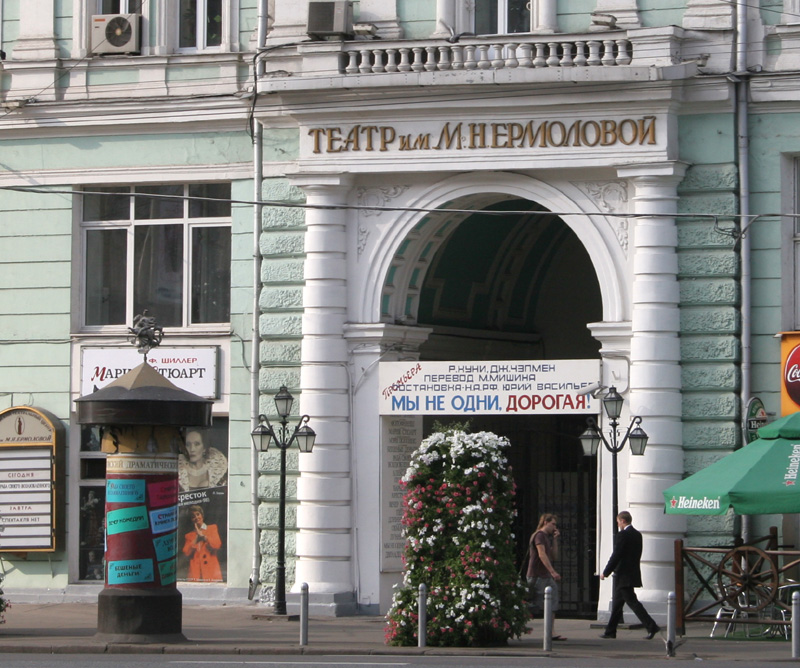
Photo: Зимин Василий геннадиевич, Public domain

Yermolova Theatre

See & Do Sight
The Yermolova Theatre is one of those rare places in Moscow where time seems to slow down, where the walls themselves carry the weight of decades of theatrical history. Tucked away in the heart of the city, just a short walk from the Kremlin, it occupies a quiet corner of Moscow’s cultural landscape. Unlike the grand, tourist-packed venues that dominate the center, the Yermolova feels like a well-kept secret—a place where the past and present coexist without fanfare, where the tradition of live performance is kept alive not through spectacle, but through sincerity.

The theatre’s story began nearly a century ago, when a group of graduates from the Studio of the Maly Theatre decided to carve out their own space in Moscow’s theatrical world. In 1925, they staged their first performance, laying the foundation for what would become one of the city’s most respected institutions. The theatre was named in honor of Maria Yermolova, a legendary actress whose name had become synonymous with Russian dramatic art in the early 20th century. Though Yermolova herself never performed on this stage, her influence lingers in the theatre’s commitment to depth, emotion, and the power of the spoken word.

The building itself is unassuming, almost modest in its appearance. There are no towering columns or gilded facades here—just a simple, intimate space that feels more like a gathering place than a grand cultural monument. The auditorium is small, with seats arranged so closely to the stage that the boundary between actor and audience often blurs. This closeness creates an atmosphere where every glance, every pause, every line delivered feels personal, as if the performance is unfolding just for you. It’s not the kind of theatre where you can drift off or scroll through your phone; here, the experience demands attention, and in return, it offers something far more rewarding.

When Oleg Menshikov took over as artistic director, the theatre entered a new phase of its evolution. Menshikov, a figure known for his ability to bridge the gap between classical and contemporary theatre, brought fresh energy to the Yermolova without discarding its traditions. Under his leadership, the repertoire expanded to include both time-honored classics and bold new works, all while maintaining the theatre’s focus on strong performances and compelling storytelling. The result is a programme that feels both rooted and dynamic, where Chekhov shares the stage with modern playwrights, and where experimentation is welcomed—but never at the expense of substance.

The theatre’s company is a mix of seasoned performers and rising talent, each bringing their own style and perspective to the stage. Actors like Vladimir Andreev, Anastasia Nazarova, and Sergei Golovin have long been associated with the Yermolova, while younger performers such as Kristina Asmus and Dmitry Melnikov represent the next generation. This blend of experience and youth gives the theatre’s productions a sense of vitality, where each performance feels distinct, unpredictable, and alive. The chemistry between the actors is palpable, whether they’re tackling a 19th-century drama or a contemporary piece.

What sets the Yermolova apart is its approach to programming. Rather than chasing trends or box-office success, the theatre chooses plays that resonate with the here and now—stories that challenge, provoke, or simply offer a moment of reflection. The repertoire includes everything from Shakespeare’s *Hamlet* and Gogol’s *The Government Inspector* to modern works like *Text* and *The Biggest Little Drama*. Some productions, like *The Picture of Dorian Gray* or *1900*, have become standout events, offering fresh interpretations of familiar tales. Yet the theatre never prioritizes shock value or novelty for its own sake; instead, it invites the audience to engage, to feel, and to connect with the material on a deeper level.

Menshikov’s own performances are a major draw. Whether he’s taking on the role of Hamlet or starring in a contemporary piece, his presence on stage is magnetic. He doesn’t just act—he inhabits his roles so fully that the line between character and performer dissolves. It’s this intensity that keeps audiences coming back, filling the theatre even on nights when other venues struggle to sell tickets. His work is a reminder of what live theatre can achieve when an actor is truly in sync with the material and the moment.

But the Yermolova isn’t just for theatre aficionados. It’s a place where anyone can come to spend an evening in good company, surrounded by the kind of storytelling that lingers long after the curtain falls. There’s no pretension here, no need to be an expert to appreciate what’s happening on stage. The theatre’s strength lies in its ability to make even the most complex themes feel accessible, to create an atmosphere where the audience isn’t just watching a play—they’re part of it.

Visiting the Yermolova is an opportunity to experience theatre as it was meant to be: intimate, immediate, and deeply human. After the performance, you can step out into the quiet streets of central Moscow, where the city’s history is etched into every building and cobblestone. The theatre is just one chapter in that story, but it’s a chapter worth savoring—a place where the magic of live performance is kept alive, one show at a time.
Day around this place

Where else to go on the same day

Building the day…

Where it is

55.75784, 37.61257

Contacts

Nearby in the same city

All places in Moscow