Tashmajdan is one of those places in Belgrade where the city’s past feels almost tangible, rising through the layers of time like an old scar. The name itself hints at its origins—*taş* meaning stone and *meydan* meaning square in Turkish—referring to the quarries that once supplied building material for Ottoman fortresses and mosques. Today, it’s a park, a green pocket in the heart of the city, but beneath the grass and pavement, the echoes of its history remain. Ancient stone pits, forgotten tunnels, and fragments of Roman and Byzantine structures lie just below the surface, reminders of how this land has been shaped and reshaped over centuries.
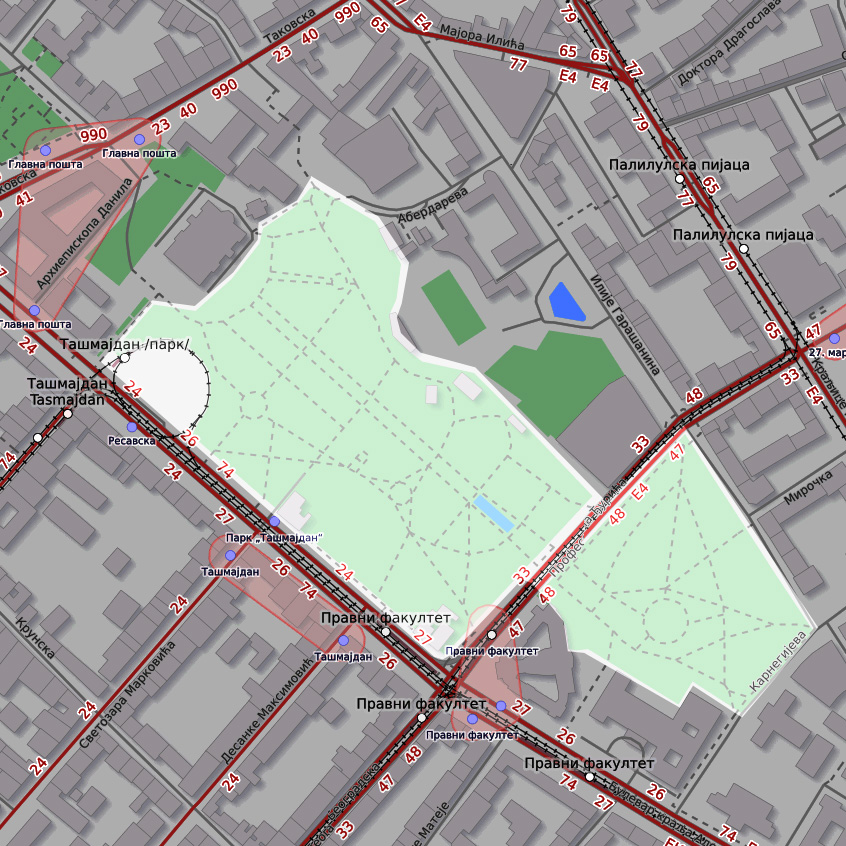
In the 19th century, Tashmajdan was a stage for public executions, a grim testament to its role in the city’s darker moments. Later, it became a gathering place for protests, celebrations, and political rallies, a space where Belgrade’s collective voice could be heard. The park stretches between Takovska Street, Ilije Garašanina Street, and King Alexander Boulevard, a quiet contrast to the bustle of the surrounding avenues. There’s no single grand entrance, but the most recognizable approach is from the side of St. Mark’s Church, its golden domes peeking through the trees like a beacon.
St. Mark’s itself is a striking presence, built in 1940 on the site of an older 19th-century church. Its design draws from medieval Serbian monasteries, particularly Gračanica, with its distinctive red bricks, white stone accents, and cross-shaped layout. Inside, the mosaics and frescoes follow Byzantine traditions, creating an atmosphere of solemn beauty. The church also houses the sarcophagus of Tsar Dušan, one of Serbia’s most powerful medieval rulers, making it a place of both spiritual and historical significance for many Belgraders.
Nearby, the former Radio Belgrade building stands as a relic of the 1930s, its modernist architecture still carrying the weight of its past. Once the voice of Yugoslavia, the radio station broadcast news and culture across the country. Today, the building hosts exhibitions, concerts, and lectures, but the old radio’s presence lingers in the high ceilings and large windows. It’s easy to imagine the voices of past announcers filling the halls, a ghostly echo of a different era.
Tashmajdan’s most somber landmark is the memorial to the victims of the 1941 Nazi bombings. A modest stone monument with an eternal flame, it honors those who perished in the early days of World War II. The names inscribed on the plaques and the mass grave nearby serve as a quiet but powerful reminder of the human cost of war. Veterans, school groups, and ordinary citizens often visit, paying their respects in silence.
The park itself is unassuming, a place where life unfolds without pretense. On any given day, you might see students strumming guitars on benches, elderly men playing chess under the shade of trees, or families pushing strollers along the paths. There’s no attempt at grandeur here—just the rhythm of everyday life. In the summer, the park fills with people seeking refuge from the heat, while winter brings ice skaters to the small rink. Spring transforms the space into a burst of color, as if nature is reclaiming what was once stripped away by centuries of stone extraction.
Beneath the surface, Tashmajdan holds even more secrets. Long before it was a park, the area was a network of quarries and catacombs, supplying stone for the Roman city of Singidunum, as Belgrade was then known. The Ottomans later used the same quarries to build their mosques and fortifications. Some of these underground passages have been sealed off, but stories about them persist—tales of wartime hideouts, smugglers, and thieves who once lurked in the shadows. Whether these legends are entirely true or not, they add to the park’s mystique.
What makes Tashmajdan special is its ability to feel both timeless and immediate. It’s a place where history isn’t confined to plaques or museums but seeps into the present. The park doesn’t demand attention or admiration; it simply exists, much like Belgrade itself—loud, contradictory, and alive. You can visit in the morning with a book, return in the afternoon with children, or wander through in the evening with friends, and each time, it will reveal something new. There’s no need for spectacle here. The weight of its past, the quiet hum of daily life, and the occasional glimpse of something unexpected—those are the things that make Tashmajdan more than just a park. It’s a piece of the city’s soul.