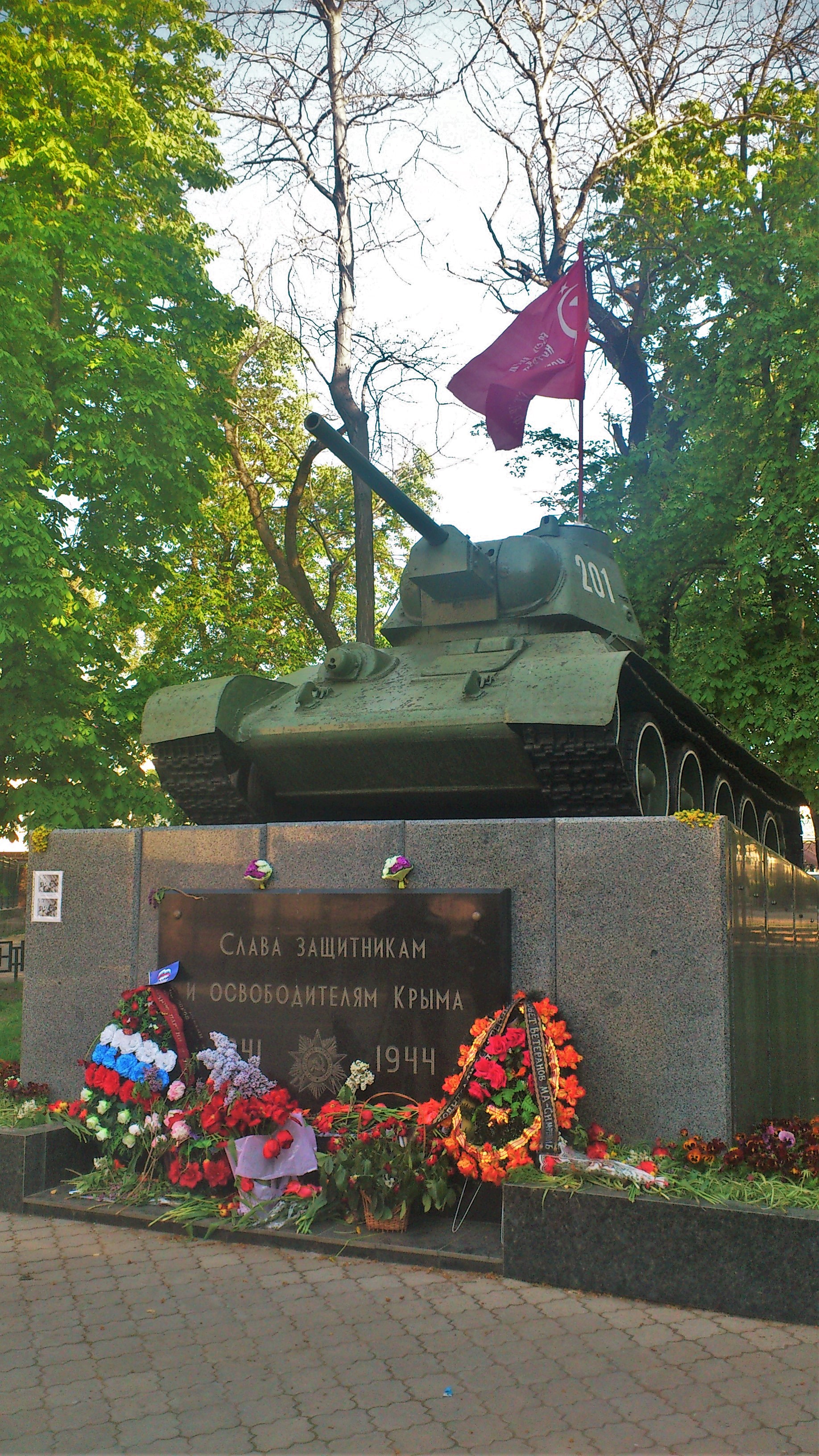
The tank monument to the liberators of Simferopol stands where the city’s past and present quietly intersect. It’s not tucked away in a grand square or behind museum gates but positioned at a modest elevation near the junction of Kievskaya and Sevastopolskaya streets, a spot that saw some of the fiercest fighting in April 1944. For locals, it’s an unremarkable part of the urban landscape, a familiar landmark passed daily without much thought. For visitors, it often comes as a surprise—a real T-34 tank, its barrel raised as if still poised for battle, set on a granite pedestal amid the hum of city life.
The story of the monument begins in the immediate aftermath of the war. In 1945, one of the tanks that had fought in the battle for Simferopol was recovered from its final battlefield and placed here. At the time, it wasn’t just a symbol of victory but a stark reminder of the cost of that victory. Over the years, the site grew into a small memorial complex. Granite slabs bearing the names of the fallen were added, followed by an eternal flame and later, plaques recounting the key events of the city’s liberation. Today, it remains a place where history is both honored and taught—where veterans come to remember, and schoolchildren attend lessons on courage.
The T-34 itself is one of the most recognizable symbols of the Second World War. More than just a machine, it represented a turning point in military technology, combining speed, firepower, and durability in a way that made it formidable on the battlefield. The tank on the pedestal is preserved in its wartime state, its tracks still caked with the dust of the past. A small plaque nearby recounts how Simferopol was retaken in April 1944 during the Crimean Offensive, a brief but brutal chapter in the region’s history. The monument doesn’t glorify war; it simply stands as a silent witness to what happened here.
For Simferopol, this isn’t just another war memorial. It’s a place where the city’s collective memory is kept alive. On ordinary days, you might see an elderly veteran laying flowers at the base of the tank or a group of teenagers snapping photos before moving on. But on Victory Day and the anniversary of the city’s liberation, the atmosphere shifts. Hundreds gather here—families, students, officials—listening to speeches, watching as wreaths are placed and the eternal flame flickers in the breeze. There’s no grand ceremony, just a quiet, shared moment of reflection.
The location of the monument isn’t accidental. Kievskaya Street, where it stands, was one of the last lines of defense during the battle for Simferopol. In 1944, this area saw house-to-house fighting, with every building turned into a fortress. Today, the street is lined with modern apartment blocks and busy traffic, a far cry from the ruins of wartime. Yet if you look closely, traces of the past remain—bullet scars on the walls of older buildings, a reminder that history isn’t as distant as it sometimes seems. The monument bridges that gap, connecting the city’s wartime suffering with its present-day life.
Over time, the memorial has become woven into the fabric of daily life. It sits near bus stops, shops, and cafes, a constant presence in the background of the city’s routines. Most people pass by without a second glance, absorbed in their own lives. But on certain days, the space transforms. The square fills with people, the air hums with the sound of wartime songs, and in the evening, the glow of candles and the soft light of streetlamps create a different kind of atmosphere. For many in Simferopol, this is a place that pulls them back, if only for a moment, to remember what came before.
Architecturally, the monument is understated. The granite pedestal is simple and unadorned, the tank itself untouched by embellishment. Nearby, the names of the fallen are etched into stone, the eternal flame framed by a metal wreath. There’s no pomp or grandeur, just a sense of solemnity and respect. The design doesn’t try to impress; it lets the weight of history speak for itself. That’s perhaps why the monument doesn’t feel out of place in the city—it belongs here, as much a part of Simferopol as the streets and buildings around it.
Beyond its role as a war memorial, the site has become a place for quiet contemplation. School groups often visit, listening as teachers recount the events of 1944. Tourists stop to read the plaques, snapping photos before moving on. For some, it’s just another stop on a sightseeing route; for others, it’s a moment of connection to something larger than themselves. The monument doesn’t demand attention, but it doesn’t let you forget, either. It stands as a reminder that history isn’t just about dates and battles—it’s about the people who lived through them, the choices they made, and the legacy they left behind.