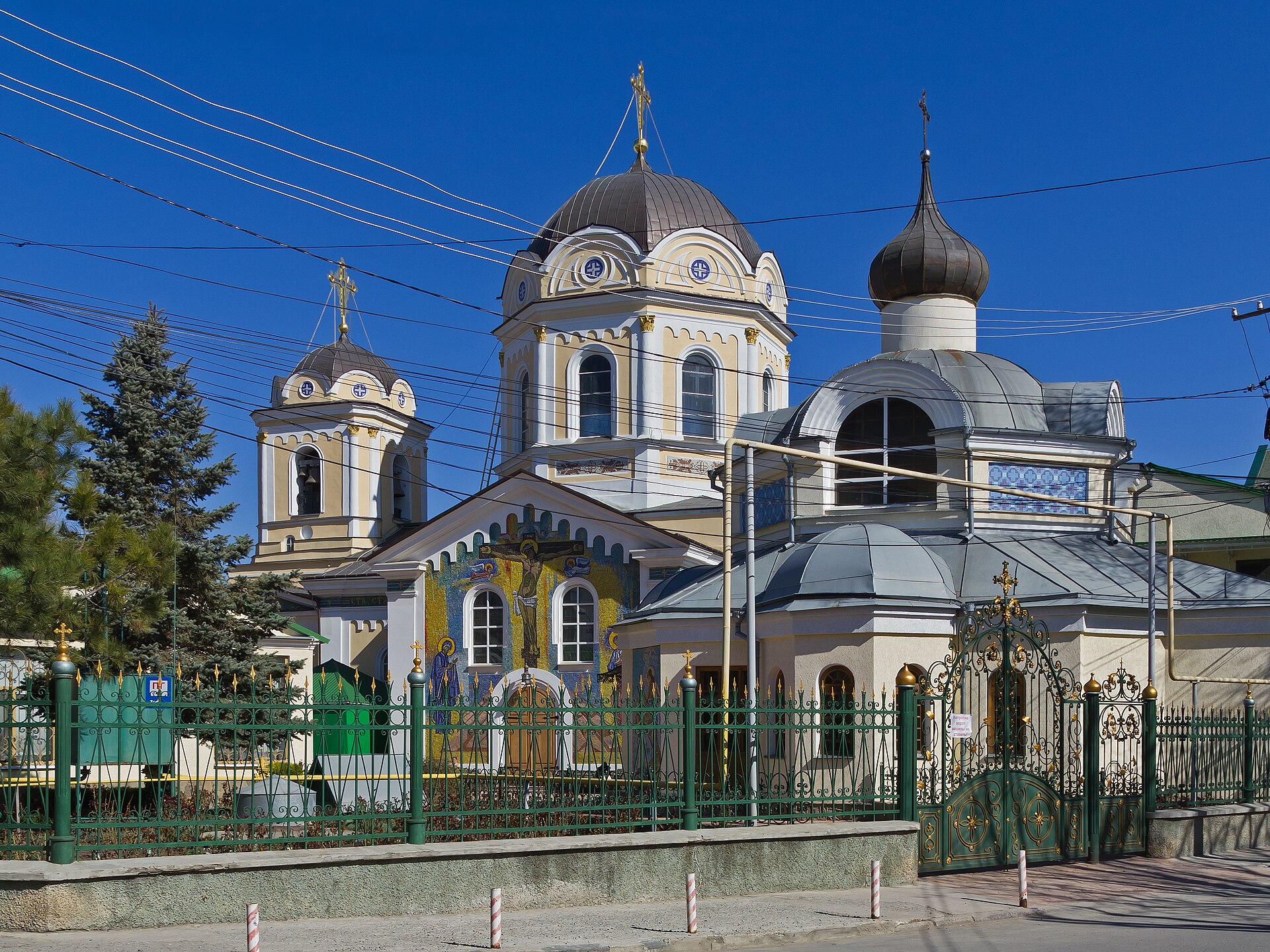
The Holy Trinity Cathedral in Simferopol is one of those quiet witnesses to history that still breathe with the life of the city. It stands at the intersection of streets that have seen the ebb and flow of time—from the Crimean Tatar quarters of the past to the Soviet-era boulevards that reshaped the city. The building itself seems to hold the memory of these changes, not as a relic, but as something that has grown alongside the people who pass by it every day. It’s not just a monument; it’s a living part of Simferopol, where the rhythm of daily life—worshippers hurrying to services, tourists pausing in curiosity, locals treating it as a familiar landmark—unfolds naturally around it.
Built in the mid-19th century, the cathedral emerged when Simferopol was no longer a small provincial town but a growing administrative center of the Taurida Governorate. Its architecture reflects the era’s blend of traditional Orthodox forms with the emerging Russian Revival style. The white walls, domes, and bell tower give it a restrained elegance, as if the architect sought to create not just a place of worship but a sanctuary from the outside world. The cathedral has endured through the rise and fall of empires, revolution, and Soviet rule, when many churches were closed or destroyed. It survived, though not unscathed—mid-20th century saw it repurposed as a warehouse before being returned to the faithful.
Stepping inside, the atmosphere shifts. The quiet, the dim light, the scent of incense and wax—it all feels like a world apart. The iconostasis, painted in the traditional style, dominates the space, while the frescoes on the walls depict biblical scenes as 19th-century artists imagined them. The icon of the Holy Trinity, which gives the cathedral its name, stands out for its meticulous craftsmanship. Painted in a restrained academic style, it lacks grandiosity but carries a quiet intensity, as if each brushstroke holds the devotion of those who have prayed before it over the decades. Much was lost during the Soviet years, but what remains offers a glimpse of the cathedral’s former splendor.
Beyond its religious role, the Holy Trinity Cathedral is a piece of Simferopol’s cultural fabric. Over the years, it has been many things to many people—a symbol of imperial legacy, a place of solace, a quiet corner where one can feel connected to something enduring. Today, it remains a venue for services, baptisms, and weddings, each event weaving another small story into its history. Occasionally, the cathedral hosts concerts of sacred music, intimate and unassuming, yet deeply moving in their simplicity.
From the outside, the cathedral may seem modest compared to the grand cathedrals of Moscow or St. Petersburg, but that’s part of its charm. It doesn’t overwhelm with scale; instead, it invites you to step inside, sit on a bench in the courtyard, and watch the world go by. In summer, the shade of the trees and the scent of flowers planted by parishioners create a peaceful atmosphere. Winter brings a different kind of beauty, with snow dusting the domes and the quiet deepening, as if time itself slows down.
Simferopol is a city where cultures and traditions intertwine, and the Holy Trinity Cathedral is one of those landmarks that help make sense of its character. It doesn’t demand attention or try to impress visitors, which is perhaps why it feels so authentic. There’s nothing performative about it—just the solid presence of walls that remember the past and people who come here for reasons of their own. It’s not a museum but a place where faith and history continue to exist side by side with the present, quietly enduring.