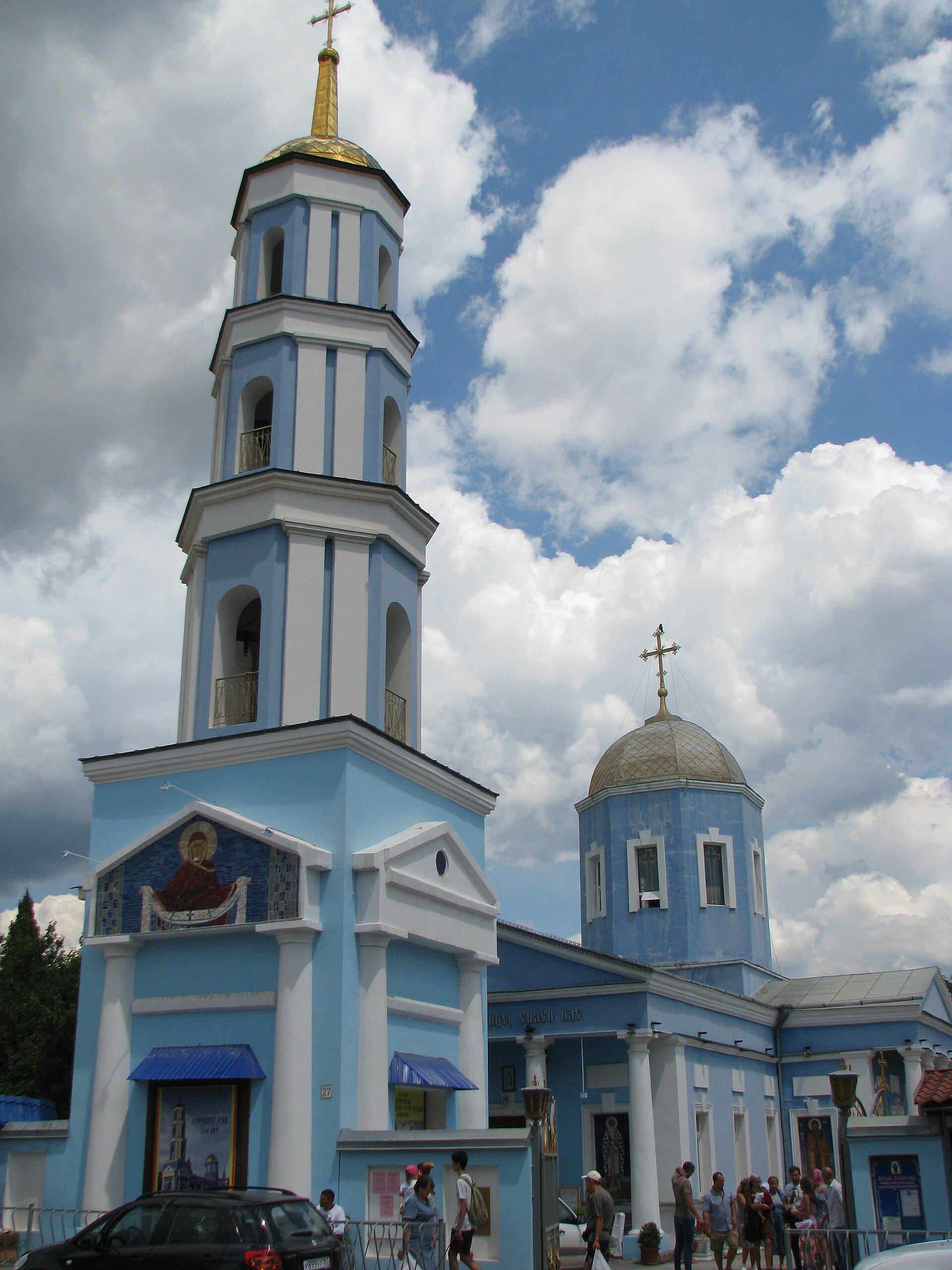
Perched on a gentle rise in the heart of Sudak’s old town, the Church of the Intercession of the Holy Virgin stands as a quiet guardian of time. Unlike cathedrals that tower over cities, this modest structure fits among low-slung houses with terracotta roofs and narrow streets worn smooth by generations.
In the 19th century, Sudak was a port where Greek, Armenian, and Russian communities lived side by side. The Orthodox parish took shape in the 1860s when locals pooled resources to build a church. The first version was wooden. The stone building that stands today went up later, toward the end of the century, after Sudak became part of the Russian Empire and began attracting visitors as a resort town. For the growing Orthodox community, the church marked their place in the town.
The architecture is simple. A single dome crowns the structure, and a bell tower rises in a style with Byzantine echoes. The walls, built from local limestone, have mellowed into a warm golden hue. Inside, darkened icons and wooden pews fill the space, along with the faint scent of incense. Prayers and hymns carry in the acoustics, making the space feel intimate.
During the Soviet era, the church was repurposed—first as a warehouse, then a club, and later a gym. In the 1990s, when religious life revived across Russia, the building was returned to the faithful. Restoration was slow, scrubbing away layers of neglect. Today, the church holds services for locals and visitors. For those who grew up in Sudak, it holds childhood memories and family traditions.
The church has seen the town’s fortunes shift. Fishermen, merchants, soldiers, and townspeople have passed through its doors. In summer, tourists wander in, but even then, the atmosphere remains quiet. The worn stone steps, the flicker of candlelight, and the rustle of prayer books make the space feel lived-in.
Major holidays bring the most striking moments. On Christmas and Easter, the church is adorned with flowers, and bells ring beyond the old town. Even those who rarely attend services come here on these days. The liturgy follows ancient traditions, and the voices rise and fall in the vaulted space. It reminds you how ritual can anchor a community.
A small courtyard lies beyond the church walls. Old trees cast shade in summer, and cicadas hum. Locals leave food for stray cats, which doze near the entrance. You might linger here, watching the light shift across the stone.
What makes the Church of the Intercession of the Holy Virgin stand out isn’t its size or grandeur. It’s the quiet persistence of a place that has endured. If you want to sense the layers of history beneath the surface, this is where you’ll find them. The church doesn’t tell its story—it lets you discover it.