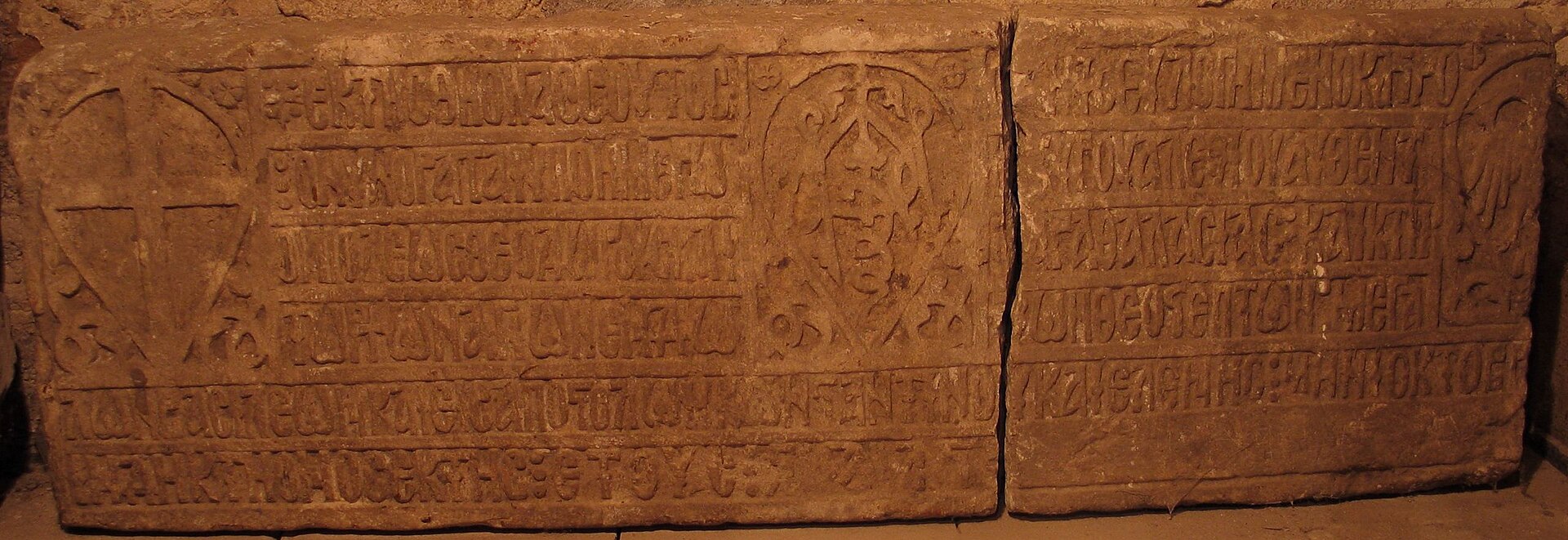
In Bakhchisaray, where layers of history overlap, some details slip past unnoticed. The 1427 construction inscription of Alexios is one of them. Tucked away on the wall of an old building in the historic center, it doesn’t compete with the Khan’s Palace or the city’s famous mosques. But if you’re curious about Crimea’s deeper past, it’s worth finding.
The inscription is carved in Greek. It dates to a time when Bakhchisaray wasn’t yet the capital of the Crimean Khanate but part of the Principality of Theodoro. Alexios was likely a local ruler or noble who funded the construction or renovation of the building. His name, etched in stone, has survived for centuries.
Locating it isn’t simple. The stone is set into the facade of a house that may have been rebuilt or altered over time. It might even have been repurposed from an older structure. Cities with long histories often reuse materials, and Bakhchisaray is no exception. The inscription’s current spot may not be its original one, but it still bridges past and present.
This small carving does more than record a construction date. It reminds us that Bakhchisaray existed long before the Crimean khans. In the 15th century, it was a modest settlement at the crossroads of trade routes, where Christian and Muslim communities lived side by side. The inscription is one of the few physical traces of that era, before Ottoman rule and when local principalities maintained their independence.
Historians value such inscriptions. They help reconstruct timelines, identify rulers, and reveal social structures. The building with Alexios’s inscription might have been a church, monastery, or administrative center. Its exact purpose is unclear, but the inscription offers a rare clue.
Bakhchisaray is famous for its Khanate past and Islamic architecture. But its history goes further back, shaped by different peoples and faiths. The inscription of Alexios is a quiet piece of that story, a fragment of a time when the city’s identity was still forming.
You won’t find signs pointing to it. No crowds gather here. Just a stone on the side of a building, easy to miss unless you know where to look. For those who stop to examine it, the inscription isn’t just an old carving—it’s a connection to the people who lived here centuries ago.
What makes such places special? They don’t shout for attention. They don’t offer grand narratives. They’re part of the city’s fabric, unchanged by time. The inscription doesn’t tell a dramatic story, but it adds to Bakhchisaray’s past. History isn’t only in monuments and museums. Sometimes, it’s carved into the walls of ordinary buildings, waiting to be seen.
Bakhchisaray’s past is always visible. The Khan’s Palace and Uspensky Monastery are its most famous landmarks, but smaller details like this inscription fill in the gaps. They might not be the first things visitors notice, but for those who look, they offer a fuller picture of the city’s long history.