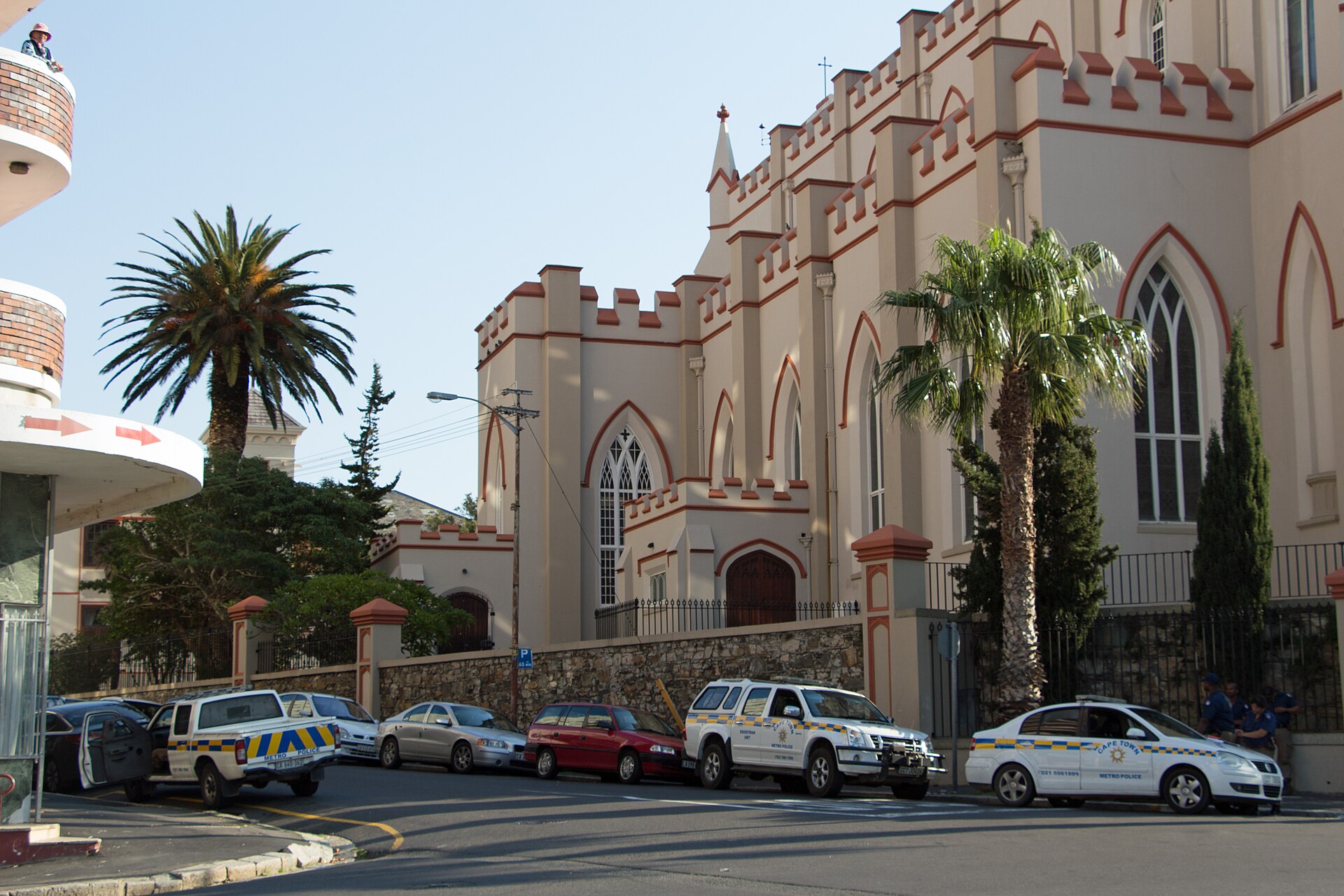
St. Mary’s Cathedral occupies a quiet corner of Cape Town, where the city’s modern pulse meets its colonial past. Tucked between Buitenkant and Plein Streets, it doesn’t demand attention like the grander landmarks nearby. The exterior is unassuming—a low stone facade, pointed windows, and a modest bell tower—but step inside, and the space unfolds differently. Light filters through stained glass, softening the air, while the hush of the nave offers a rare stillness in a city that rarely slows down.
The cathedral’s origins trace back to the mid-1800s, when Cape Town was already a bustling port, though its Catholic community remained small. The first church on this site, built in 1841, quickly proved too cramped for the growing congregation. Construction on the current building began in 1851, designed by Carl Otto Hager in the neo-Gothic style then fashionable in Europe. Delays plagued the project—funding shortages, political upheavals—and it wasn’t consecrated until 1952, a century after the first stone was laid. The wait, however, gave the structure a layered history, visible in its blend of old and new.
Inside, the architecture balances restraint with quiet elegance. The altar is carved with intricate woodwork, and the stained-glass windows, added in the 20th century, depict scenes from the lives of saints and biblical figures. The organ, installed in the 1950s, still fills the space with music during services, its deep tones resonating through the vaulted ceilings. The bell tower, though modest in height, carries its chime across the surrounding streets, a familiar sound in the early mornings when the city is just waking.
St. Mary’s has long been a cornerstone of Cape Town’s Catholic community. In the 19th century, it drew European immigrants—particularly Irish and Portuguese settlers—who found a spiritual home here. During apartheid, the cathedral became a refuge for those fighting for equality, offering shelter and organizing aid. Today, services are held in multiple languages, reflecting the city’s diversity. The congregation is as varied as Cape Town itself, a mix of longtime residents and newcomers, all drawn to the same place.
The cathedral sits in the heart of the City Bowl, Cape Town’s oldest district, where colonial-era buildings stand alongside modern developments. Nearby, the Greenmarket Square buzzes with vendors selling handmade crafts, while the Victoria & Alfred Waterfront offers views of Table Mountain rising over the harbor. From the cathedral’s steps, the city sprawls between ocean and peaks, a reminder of how geography shapes Cape Town’s identity.
Visiting in December, when summer arrives in the Southern Hemisphere, offers a particularly vivid experience. The cathedral is adorned for Christmas, its decorations glowing against the stained glass, and the scent of pine and candle wax fills the air. Services during this time are especially moving, with choirs and organ music creating a sense of celebration. But even on ordinary days, the cathedral provides a quiet counterpoint to the city’s energy, a place to pause and reflect.
Beyond its religious role, St. Mary’s serves as a cultural hub. Concerts, art exhibitions, and lectures often take place within its walls, drawing visitors who might not otherwise step inside. Local musicians perform here, and artists have long been inspired by its architecture, capturing its light and lines in their work. For many Capetonians, the cathedral is more than a place of worship—it’s a space where history, art, and community intersect.
Cape Town is a city of contrasts, where wealth and poverty exist side by side, and the past constantly brushes against the present. St. Mary’s Cathedral stands as a steady presence amid this flux. It hasn’t changed much over the decades, remaining a place where people come for solace, connection, or simply a moment of quiet. Its value lies not in grandeur or opulence, but in the way it holds space for those who need it—whether for prayer, reflection, or a brief respite from the world outside.