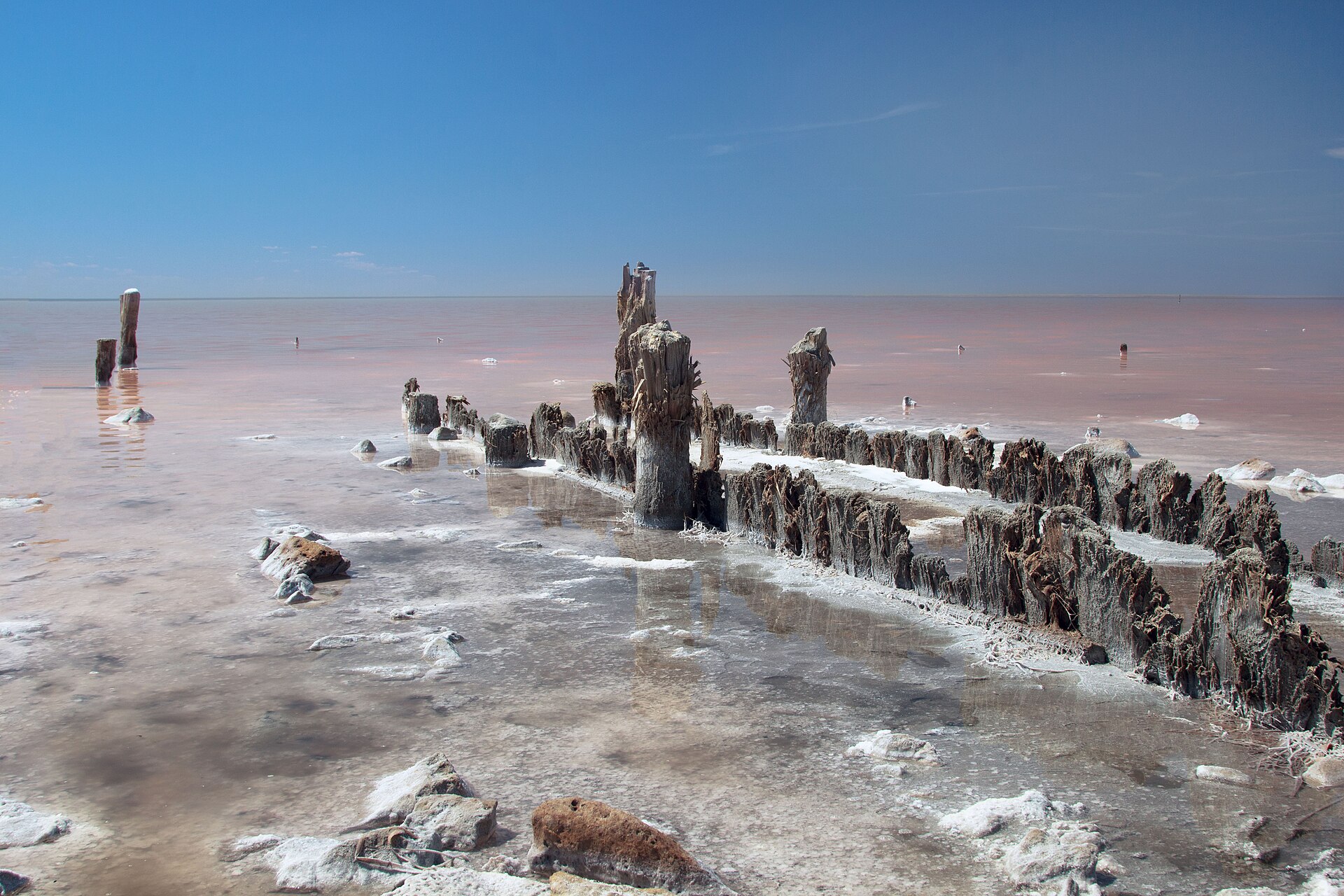
Elton is a salt lake in the Pallasovsky District of the Volgograd Region, close to the border with Kazakhstan. Its area is given as anything from 152 to 180 km², it measures about 18 by 14 km, and its surface lies below sea level, at roughly −16 m. It is the largest mineral, or hypersaline, lake in Europe. The qualification matters: the Caspian and Lake Manych-Gudilo are salt water too and much larger, but their water is 10 to 25 times less salty.
The salinity of the brine depends on the season: from 19 to 37 %, about 270 grams per litre on average (V. Brylev, 2019); in 2014 NASA put it at roughly 300 grams per litre. The Dead Sea stands at 34.2 %. So Elton is usually less salty than the Dead Sea and only catches up with it in the summer drought; the claim that it is twice as salty is not backed by the sources. Common salt makes up most of the brine, with magnesium, potassium and calcium salts and bromine as well.
The lake is very shallow. In spring the depth reaches 0.7–1.5 m, depending on the source, and in July and August only 5–10 cm remain. The pink and reddish colour of the water comes from the single-celled alga Dunaliella salina, which contains red carotene; Pallas described the red brine as early as 1788. But the water is not always pink: it ranges from pale pink to silvery grey and white, and at sunset the reflected sky looks pink as well. Guidebooks promise pink water from June, although photographs show it as early as May. By the end of summer the dried-out salt bed is visible even from space; in NASA images it is the colour of ivory.
Salt was mined here for more than a century. The Elton commissariat was established on 24 February 1747; state extraction continued until 1865, and private extraction ended in the 1880s. The salt taken was the kind that settles on the lake bed by itself, and it was hauled away along two salt roads, to the Nikolaevskaya and Pokrovskaya settlements.
The name is explained in two ways. One version derives it from the Kalmyk Altyn-Nor, "golden bottom" or "golden lake"; the other from the surname of an English lieutenant, John Elton. The lake basin lies between salt domes; one of them is Mount Ulagan, 67–68 m above sea level.
On the shore stands the village of Elton with a sanatorium that has been operating since 1910; the Krasny Kut to Astrakhan railway runs through the village. From Volgograd it is 205 km as the crow flies and about 330 km by road, and the daily bus from the central bus station takes about six hours. By train, people come from Saratov, a journey of 5–6 hours; there is no direct train from Volgograd. The lake lies within the Eltonsky Nature Park, and since 2025 tents may be pitched only with the park management's approval.
The best time to come is May, when the lake is full and the steppe is in bloom. In July and August the heat reaches +45 °C. September and October are recommended for mud treatments.