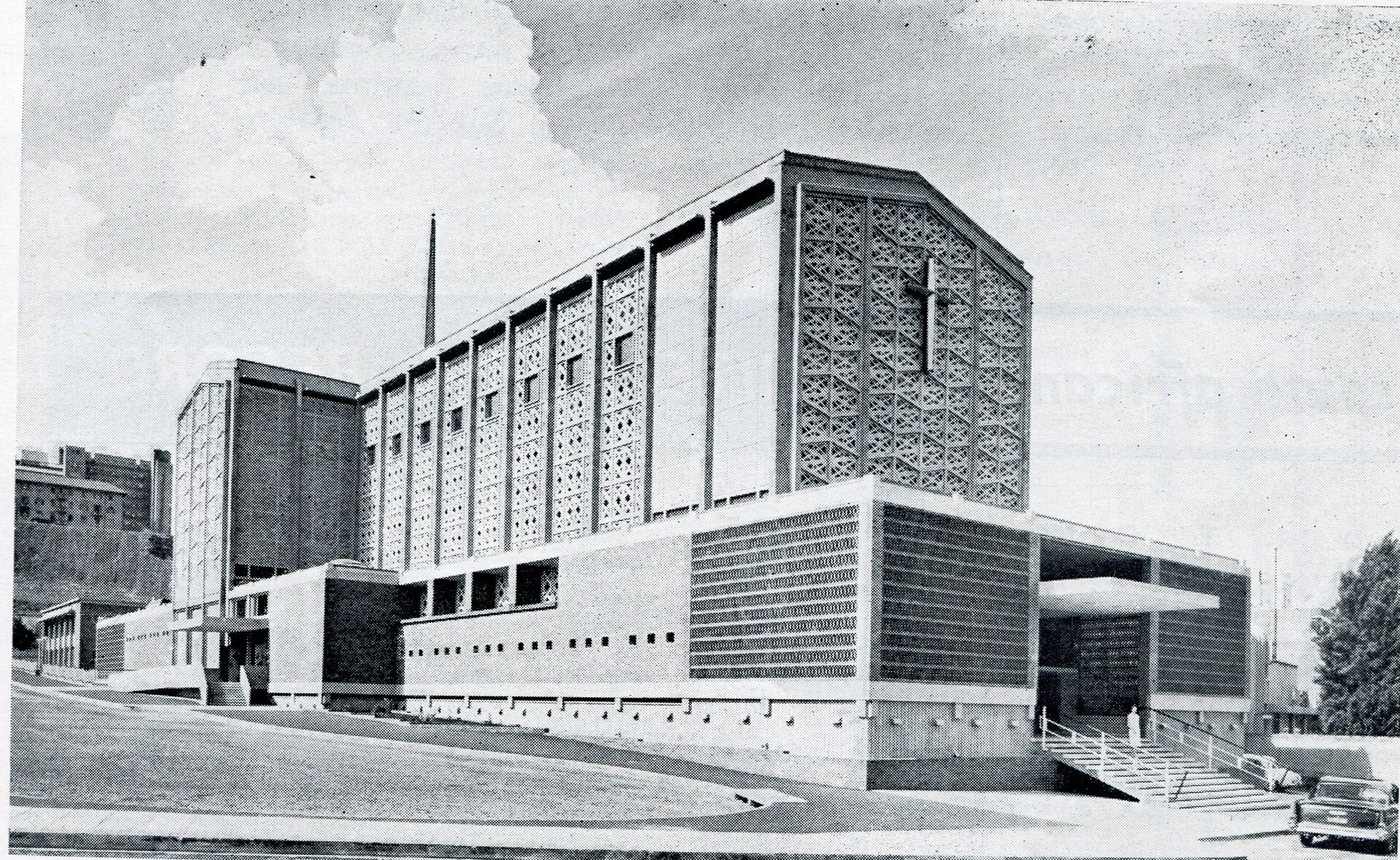
The Cathedral of Christ the King in Johannesburg is one of those places that doesn’t demand attention but lingers in the mind long after you’ve left. Tucked away on the corner of Sarat Street and Enderby Road in Hillbrow, a neighborhood that once pulsed with urban energy and is now quietly reinventing itself, the cathedral stands as a quiet witness to the city’s shifting identity. Unlike the soaring Gothic cathedrals of Europe or the ornate basilicas of Rome, its architecture is understated, yet no less meaningful. Built in the mid-20th century, when Johannesburg had already established itself as South Africa’s economic heart but was still searching for its cultural and spiritual voice, the cathedral reflects a moment when modernity and tradition intersected in unexpected ways.
Designed by architect Frank Fleming and completed in 1958, the building blends contemporary lines with timeless ecclesiastical forms. From the outside, it appears restrained—tall walls of pale brick, narrow vertical windows that echo Gothic arches without their elaborate tracery, and a simple portal crowned by a modest cross. There’s no gilding, no grand flourishes, just a quiet dignity. Inside, the space feels expansive and luminous. High ceilings, supported by slender columns, create an airy sense of openness, while the stained glass, though not as vivid as medieval examples, softens the daylight into warm, diffused hues. The effect is one of serenity, a place where light and space invite reflection rather than awe.
The cathedral’s history is deeply entwined with Johannesburg’s Catholic community, which grew rapidly in the first half of the 20th century as migrants from across South Africa and beyond flocked to the city. For many European immigrants—Irish, Italian, Polish, Portuguese—the church became a vital anchor in their new lives. Later, as the local African population also embraced Catholicism, the cathedral became a rare space of unity in a divided city. During the apartheid era, when Johannesburg was rigidly segregated, the cathedral remained one of the few places where people of all backgrounds could gather without restriction. This wasn’t a political statement; it was simply the nature of the church—to offer solace and community to anyone who sought it.
The interior is spare but thoughtfully designed. The altar, crafted from local stone, anchors the space, with a mosaic of Christ the King rising behind it. The mosaic isn’t grandiose, but its golden tones and clean lines lend a sense of reverence. The pews, arranged in a semicircle rather than the traditional linear rows, bring worshippers closer to the altar, fostering an intimate, almost familial atmosphere. In the side chapels, statues of saints stand quietly, including figures particularly venerated in Southern Africa, like St. Charles Lwanga, one of the Ugandan martyrs. The overall effect is one of warmth and inclusivity, a space that feels both sacred and welcoming.
Unlike many of Johannesburg’s more famous landmarks, the Cathedral of Christ the King isn’t a tourist hotspot. You won’t find crowds here, nor will it feature prominently in guidebooks. That’s part of its charm. It’s a place for those who appreciate stillness and authenticity. On Sundays, services are held in multiple languages—English, Zulu, Sotho, Portuguese—and the cathedral comes alive with hymns, the scent of incense, and a congregation dressed in everything from suits to traditional African attire. The blend of voices and cultures creates a rhythm that feels both timeless and distinctly Johannesburg. On weekdays, the space is quieter, with only the occasional visitor stopping to pray or simply sit in silence.
Johannesburg is a city of contrasts—where gleaming skyscrapers stand beside informal settlements, and the legacy of the struggle for freedom coexists with the hustle of daily life. The cathedral offers a counterpoint to all that noise. It doesn’t seek to impress or dazzle; it simply endures, a steady presence in a city that is constantly reinventing itself. Outside, the streets hum with activity—markets buzz, traffic rushes, people hurry past—but step inside, and time slows. The light filtering through the stained glass, the cool stone underfoot, the hush of the high ceilings—it’s a space that invites pause, whether for prayer, reflection, or just a moment of respite.
Over the decades, the cathedral has weathered its share of challenges—economic downturns, social upheavals, even attempts at vandalism. Yet it has remained, much like the faith of those who sustain it. In recent years, the building has shown signs of age: cracks in the plaster, dulled glass, the subtle wear of time. But far from detracting from its character, these marks add a layer of depth, a reminder that nothing is permanent except, perhaps, the spirit of the place itself. Occasionally, the cathedral hosts concerts of sacred music or charitable events, but for the most part, it exists at its own unhurried pace, a quiet heartbeat in the city’s rhythm.
For first-time visitors to Johannesburg, the cathedral might not seem like an obvious destination. But those who venture beyond the usual tourist trail often find something unexpected here—a different side of the city, one that’s contemplative rather than chaotic. There are no souvenir stalls, no tour groups, no scripted narratives. Just a space filled with light and quiet, and a history that doesn’t shout but simply is, as much a part of Johannesburg as the streets outside. It’s a place where the past and present coexist without fanfare, where the act of stepping inside feels like entering a different kind of time.