St. Nicholas Cathedral, or Stockholm Cathedral as it’s often called, stands where the city’s past feels most alive. Perched on a slight rise in the heart of Gamla Stan, the old town, its spire has guided wanderers through narrow cobblestone streets for centuries. The surrounding medieval houses, the square with its fountain and statue of Gustav Vasa, and the nearby waterfront where boats dock all frame the cathedral as part of the city’s daily rhythm. Yet stepping inside is like crossing into another time—one where the hum of the city fades, replaced by the quiet weight of history.
The first records of a church here date to the mid-13th century, though its exact origins are lost. Back then, it was likely a modest wooden chapel dedicated to St. Nicholas, the patron saint of sailors—a fitting choice for a city built on islands and shaped by trade. By the 14th century, the church had been rebuilt in stone, becoming the spiritual and civic heart of a growing Stockholm. In the Middle Ages, it wasn’t just a place of worship but a gathering spot where townspeople met, royal decrees were announced, and the city’s archives were kept. The Reformation in 1527 turned it into a Lutheran cathedral, a role it still holds today as the seat of the Stockholm diocese.
The building itself is a patchwork of styles, each layer reflecting the tastes and needs of its time. The core structure is Gothic, with soaring pointed arches, sturdy buttresses, and vaulted ceilings—typical of northern European churches. But look closer, and you’ll find later additions: a lavish Baroque chapel added in the 17th century for Queen Christina, and the current spire, which replaced an earlier one destroyed by fire in the 18th century. Inside, the changes are just as evident. Medieval frescoes and altars survive only in fragments, while newer elements like intricately carved wooden pews, a Renaissance-style pulpit, and a still-functioning organ tell their own stories.
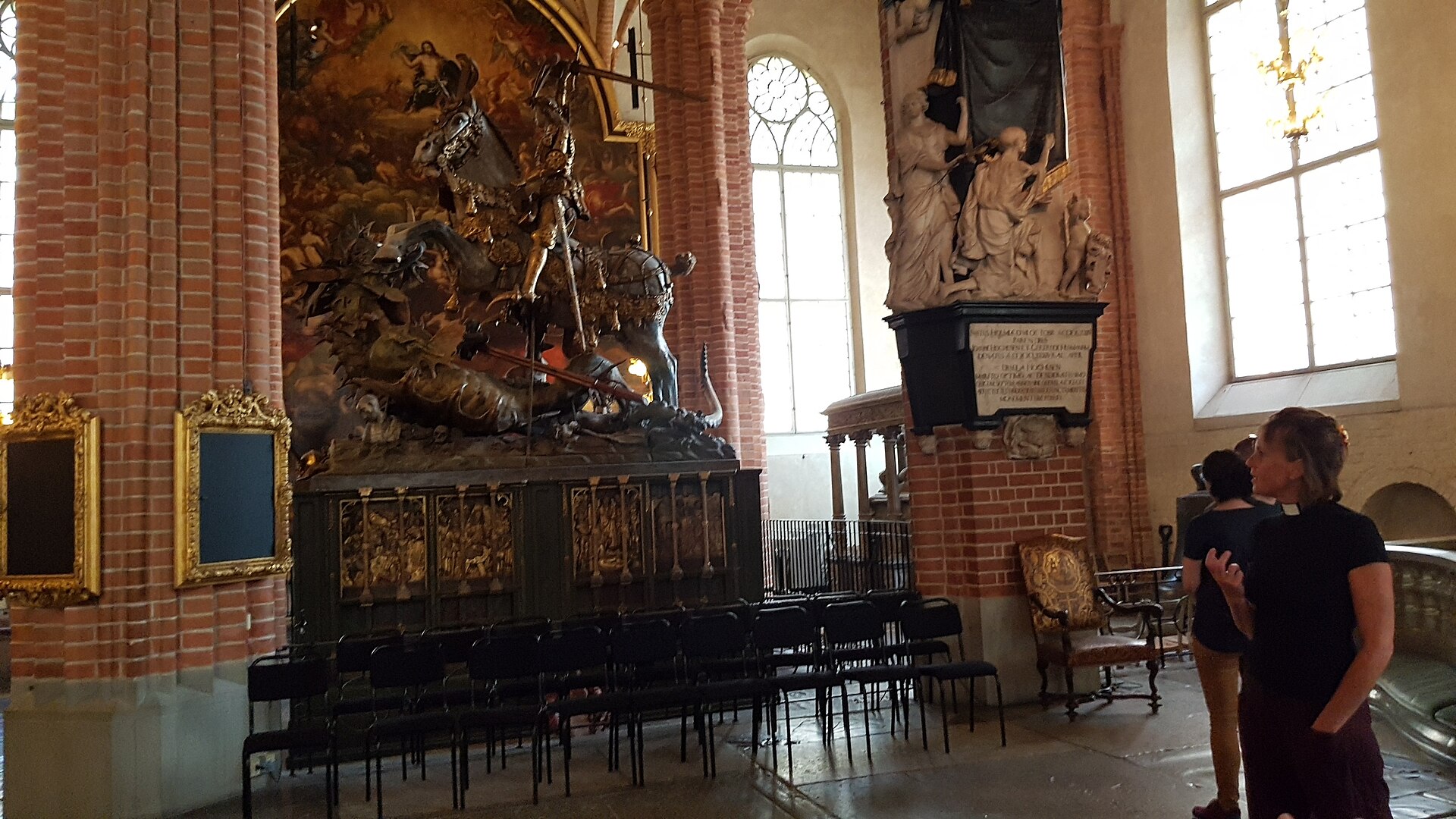
The cathedral’s greatest treasure is its altarpiece, crafted in 1468 by Bernt Notke, one of the most celebrated sculptors of medieval Northern Europe. Carved from oak, the piece is a multi-tiered masterpiece of saints, biblical scenes, and delicate ornamentation. The central panel, depicting the Crucifixion surrounded by angels and apostles, remains as striking today as it must have been centuries ago. Despite fires, wars, and restorations, the altarpiece has survived nearly intact, a testament to Notke’s skill. Another highlight is his statue of St. George slaying the dragon, created in the late 15th century as a symbol of victory over the Danes. The painted wooden figures—St. George poised in triumph, the dragon coiled beneath his horse—feel almost lifelike.
More than just a historical monument, St. Nicholas Cathedral is a living place of worship. Services, concerts, and ceremonies fill its space year-round. Weddings and baptisms are common, and royal events—like the 2010 marriage of Crown Princess Victoria and Daniel Westling—draw national attention. Even on ordinary days, the cathedral has a quiet presence: sunlight filtering through stained glass, the scent of wax and aged wood, the hush of visitors sitting in the pews or studying the details that aren’t immediately obvious. There’s no grand spectacle here, just the steady pulse of a place that has witnessed centuries of ordinary and extraordinary moments.
The area around the cathedral has its own rhythm. Mornings bring worshippers, afternoons see tourists wandering in and out, and by evening, the square empties, leaving only the glow of lamplight on the old stone walls. Occasionally, small markets or open-air concerts animate the space, filling the air with music and the smell of fresh pastries. Nearby cafés offer a chance to sit with a coffee and a cinnamon bun, watching the ebb and flow of people. A short walk toward the waterfront reveals the bay, where boats bob in warmer months and ice spreads across the surface in winter.
What makes St. Nicholas Cathedral special isn’t its size or age—it can’t compete with the grandeur of Parisian cathedrals or the ancient ruins of Rome. Instead, it feels deeply human, woven into the fabric of the city. This is where kings were baptized, where ordinary citizens prayed, where words spoken under its vaults shaped history. Maybe that’s why it doesn’t feel like a relic but a natural part of life, a place you can visit for a service, a moment of reflection, or simply to feel the weight of the past. In a city that’s constantly evolving, the cathedral reminds you that Stockholm’s roots run deep, and every stone here carries the memory of those who came before.