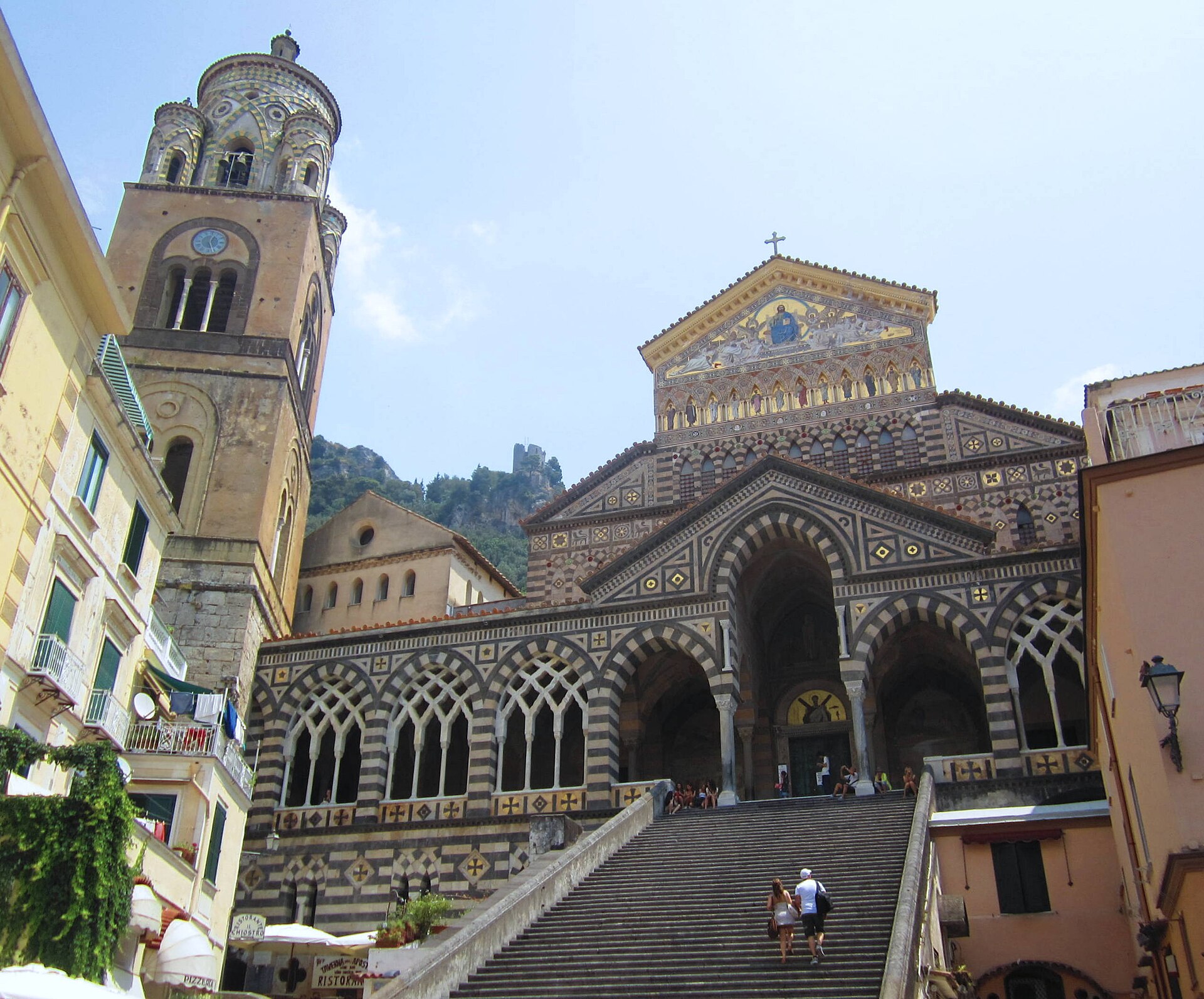
Amalfi’s Cathedral of Saint Andrew isn’t just a place of worship—it’s the living core of the town, a building that has witnessed its rise and fall, its triumphs and quiet moments. Standing on the main square, it feels like the natural center of everything, a silent observer of centuries gone by. The cathedral’s facade, with its intricate mosaics and broad staircase leading to the bronze doors, is one of the most recognizable sights along the coast, a postcard image that somehow never loses its power in person.
The story of the cathedral begins in the 9th century, when Amalfi was one of Italy’s four great maritime republics, a rival to Venice, Genoa, and Pisa. The original basilica was built then, though little of it remains today except fragments hidden in the crypts beneath the current structure. The cathedral as it stands now took shape between the 11th and 12th centuries, when it was rebuilt in a Romanesque style infused with Byzantine and Arab influences—a reflection of Amalfi’s role as a crossroads of trade and culture. Later, in the 18th century, the facade was updated with Baroque touches, but the interior retained its medieval austerity, a contrast that still defines the space.
Stepping inside feels like entering another era. The main nave is tall and airy, with light filtering through narrow windows to illuminate the marble columns and faded frescoes. The 12th-century pulpit, adorned with mosaics of the Evangelists, draws the eye, but the real heart of the cathedral lies beneath the altar. In the crypt, the relics of Saint Andrew, Amalfi’s patron saint, are kept—brought here from Constantinople in 1208, according to tradition. Legend says that when the relics arrived, a radiant light shone over the cathedral, and to this day, the town celebrates their arrival with solemn processions every June 27th and November 30th.
The architecture tells its own story, a conversation between different periods and styles. Romanesque arches stand alongside Gothic vaults, while Byzantine mosaics share space with Baroque statues. The facade is particularly striking, not just for its beauty but for its history. The bronze doors, cast in Constantinople in the 11th century, are among the oldest in Italy, their surfaces etched with scenes from the Old Testament and figures of saints, framed by patterns that echo Arabic calligraphy. The wide staircase leading up to them feels like an invitation, a slow ascent into the past.
The cathedral isn’t just a monument; it’s woven into the fabric of daily life in Amalfi. Locals come here to be married, to baptize their children, and to mark the town’s festivals. In May, during the Feast of Saint Andrew, the relics are carried through the streets in a procession that turns the cathedral into the focal point of the town. But even on ordinary days, the building exudes a quiet presence. The only sounds are the echo of footsteps on stone and the occasional chime of the bells, a rhythm that feels timeless.
Behind the cathedral, the cloister offers a peaceful retreat from the sun and the bustle of the streets. Surrounded by a graceful arcade, it’s a place to sit and breathe, to study the old tombstones and the marble fountain at its center. The cypress and palm trees cast long shadows, and it’s easy to imagine merchants and sailors gathering here centuries ago, planning voyages and exchanging news from distant lands. Today, the cloister remains a place where time slows down, where even a hurried visitor might pause for a moment.
Beyond its religious significance, the cathedral is a treasure trove of art and history. The walls hold medieval frescoes, Renaissance paintings, and intricate mosaics, each piece adding to the story of Amalfi. The Chapel of Paradise, with its 13th-century mosaics, is especially remarkable, blending biblical scenes with symbols of the maritime republic. The town’s coat of arms—a white cross on a blue field—appears here and there, a reminder of the days when Amalfi commanded a fleet and dominated trade routes across the Mediterranean.
Visiting the cathedral isn’t just about seeing a landmark; it’s about feeling the weight of history in a place that has stood unchanged for nearly a thousand years. It overlooks the sea just as it did when ships set sail from Amalfi’s harbor, carrying goods and ideas to distant shores. Today, the cathedral serves as a bridge between past and present, a quiet testament to the fact that even a small coastal town can hold the echoes of a much larger world.