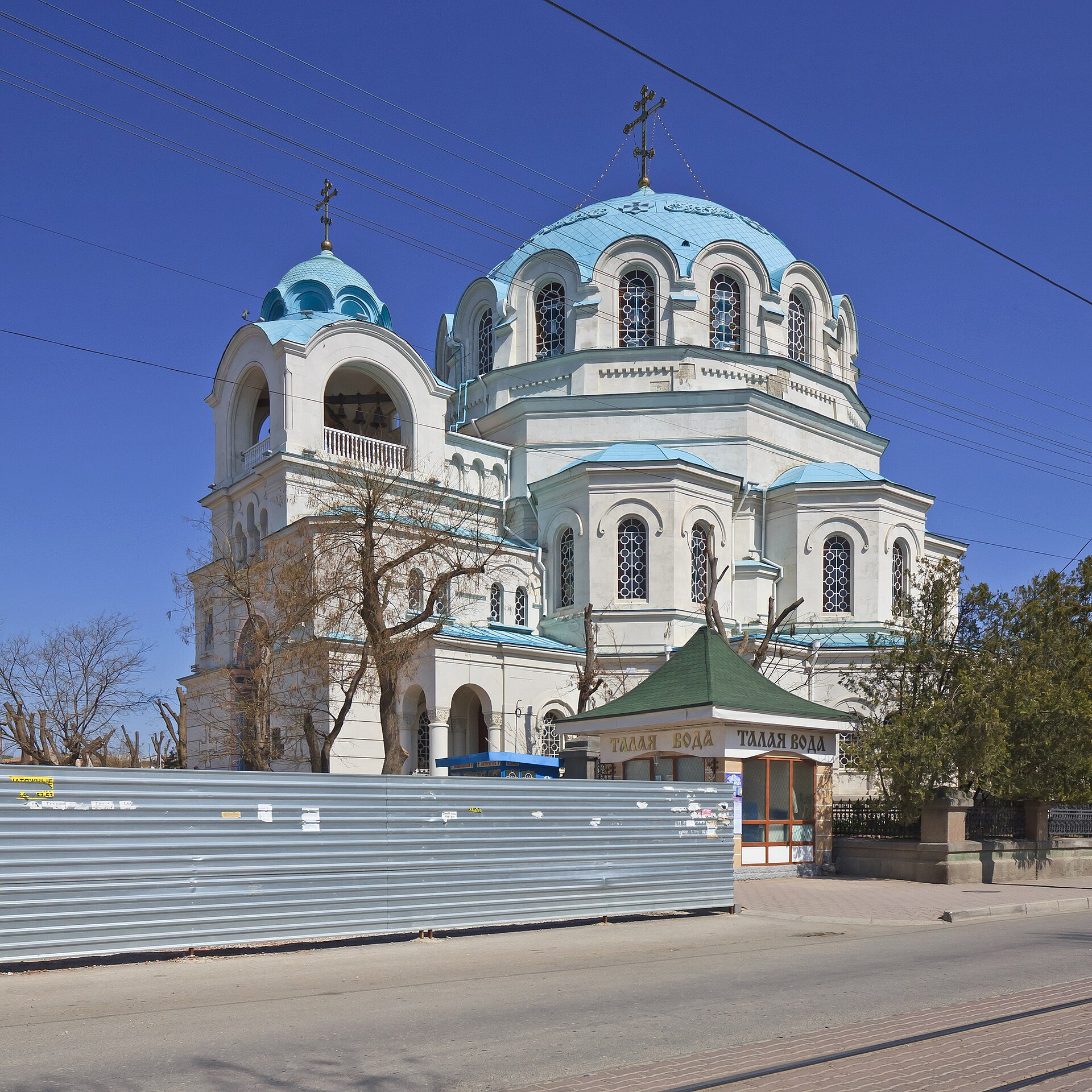
St. Nicholas the Wonderworker Cathedral in Yevpatoria is one of those places that seems to pause time itself. Perched on a gentle rise in the heart of the city, its white stone walls and gilded domes catch the sunlight from afar, turning the church into a radiant landmark against the Crimean sky. Built in the late 19th century, it stands not only as a spiritual center but also as an architectural monument, blending Byzantine and Russian traditions into a structure that feels both timeless and deeply rooted in its surroundings.
The cathedral’s story begins in the 1890s, when Yevpatoria was flourishing as a resort and trading hub. The city’s large Greek community, one of the most prominent in Crimea at the time, sought to honor St. Nicholas, the patron saint of sailors and travelers, by erecting a church in his name. The task fell to architect Alexander Bernardazzi, whose work had already left its mark on Odessa and the southern coast of Crimea. Construction took several years, and in 1899, the cathedral was consecrated. Originally intended as a Greek Orthodox church, it eventually became part of the Russian Orthodox Church, reflecting the shifting cultural and political currents of the region.
The architecture of St. Nicholas Cathedral is striking in its balance and attention to detail. Designed in the Neo-Byzantine style, which was gaining popularity in Russia at the turn of the century, the cathedral’s central dome is flanked by four smaller ones, creating a silhouette reminiscent of ancient churches in Constantinople. The facades are adorned with arched friezes, columns, and mosaic panels, while the entrance is framed by an intricately carved portico. Inside, the space is just as impressive: soaring vaults supported by marble columns, painted walls, and an iconostasis crafted in the traditions of Orthodox art. One of the most remarkable features is the mosaic above the main entrance, depicting St. Nicholas, created by Italian artisans and still vibrant after more than a century.
Like many religious sites in the region, the cathedral has weathered turbulent times. During the Soviet era, it was closed and repurposed—first as a warehouse, later as a gym. It wasn’t until the 1990s that restoration began, returning the building to its original purpose. Today, it functions as an active place of worship, hosting services, baptisms, and weddings. Yet it remains open to all who wish to step inside, whether to find a moment of quiet reflection or simply to admire the craftsmanship. In the summer, the cathedral draws crowds not only for its history but also for the cool respite its thick walls provide from the Crimean heat.
The area around the cathedral is worth exploring as well. Located in Yevpatoria’s historic center, the church is surrounded by narrow streets and buildings that hint at the city’s layered past. Nearby stands the Karaite kenesa, another architectural gem, a reminder of the diverse communities that once called this place home. A short walk away, the city park offers shade and tranquility, while the seafront beckons with the sound of waves and the cries of gulls. The cathedral seems to stand at the crossroads of all this diversity, a silent witness to the cultures, eras, and lives that have shaped Yevpatoria.
For locals, St. Nicholas Cathedral is more than just a landmark—it’s a place woven into personal histories. Some were baptized here, others married within its walls, and many return to light a candle in memory of loved ones. On religious holidays, the cathedral comes alive with the sound of choirs and the scent of incense, its halls filled with worshippers. Christmas and Easter are especially moving, with the church adorned in flowers and crowds spilling out into the surrounding streets. But even on ordinary days, the atmosphere is one of quiet reverence, as if time moves a little slower within these walls.
Beyond its architectural and historical significance, the cathedral serves as a living testament to Yevpatoria’s evolution. It speaks to a time when the city was a melting pot of cultures, where Greek, Russian, Karaite, and other communities coexisted. Today, as Crimea draws more visitors, the cathedral remains a place of calm, offering a respite from the hustle of modern tourism. There are no souvenir stalls or pushy guides here—just the soft light filtering through stained glass, the hush of footsteps on stone, and the sense that you’ve touched something enduring.
Perhaps that’s why people keep coming back. Even those who have seen everything Yevpatoria has to offer often find themselves drawn to this quiet corner of the city. It’s not just about the beauty of the building or the weight of its history, but the way it makes you feel—like you’ve stepped into a space where the past and present coexist, and where the noise of the world fades into something simpler, more meaningful. In a place like this, it’s easy to understand why some things never really change.